Table of Contents
- The ICD-10-CM Diabetes Code Categories
- How Combination Codes Work for Diabetes
- The Default Rule: Type 2 When Type Is Not Specified
- Complication Subcodes: What Each Range Covers
- Insulin Use: Z79.4 and Z79.84
- Secondary Diabetes: E08 and E09
- Gestational and Pregnancy-Related Diabetes
- Sequencing Rules for Multiple Diabetic Complications
- Clinical Examples
- Frequently Asked Questions
Diabetes mellitus is one of the most frequently coded conditions in medical coding — and one of the most heavily tested topics on the CPC exam. ICD-10-CM uses a combination code system for diabetes that captures both the type of diabetes and any associated complications in a single code. A coder who understands this system can handle diabetes charts quickly and confidently; a coder who doesn’t will miscombine types and complications, miss sequencing instructions, or forget the insulin-use code that must accompany certain Type 2 diagnoses.
This guide walks through the full ICD-10-CM diabetes coding framework: the code categories, how combination codes work, complication coding rules, secondary diabetes, pregnancy-related diabetes, and every sequencing rule tested on the CPC exam.
The ICD-10-CM Diabetes Code Categories
ICD-10-CM organizes diabetes mellitus under categories E08–E13 in Chapter 4 (Endocrine, Nutritional and Metabolic Diseases). Each category corresponds to a specific etiology or type:
| Category | Type of Diabetes | Notes |
|---|---|---|
| E08 | Diabetes mellitus due to underlying condition | Secondary to another disease (e.g., chronic pancreatitis, Cushing syndrome) |
| E09 | Drug or chemical induced diabetes mellitus | Caused by a medication or toxic substance |
| E10 | Type 1 diabetes mellitus | Autoimmune; inherently insulin-dependent |
| E11 | Type 2 diabetes mellitus | Most common; includes insulin-resistant and non-insulin-dependent presentations |
| E13 | Other specified diabetes mellitus | Post-pancreatectomy, post-procedural, secondary to other causes not E08/E09 |
There is no E12 in ICD-10-CM — that number is unassigned. The gap trips up candidates who try to memorize sequential code numbers rather than learning what each category means.
📌 CPC Exam Tip: The most-tested distinction is E10 vs. E11. Type 1 is autoimmune, typically early-onset, and inherently insulin-dependent. Type 2 is the default when documentation doesn’t specify type. Many CPC exam questions include the phrase “insulin-dependent” to see if candidates correctly recognize that a Type 2 patient on insulin is still coded E11, not E10. The need for insulin does not change the diabetes type — it requires an additional code (Z79.4).
How Combination Codes Work for Diabetes
ICD-10-CM uses combination codes for diabetes — codes that capture both the underlying disease and the complication in a single code. The structure is: [Category].[Complication subcode]
Examples:
- E11.40 — Type 2 diabetes mellitus with diabetic neuropathy, unspecified
- E10.311 — Type 1 diabetes mellitus with unspecified diabetic retinopathy with macular edema
- E11.65 — Type 2 diabetes mellitus with hyperglycemia
The combination code structure is one of ICD-10-CM‘s major improvements over ICD-9-CM, where diabetes and its complications required two separate codes. In ICD-10-CM, a single code documents both — unless multiple distinct complications are present, in which case each complication gets its own combination code within the same category.
📌 CPC Exam Tip: CPC exam questions frequently give a diagnosis like “Type 2 diabetes with diabetic peripheral neuropathy” and ask for the code. The answer is a single combination code from E11 (e.g., E11.40), not two separate codes. Selecting two codes where one combination code exists is a common exam error.
The Default Rule: Type 2 When Type Is Not Specified
The ICD-10-CM Official Guidelines for Coding and Reporting include a critical default rule:
When the medical record does not specify the type of diabetes, code Type 2 (E11).
If a physician documents “diabetes mellitus” without indicating Type 1, Type 2, gestational, or a specific etiology, the coder assigns E11 by convention. This reflects the real-world prevalence of Type 2 — approximately 90–95% of all diabetes cases.
The coder may NOT make assumptions about the type based on the patient’s age, insulin use, or other clinical factors. If it isn’t documented, the answer is E11.
Complication Subcodes: What Each Range Covers
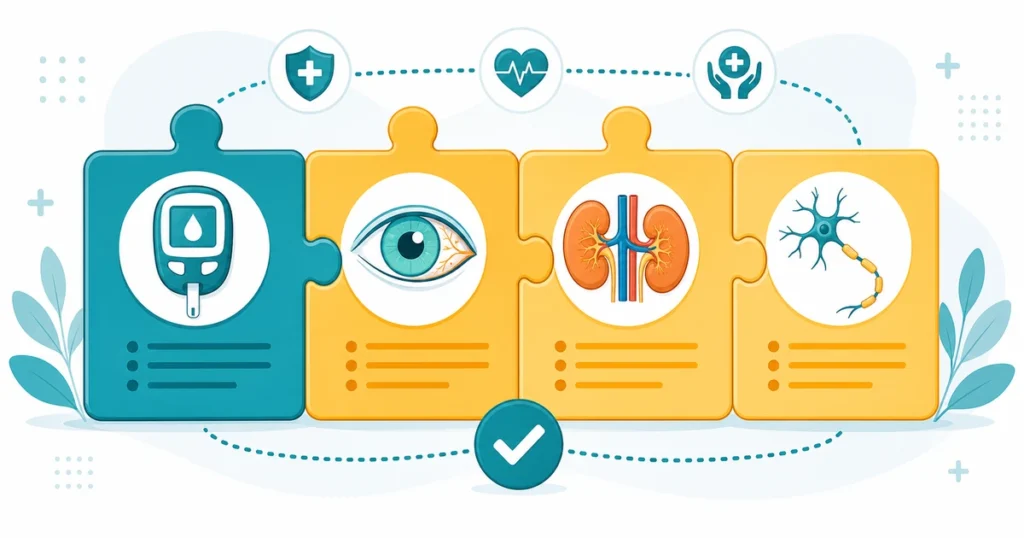
Each diabetes category (E10, E11, E08, E09, E13) uses the same complication subcode structure. The subcodes are organized by body system:
Diabetic Kidney Disease (E_x_.2x)
| Code | Description |
|---|---|
| E11.21 | Type 2 DM with diabetic nephropathy |
| E11.22 | Type 2 DM with diabetic chronic kidney disease, stage 1–2 |
| E11.29 | Type 2 DM with other diabetic kidney complication |
When diabetic CKD is coded, an additional N18.- code is required to identify the specific CKD stage — the ICD-10-CM “use additional code” instruction at E11.22 mandates this.
Diabetic Eye Disease (E_x_.3xx)
| Code | Description |
|---|---|
| E11.311 | Type 2 DM with unspecified diabetic retinopathy with macular edema |
| E11.319 | Type 2 DM with unspecified diabetic retinopathy without macular edema |
| E11.36 | Type 2 DM with diabetic cataract |
| E11.39 | Type 2 DM with other diabetic ophthalmic complication |
Retinopathy codes require specifying whether macular edema is present — this is the critical distinction within the E11.3xx range. Proliferative vs. non-proliferative retinopathy adds further granularity at the 5th and 6th character level.
Diabetic Neurological Complications (E_x_.4x)
| Code | Description |
|---|---|
| E11.40 | Type 2 DM with diabetic neuropathy, unspecified |
| E11.41 | Type 2 DM with diabetic mononeuropathy |
| E11.42 | Type 2 DM with diabetic polyneuropathy |
| E11.43 | Type 2 DM with diabetic autonomic (poly)neuropathy |
| E11.44 | Type 2 DM with diabetic amyotrophy |
Polyneuropathy (E11.42, affecting multiple nerves) is the most common neuropathic pattern and the most frequently coded. Mononeuropathy (E11.41) affects a single nerve and is coded when specifically documented.
Diabetic Circulatory Complications (E_x_.5x)
| Code | Description |
|---|---|
| E11.51 | Type 2 DM with diabetic peripheral angiopathy without gangrene |
| E11.52 | Type 2 DM with diabetic peripheral angiopathy with gangrene |
| E11.59 | Type 2 DM with other circulatory complications |
When gangrene is present with diabetic peripheral angiopathy, E11.52 is used — the combination code captures both. Do not separately code the gangrene.
Skin, Foot, and Other Complications (E_x_.6x)
| Code | Description |
|---|---|
| E11.621 | Type 2 DM with foot ulcer |
| E11.622 | Type 2 DM with other skin ulcer |
| E11.649 | Type 2 DM with hypoglycemia without coma |
| E11.65 | Type 2 DM with hyperglycemia |
| E11.69 | Type 2 DM with other specified complication |
| E11.9 | Type 2 DM without complications |
For diabetic foot ulcers (E11.621), an additional code from L97.- is required to identify the ulcer site and severity — another “use additional code” instruction in the ICD-10-CM tabular.
Insulin Use: Z79.4 and Z79.84
When a patient with Type 2 diabetes is being treated with insulin, an additional code is required:
Z79.4 — Long-term (current) use of insulin
This code is never used for Type 1 diabetes — E10 already implies insulin dependence. Z79.4 applies exclusively to Type 2 (E11) and other non-Type-1 categories (E08, E09, E13) when insulin is prescribed as part of management.
When a Type 2 patient is treated with oral hypoglycemic agents (such as metformin), the additional code is:
Z79.84 — Long-term (current) use of oral hypoglycemic drugs
📌 CPC Exam Tip: One of the most reliably tested diabetes coding nuances: “Type 2 diabetes patient who takes insulin daily” requires both the E11 combination code AND Z79.4. Missing Z79.4 is an incomplete code selection. Always ask — if the patient has Type 2 diabetes, is insulin use documented? If yes, Z79.4 is required.
Secondary Diabetes: E08 and E09
Secondary diabetes — diabetes caused by another disease or substance rather than the patient’s own autoimmune or genetic factors — uses E08 or E09 depending on the cause.
E08: Diabetes mellitus due to underlying condition. When another disease process causes or contributes to diabetes development (such as chronic pancreatitis, cystic fibrosis, Cushing syndrome, or acromegaly), E08 is the category. Per the etiology/manifestation convention in ICD-10-CM, the underlying causal condition is sequenced first — E08 follows it.
E09: Drug or chemical induced diabetes mellitus. When a medication or toxic substance caused the diabetes, E09 is used. An additional code from the Table of Drugs and Chemicals (T36–T65) identifies the substance and whether the circumstance is adverse effect, underdosing, or poisoning. For adverse effects (correct drug, correct dose, properly administered), E09 is sequenced first; for poisoning, the poisoning code leads.
E13 covers all other secondary diabetes not captured by E08 or E09 — most commonly post-pancreatectomy diabetes or diabetes following other pancreatic surgery.
Gestational and Pregnancy-Related Diabetes
Diabetes in pregnancy uses the O24 category — not E10 or E11. The O24 codes apply to gestational diabetes (diabetes that develops during pregnancy in a woman who did not have pre-existing diabetes) and are used during pregnancy encounters.
| Code | Description |
|---|---|
| O24.410 | Gestational diabetes in pregnancy, diet controlled |
| O24.414 | Gestational diabetes in pregnancy, insulin controlled |
| O24.419 | Gestational diabetes in pregnancy, unspecified control |
For a woman with pre-existing Type 1 or Type 2 diabetes who becomes pregnant, the appropriate E10 or E11 code is used along with O24.0x (pre-existing Type 1 in pregnancy) or O24.1x (pre-existing Type 2 in pregnancy) to capture the pregnancy context.
📌 CPC Exam Tip: Do not use E11 for gestational diabetes. The CPC exam tests this by presenting a pregnant patient with elevated glucose and asking for the correct code. If diabetes arose during pregnancy and was not pre-existing, the answer is always in the O24 category — never E11.9 or E11.649.
Sequencing Rules for Multiple Diabetic Complications
When a patient has more than one diabetic complication, each complication is coded separately using its own combination code within the same diabetes category. No single code captures two different complications simultaneously.
Example: A Type 2 diabetes patient with documented polyneuropathy and diabetic chronic kidney disease, stage 3, on insulin:
- E11.42 — Type 2 DM with diabetic polyneuropathy
- E11.22 — Type 2 DM with diabetic chronic kidney disease, stage 1–2 (or the appropriate stage code)
- N18.3 — Chronic kidney disease, stage 3 (required by “use additional code” instruction)
- Z79.4 — Long-term use of insulin
In outpatient settings, the condition chiefly responsible for the visit is sequenced first. In inpatient settings, the principal diagnosis per UHDDS criteria leads the claim.
Clinical Examples
Example 1: Documentation: “Type 2 diabetes mellitus with diabetic foot ulcer, left heel; patient on insulin.”
- E11.621: Type 2 DM with foot ulcer
- L97.429: Non-pressure chronic ulcer of left heel and midfoot, unspecified severity
- Z79.4: Long-term use of insulin
Example 2: Documentation: “Chronic pancreatitis with secondary diabetes mellitus, no complications, diet-controlled.”
- K86.1: Chronic pancreatitis (sequenced first — etiology/manifestation)
- E08.9: Diabetes due to underlying condition, without complications
Example 3: Documentation: “Insulin-dependent diabetes — Type 2. No current complications.”
- E11.9: Type 2 DM without complications
- Z79.4: Long-term use of insulin
(The phrase “insulin-dependent” does not change the type. Type 2 is coded because it is explicitly documented.)
5 quick questions drawn from this guide. Click an answer to check it — explanations appear as you go.
1. When the type of diabetes is not documented, the default is:
2. Long-term (current) insulin use is reported with:
3. Diabetes with a specified complication is reported using:
4. Diabetes due to an underlying condition, and drug/chemical-induced diabetes, use categories:
5. A Type 2 diabetic maintained on insulin is coded as E11.- plus:
Frequently Asked Questions
What is the ICD-10-CM code for Type 2 diabetes without complications?
E11.9 — Type 2 diabetes mellitus without complications. Use this when the physician documents Type 2 diabetes but no associated complications are mentioned or treated at that encounter. If the patient takes insulin, also report Z79.4. If the patient uses oral hypoglycemics, also report Z79.84.
Do you code Z79.4 for Type 1 diabetes patients who use insulin?
No. Z79.4 (long-term use of insulin) is only reported for Type 2 and other non-Type-1 diabetes categories where insulin is prescribed. The E10 category inherently implies insulin use — Z79.4 is not reported alongside E10 codes.
What code is used when the type of diabetes is not documented?
E11 (Type 2 diabetes mellitus). Per ICD-10-CM guidelines, Type 2 is the default when the documentation is silent on type. The coder should not infer the type from the patient’s age, weight, or treatment regimen without explicit physician documentation.
How do combination codes work for diabetes in ICD-10-CM?
Each diabetes combination code captures both the diabetes type (E10, E11, etc.) and the associated complication in a single code. For example, E11.42 encodes both Type 2 diabetes and diabetic polyneuropathy — no separate neuropathy code is needed. When multiple complications exist, each gets its own combination code.
What is the difference between E08 and E09 diabetes?
E08 is diabetes caused by another underlying disease (like chronic pancreatitis or Cushing syndrome); the underlying condition is sequenced first per the etiology/manifestation convention. E09 is drug or chemical-induced diabetes; it also requires a code from the Table of Drugs and Chemicals to identify the responsible substance.