Table of Contents
- How to Code Wound Repairs â Simple vs Intermediate vs Complex
- Why Wound Repair Coding Matters on the CPC Exam
- The Three Types of Wound Repair
- Wound Length Summation Rules
- Step-by-Step Wound Repair Coding Method
- When E/M Codes Apply with Wound Repair
- Debridement Before Wound Repair
- Wound Exploration Codes (20100â20103)
- Modifier Usage with Wound Repairs
- Common CPC Exam Traps
- Wound Repair and Skin Procedures â Knowing the Boundaries
- Quick Reference: Choosing the Right Repair Type
- Frequently Asked Questions
How to Code Wound Repairs â Simple vs Intermediate vs Complex
Wound repair coding is one of the most calculation-heavy topics on the CPC exam â and it appears on nearly every practice test. The CPT codes for wound repair (12001â13160) require you to classify the repair type correctly, measure and sum wound lengths according to specific rules, and assign the right anatomical grouping. Miss any one of those steps and you pick the wrong code. This guide walks through the entire process systematically, with multiple worked examples and the exam traps that catch most first-time test takers.
Why Wound Repair Coding Matters on the CPC Exam
Wound repair questions are popular with exam writers because they test multiple skills at once. You need to understand anatomy (which body sites group together), math (summing wound lengths in centimeters), and CPT structure (choosing the right code range). Expect at least two to three wound repair questions on the actual CPC exam. These questions often appear in the Integumentary System surgery section, but the underlying logic â classifying complexity, summing lengths, and grouping sites â shows up in other coding scenarios as well.
CPC Exam Tip: Before you start any wound repair question, identify three things from the operative note: (1) the repair type, (2) the wound length in centimeters, and (3) the anatomical site. Get those three pieces first, then go to the code tables.
The Three Types of Wound Repair
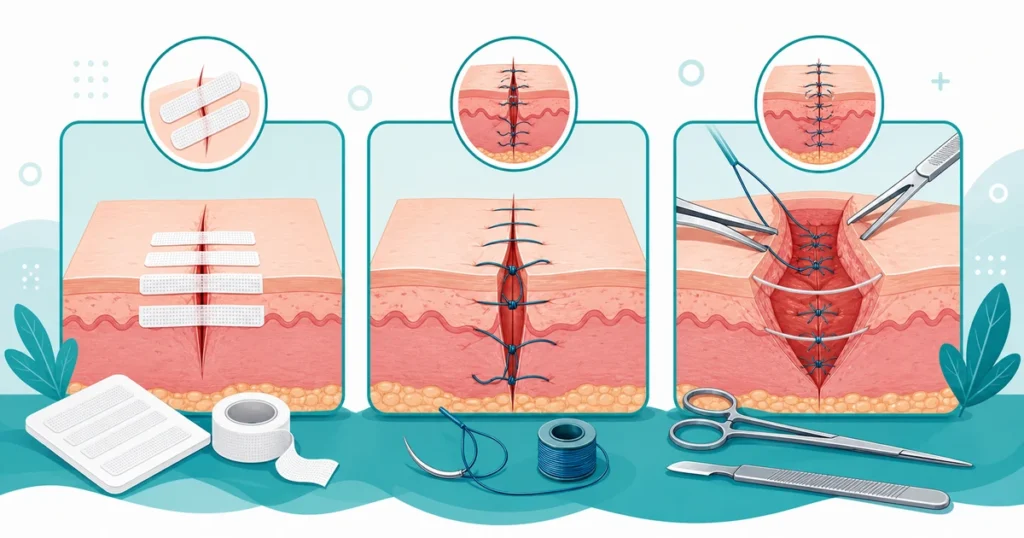
CPT divides wound repairs into three complexity levels. The level determines which code range you use, so correctly classifying the repair is the first and most critical step. The Surgery Coding Beginners guide covers how surgical CPT sections are organized if you need background.
Simple Repair (12001â12021)
Simple repair involves superficial wounds that require single-layer closure. This means the physician closes only the epidermis, dermis, or subcutaneous tissue â one layer of sutures, staples, or tissue adhesive. There is no significant contamination, no removal of foreign bodies, and no undermining or layered closure.
Key characteristics of simple repair:
- Single-layer closure (one suture line through skin and subcutaneous tissue)
- Superficial wounds â lacerations, cuts, abrasions that need basic closure
- Includes local anesthesia and simple wound cleaning (these are not coded separately)
- Chemical or electrocauterization of wounds is included in simple repair
- Adhesive strips (butterfly bandages, Steri-Strips) alone do not qualify â they are included in the E/M service
| CPT Code | Body Area | Length |
|---|---|---|
| 12001 | Scalp, neck, axillae, external genitalia, trunk, extremities (including hands and feet) | 2.5 cm or less |
| 12002 | Same group | 2.6â7.5 cm |
| 12004 | Same group | 7.6â12.5 cm |
| 12005 | Same group | 12.6â20.0 cm |
| 12006 | Same group | 20.1â30.0 cm |
| 12007 | Same group | Over 30.0 cm |
| 12011 | Face, ears, eyelids, nose, lips, mucous membranes | 2.5 cm or less |
| 12013 | Same group | 2.6â5.0 cm |
| 12014 | Same group | 5.1â7.5 cm |
| 12015 | Same group | 7.6â12.5 cm |
| 12016 | Same group | 12.6â20.0 cm |
| 12017 | Same group | 20.1â30.0 cm |
| 12018 | Same group | Over 30.0 cm |
| 12020 | Treatment of superficial wound dehiscence â simple closure | â |
| 12021 | Treatment of superficial wound dehiscence â packing | â |
Intermediate Repair (12031â12057)
Intermediate repair requires closure of one or more of the deeper subcutaneous layers and superficial (non-muscle) fascia, in addition to the skin closure. CPT defines two situations that qualify as intermediate:
- Layered closure of the wound â the physician closes deeper tissue layers separately from the skin layer, using multiple suture lines at different depths.
- Heavy contamination requiring extensive cleaning or removal of particulate matter â even if the wound itself is closed in a single layer, the extensive debridement and cleaning elevate it to intermediate.
This is the distinction that trips up most CPC candidates. A wound can be intermediate even with a single-layer skin closure if extensive contamination required debridement before that closure.
| CPT Code | Body Area | Length |
|---|---|---|
| 12031 | Scalp, axillae, trunk, extremities (excluding hands and feet) | 2.5 cm or less |
| 12032 | Same group | 2.6â7.5 cm |
| 12034 | Same group | 7.6â12.5 cm |
| 12035 | Same group | 12.6â20.0 cm |
| 12036 | Same group | 20.1â30.0 cm |
| 12037 | Same group | Over 30.0 cm |
| 12041 | Neck, hands, feet, external genitalia | 2.5 cm or less |
| 12042 | Same group | 2.6â7.5 cm |
| 12044 | Same group | 7.6â12.5 cm |
| 12045 | Same group | 12.6â20.0 cm |
| 12046 | Same group | 20.1â30.0 cm |
| 12047 | Same group | Over 30.0 cm |
| 12051 | Face, ears, eyelids, nose, lips, mucous membranes | 2.5 cm or less |
| 12052 | Same group | 2.6â5.0 cm |
| 12053 | Same group | 5.1â7.5 cm |
| 12054 | Same group | 7.6â12.5 cm |
| 12055 | Same group | 12.6â20.0 cm |
| 12056 | Same group | 20.1â30.0 cm |
| 12057 | Same group | Over 30.0 cm |
Important: Notice that the anatomical groupings shift between simple and intermediate repair. In simple repair, hands and feet group with the trunk and extremities (12001 series). In intermediate repair, hands and feet move to the neck/genitalia group (12041 series). This is a classic exam trap.
Complex Repair (13100â13160)
Complex repair involves more than layered closure. It includes one or more of: scar revision, debridement of traumatic lacerations or avulsions, extensive undermining, stents or retention sutures, or placement of local tissue rearrangements (such as Z-plasty, W-plasty, or T-plasty). If the wound requires any of these techniques, it qualifies as complex repair regardless of wound depth.
| CPT Code | Body Area | Length |
|---|---|---|
| 13100 | Trunk | 1.1â2.5 cm |
| 13101 | Trunk | 2.6â7.5 cm |
| 13102 | Trunk â each additional 5 cm or less | Add-on |
| 13120 | Scalp, arms, legs | 1.1â2.5 cm |
| 13121 | Scalp, arms, legs | 2.6â7.5 cm |
| 13122 | Scalp, arms, legs â each additional 5 cm or less | Add-on |
| 13131 | Forehead, cheeks, chin, mouth, neck, axillae, genitalia, hands, feet | 1.1â2.5 cm |
| 13132 | Same group | 2.6â7.5 cm |
| 13133 | Same group â each additional 5 cm or less | Add-on |
| 13151 | Eyelids, nose, ears, lips | 1.1â2.5 cm |
| 13152 | Same group | 2.6â7.5 cm |
| 13153 | Same group â each additional 5 cm or less | Add-on |
| 13160 | Late closure of a complicated wound | â |
Note that complex repair uses add-on codes (13102, 13122, 13133, 13153) for lengths beyond 7.5 cm. These add-on codes cannot be reported alone â they must accompany the base code.
Wound Length Summation Rules
This is where most coding errors happen. CPT has specific rules about when you can add wound lengths together and when you must code them separately.
The Core Rule
Sum the lengths of wounds repaired using the same classification (simple, intermediate, or complex) in the same anatomical group. Report a single code for the total length.
Do not sum across different repair types or different anatomical groups.
How This Works in Practice
Suppose a patient has three lacerations:
- 4.0 cm simple repair on the right arm
- 3.0 cm simple repair on the left leg
- 5.0 cm intermediate repair on the right arm
The right arm and left leg are in the same anatomical group for simple repair (scalp, neck, axillae, external genitalia, trunk, extremities). So you sum the two simple repairs: 4.0 + 3.0 = 7.0 cm. Report 12002 (simple repair, 2.6â7.5 cm).
The intermediate repair on the right arm is a different classification, so it cannot be summed with the simple repairs. Report it separately: 12032 (intermediate repair, scalp/axillae/trunk/extremities, 2.6â7.5 cm).
Reporting Multiple Repair Types
When a patient has wounds closed at different complexity levels, report the most complex repair first as the primary procedure, and the less complex repairs as secondary procedures. The secondary repairs may need modifier -59 to indicate they are distinct procedural services.
Order of reporting: Complex â Intermediate â Simple.
Step-by-Step Wound Repair Coding Method
Use this systematic approach for every wound repair question on the CPC exam:
Step 1 â Classify each wound. Read the operative note and determine whether each wound received simple, intermediate, or complex repair. Look for keywords: “layered closure” (intermediate), “undermining” or “retention sutures” (complex), “single-layer closure” (simple).
Step 2 â Identify the anatomical site. Match each wound to the correct body area group. Remember that groupings shift between repair types.
Step 3 â Sum eligible lengths. Add together wounds that share the same repair type AND the same anatomical group. Keep everything else separate.
Step 4 â Look up the codes. Use the summed lengths to find the correct code in each applicable code range.
Step 5 â Sequence correctly. List the most complex repair first. Append modifiers if needed.
Worked Example: Multiple Wound Scenario
Operative note: Patient presents to the ED after a fall through a glass door. Physician repairs the following:
- 6.0 cm laceration on the right forearm â layered closure (deep subcutaneous and skin layers)
- 3.5 cm laceration on the left forearm â layered closure
- 4.0 cm laceration on the chin â single-layer closure with sutures
- 2.0 cm laceration on the lower lip â layered closure with extensive debridement of glass fragments
Step 1 â Classify:
– Right forearm 6.0 cm â Intermediate (layered closure)
– Left forearm 3.5 cm â Intermediate (layered closure)
– Chin 4.0 cm â Simple (single-layer)
– Lower lip 2.0 cm â Intermediate (layered, plus debridement)
Step 2 â Anatomical groups:
– Right forearm â Intermediate group: scalp, axillae, trunk, extremities (12031 series)
– Left forearm â Same intermediate group (12031 series)
– Chin â Simple group: face, ears, eyelids, nose, lips, mucous membranes (12011 series)
– Lower lip â Intermediate group: face, ears, eyelids, nose, lips, mucous membranes (12051 series)
Step 3 â Sum:
– Intermediate, extremities group: 6.0 + 3.5 = 9.5 cm
– Simple, face group: 4.0 cm (only one wound, nothing to sum)
– Intermediate, face group: 2.0 cm (only one wound)
Step 4 â Codes:
– 12034 â Intermediate repair, scalp/axillae/trunk/extremities, 7.6â12.5 cm
– 12051 â Intermediate repair, face/ears/eyelids/nose/lips/mucous membranes, 2.5 cm or less
– 12013 â Simple repair, face group, 2.6â5.0 cm
Step 5 â Sequence: Intermediate repairs are more complex, so they go first. Between the two intermediate codes, the higher-value code (12034 for 9.5 cm) is primary.
Final answer: 12034, 12051-59, 12013-59
When E/M Codes Apply with Wound Repair
Under the global surgical package rules, simple wound repair includes the evaluation and management of the wound. You cannot bill a separate E/M code for assessing a wound that you then repair with simple closure.
However, you can report a separate E/M code when:
- The wound evaluation leads to a decision to perform a more significant procedure (append modifier -57)
- The E/M is for an unrelated condition treated during the same encounter
- The complexity of the patient’s other conditions requires a separately identifiable E/M service (append modifier -25)
For intermediate and complex repairs, the wound assessment is also typically included, but a significant, separately identifiable E/M can be reported with modifier -25 if documented.
Debridement Before Wound Repair
Simple debridement (removing loose tissue, cleaning foreign material) is included in the wound repair code and is not reported separately. Active wound care management codes (97597â97598) and debridement codes (11042â11047) are reported only when the debridement is performed as a stand-alone procedure without wound closure, or when the debridement is significantly more extensive than what is normally part of the repair.
Wound Exploration Codes (20100â20103)
Do not confuse wound repair with wound exploration. CPT codes 20100â20103 cover exploration of penetrating wounds â typically stab or gunshot wounds â when the physician explores deeper structures (muscles, tendons, blood vessels, nerves) to assess for damage. These codes include basic wound repair, so you do not report a separate wound repair code on top of a wound exploration code.
Wound exploration codes are organized by body region: neck (20100), chest (20101), abdomen/flank/back (20102), and extremity (20103). If the exploration leads to a definitive surgical repair (for example, repairing a severed tendon), the definitive repair code supersedes the exploration code.
Modifier Usage with Wound Repairs
Several CPT modifiers commonly apply to wound repair coding:
Modifier -25 â Append to a separately identifiable E/M code billed on the same date as wound repair. The E/M must be documented as significant and separate.
Modifier -59 â Append to secondary wound repair codes when reporting multiple repairs at different complexity levels or different anatomical groups. This tells the payer that the procedures are distinct.
Modifier -76 â Use when the same wound repair procedure is repeated on the same date (rare, but possible if a patient returns the same day with a new injury to the same type of site).
Modifier -22 â Append when the wound repair is substantially more complex than typically required. This requires clear documentation explaining why the procedure was unusually difficult.
Common CPC Exam Traps
Trap 1: Anatomical group shifts. Hands and feet are in the trunk/extremities group for simple repair but move to the neck/hands/feet/genitalia group for intermediate repair. The exam loves testing this.
Trap 2: Summing across repair types. Never add a simple repair length to an intermediate repair length, even if they are on the same body site. Different classification = separate codes.
Trap 3: Adhesive strips alone. Wound closure using only adhesive strips (Steri-Strips, butterfly bandages) is not coded as a wound repair. It is included in the E/M service.
Trap 4: Converting measurements. Operative notes sometimes give wound lengths in millimeters or inches. Convert to centimeters before looking up the code. 1 inch = 2.54 cm. 10 mm = 1 cm.
Trap 5: Forgetting add-on codes. Complex repairs over 7.5 cm require a base code plus an add-on code. Do not try to report two base codes.
Wound Repair and Skin Procedures â Knowing the Boundaries
Wound repair codes cover traumatic wound closure only. They do not apply to surgical incision closure (that is included in the primary surgical procedure code) or to procedures that involve tissue transfer or grafting. If a wound cannot be closed primarily and requires a skin graft or tissue flap, you code the graft or flap procedure instead of â not in addition to â the wound repair code.
Similarly, wound repair is distinct from skin lesion excision. When a physician excises a lesion and closes the wound, the closure is included in the excision code for simple and intermediate closures. Only complex closure of an excision site is reported separately using the 13100 series.
Understanding these boundaries prevents the most common unbundling errors on the CPC exam and in real-world coding. When in doubt, check the CPT guidelines at the beginning of the Repair (Closure) section â they explicitly state what is and is not included.
Quick Reference: Choosing the Right Repair Type
When reading an operative note, scan for these keywords to quickly classify the repair:
*
5 quick questions drawn from this guide. Click an answer to check it — explanations appear as you go.
1. The three classes of wound repair in CPT are:
2. Intermediate repair is distinguished from simple repair primarily by:
3. When multiple wounds of the same classification and anatomic group are repaired, you:
4. Wound lengths are measured and summed in:
5. Wounds of different classifications (e.g., simple vs complex) are:
Frequently Asked Questions
What is the difference between simple, intermediate, and complex wound repair?
Simple repair involves single-layer closure of superficial wounds. Intermediate repair requires layered closure of deeper tissue or extensive cleaning of a contaminated wound. Complex repair requires more than layered closure, such as scar revision, extensive undermining, or retention sutures. The complexity of the closure technique — not the cause of the wound — determines the classification.
When do you add wound lengths together for coding?
Wound lengths are added together only when the wounds are the same complexity level and in the same anatomical location group. Different complexity levels are always reported with separate codes, and different anatomical groups may require separate codes with a modifier.
Can you combine a simple repair length with an intermediate repair length?
No. Simple and intermediate repair lengths are never added together, even if performed on the same patient during the same encounter. Each complexity level is reported with its own separate code and its own summed length.
What are the anatomical location groups used for wound repair coding?
Group 1 covers face, ears, eyelids, nose, lips, and mucous membranes. Group 2 covers scalp, axillae, trunk, hands, and feet. Group 3 covers arms and legs. Wounds are only summed together within the same group.
Does the cause of the wound determine its repair classification?
No. The repair classification is based entirely on the complexity of the closure technique actually documented, not on how the wound occurred. A clean laceration closed in layers is intermediate, regardless of the mechanism of injury.