Anesthesia coding is unique in the CPT codebook — it uses a completely different payment system from other sections. Instead of a flat fee per procedure, anesthesia is calculated using a unit-based formula that accounts for the complexity of the procedure, the time involved, and the patient’s medical condition. This guide explains the entire system from scratch so you can confidently tackle anesthesia questions on the CPC exam.
How Anesthesia Coding Differs from Other CPT Coding
When a surgeon performs a procedure, you select one CPT code that describes what was done and the payer reimburses a set fee. Anesthesia works differently. The anesthesiologist or CRNA is paid based on a formula that combines three types of units multiplied by a conversion factor — a dollar amount per unit set by each payer.
The anesthesia CPT codes (00100–01999) are organized by the body area or type of procedure for which anesthesia is administered — not by what the anesthesiologist specifically does. One anesthesia code covers the entire anesthetic management of a case.
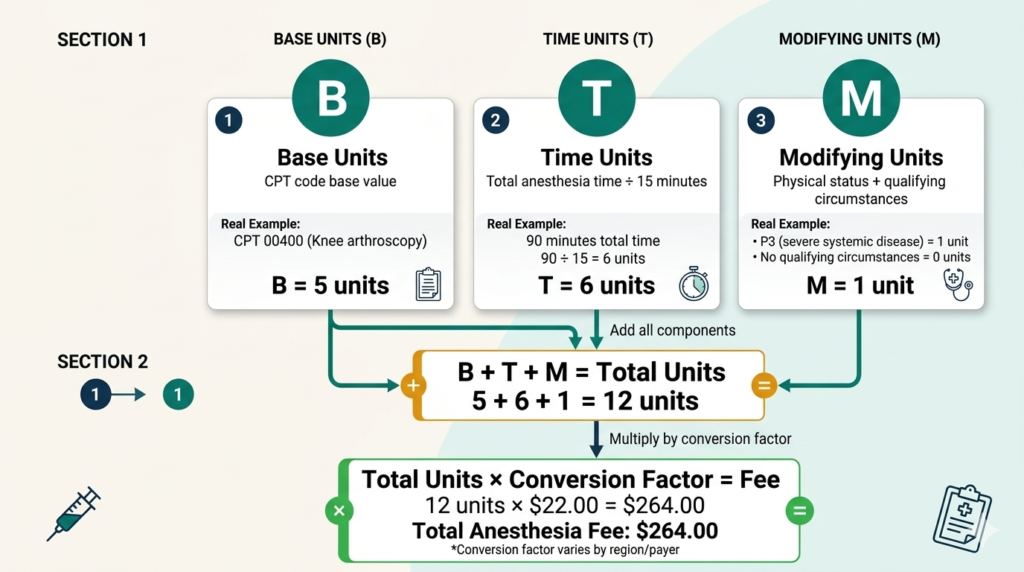
The Anesthesia Coding BTM Formula: Base + Time + Modifying Units
The anesthesia coding BTM formula calculates fees as follows:
B = Base Units · T = Time Units · M = Modifying Units
B — Base Units (Step 1 of Anesthesia Coding BTM Formula)
Each anesthesia CPT code is assigned a specific number of base units by the American Society of Anesthesiologists (ASA). Base units reflect the complexity and risk of providing anesthesia for a particular type of procedure. Simple procedures have fewer base units; complex, high-risk procedures have more. For example anesthesia for a routine knee arthroscopy might have 3 base units while anesthesia for open heart surgery might have 20 or more.
T — Time Units (Step 2 of Anesthesia Coding BTM Formula)
Time units are calculated based on how long the anesthesia service lasted. The standard calculation is one time unit for every 15 minutes of anesthesia time. Anesthesia time begins when the anesthesiologist starts preparing the patient for induction and ends when the anesthesiologist is no longer in personal attendance — typically when the patient is safely transferred to post-anesthesia care.
- 15 minutes = 1 time unit
- 30 minutes = 2 time units
- 60 minutes = 4 time units
- 90 minutes = 6 time units
M — Modifying Units (Step 3 of Anesthesia Coding BTM Formula)
Modifying units are added based on special circumstances that increase the complexity or risk of the anesthetic. The two main sources of modifying units are physical status modifiers and qualifying circumstances.
Physical Status Modifiers — P1 Through P6
Physical status modifiers describe the patient’s overall health and pre-existing medical conditions at the time of surgery. They are appended to the anesthesia CPT code and add modifying units to the anesthesia calculation. They are designated P1 through P6:
| Modifier | Description | Units Added | Example |
|---|---|---|---|
| P1 | Normal healthy patient | 0 | Healthy 25-year-old for elective surgery |
| P2 | Patient with mild systemic disease | 0 | Well-controlled type 2 diabetes, mild hypertension |
| P3 | Patient with severe systemic disease | 1 | Poorly controlled diabetes, COPD, morbid obesity |
| P4 | Patient with severe systemic disease that is a constant threat to life | 2 | Recent MI, severe cardiac dysfunction, sepsis |
| P5 | Moribund patient not expected to survive without the operation | 3 | Ruptured aortic aneurysm, massive trauma |
| P6 | Brain-dead patient — organ donor | 0 | Organ procurement surgery |
Qualifying Circumstances
Qualifying circumstances are special conditions that significantly affect the character of the anesthesia service provided. They are reported using add-on codes from the Medicine section of CPT (99100–99140) and add additional modifying units:
| Code | Circumstance | Units Added |
|---|---|---|
| 99100 | Anesthesia for patient of extreme age — younger than 1 year or older than 70 | 1 |
| 99116 | Utilization of total body hypothermia | 5 |
| 99135 | Controlled hypotension | 5 |
| 99140 | Emergency conditions — delay in treatment would lead to significant increase in threat to life | 2 |
Complete Anesthesia Calculation Example
A 72-year-old patient with poorly controlled COPD (P3) undergoes a total hip replacement as an emergency procedure. Anesthesia time is 2 hours (120 minutes). The anesthesia code has 10 base units. The conversion factor is $80 per unit.
- Base units (B): 10
- Time units (T): 120 minutes ÷ 15 = 8 units
- Modifying units (M): P3 = 1 unit + extreme age (99100) = 1 unit + emergency (99140) = 2 units → Total M = 4 units
- Total units: 10 + 8 + 4 = 22 units
- Anesthesia fee: 22 × $80 = $1,760
CRNA Modifiers
When a Certified Registered Nurse Anesthetist (CRNA) provides anesthesia services, specific HCPCS modifiers are required to identify the level of physician involvement:
- QX: CRNA with medical direction by a physician
- QZ: CRNA without medical direction
- QK: Physician medical direction of 2–4 CRNAs
- QY: Physician medically directing one CRNA
- AA: Anesthesia services performed personally by an anesthesiologist