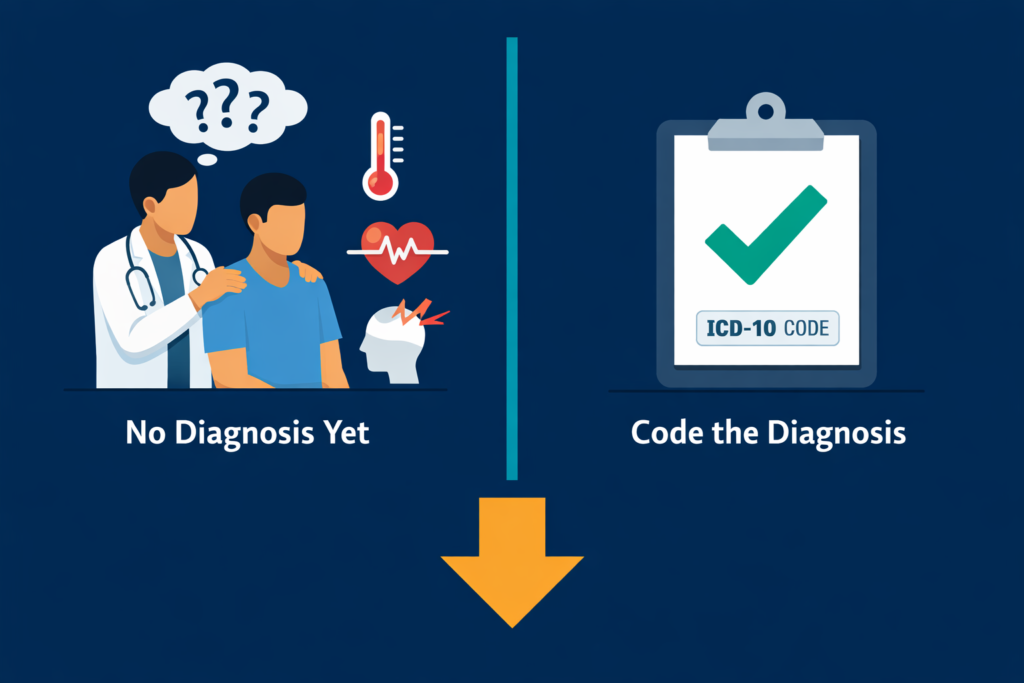
One of the most frequently tested judgment calls in ICD-10-CM coding is deciding when to code a sign or symptom and when to code a definitive diagnosis instead. Get this wrong and you either undercode a confirmed condition or overcode an uncertain one. This guide gives you the clear rules and decision framework you need to get it right every time.
In medical coding terms, a sign is an objective finding — something the provider can observe or measure, such as fever, elevated blood pressure, or an abnormal lab value. A symptom is a subjective complaint reported by the patient, such as chest pain, headache, or nausea. Both signs and symptoms are classified primarily in Chapter 18 of ICD-10-CM — the R codes (R00–R99) — though many appear throughout other chapters as well.
Signs and symptoms codes exist because patients frequently present for care before a definitive diagnosis has been established. The coder must accurately represent what is known at the time of the encounter without speculating about conditions that have not been confirmed.
The ICD-10-CM guidelines are clear: signs and symptoms that are integral to a disease process — meaning they routinely occur as part of a confirmed diagnosis — should NOT be coded separately. When you have a confirmed definitive diagnosis, code the diagnosis. The signs and symptoms are assumed to be part of it.
A patient presents with fever, productive cough, and shortness of breath. After chest X-ray and lab work, the physician documents community-acquired pneumonia. You code the pneumonia — NOT the fever, cough, or shortness of breath separately, because these are integral symptoms of pneumonia.
A patient with confirmed Type 2 diabetes presents with chest pain. The physician works up the chest pain but does not find a cardiac cause. You code the Type 2 diabetes AND the chest pain separately — because chest pain is NOT an integral symptom of diabetes. The symptom is not explained by the primary diagnosis.
There are five main situations where you DO code signs and symptoms:
Chapter 18 of ICD-10-CM (R00–R99) contains codes for symptoms, signs, and abnormal clinical and laboratory findings not classified elsewhere. It is organized by body system:
| Code Range | Body System / Type |
|---|---|
| R00–R09 | Symptoms involving the circulatory and respiratory systems |
| R10–R19 | Symptoms involving the digestive system and abdomen |
| R20–R23 | Symptoms involving the skin and subcutaneous tissue |
| R25–R29 | Symptoms involving the nervous and musculoskeletal systems |
| R30–R39 | Symptoms involving the urinary system |
| R40–R46 | Symptoms involving cognition, perception, emotional state and behavior |
| R47–R49 | Symptoms involving speech and voice |
| R50–R69 | General symptoms and signs |
| R70–R79 | Abnormal findings on examination of blood |
| R80–R82 | Abnormal findings on examination of urine |
| R83–R89 | Abnormal findings on examination of other body fluids and specimens |
| R90–R94 | Abnormal findings on diagnostic imaging and function studies |
| R97–R99 | Ill-defined and unknown causes of mortality |
Has the provider documented a definitive diagnosis for the encounter?
If YES → Code the definitive diagnosis. Are the signs/symptoms integral to that diagnosis? If yes, do not code them separately. If no, code both.
If NO definitive diagnosis → Is this outpatient or inpatient? Outpatient = code the signs/symptoms only. Inpatient = code probable/suspected as if confirmed.
If outpatient with no diagnosis → Code the presenting sign or symptom as the first-listed diagnosis.
One of the most powerful features of ICD-10-CM is the combination code — a single code that captures two conditions, a condition and its associated complication, or a condition and its cause, all in one code. Understanding combination codes prevents common errors like using two separate codes when one combination code already exists. This article explains combination codes completely with real clinical examples.
A combination code is a single ICD-10-CM code that classifies two diagnoses together — or a diagnosis together with an associated sign, symptom, manifestation, or complication. The ICD-10-CM guidelines specifically require that combination codes be used when they are available and accurately describe the condition. Using two separate codes when a single combination code exists is considered incorrect coding.
Combination codes were one of the major improvements of ICD-10-CM over ICD-9-CM. They reduce the number of codes needed on a claim, improve coding accuracy, and better reflect the clinical relationship between two conditions.
A single code captures two diagnoses that commonly occur together or have an assumed causal relationship. The most classic examples are the hypertension combination codes — I11 (hypertension with heart disease) and I12 (hypertension with CKD) — where ICD-10-CM presumes the relationship and builds it into one code.
I10 — Essential hypertension
I50.9 — Heart failure, unspecified
✅ After — One Combination Code (Correct)
I11.0 — Hypertensive heart disease with heart failure
+ I50.– to specify heart failure type (still required as additional)
The most common type of combination code captures a primary condition together with one of its common complications or manifestations. Diabetes mellitus codes are the best example — each E11 subcategory captures both the diabetes type and a specific complication in one code.
E11.9 — Type 2 diabetes mellitus, without complications
N18.3 — Chronic kidney disease, stage 3
✅ After — One Combination Code (Correct)
E11.22 — Type 2 diabetes mellitus with diabetic CKD stage 3
+ N18.3 still required as additional code to specify the stage
Some combination codes capture a disease along with a sign or symptom that routinely accompanies it. When this type of combination code exists, the sign or symptom is not coded separately — it is already captured in the combination code.
K57.30 — Diverticulosis of large intestine without perforation
K92.1 — Melena (rectal bleeding symptom)
✅ After — One Combination Code (Correct)
K57.31 — Diverticulosis of large intestine without perforation or abscess, with bleeding
| Combination Code | What It Captures in One Code |
|---|---|
| E11.329 | Type 2 diabetes + mild nonproliferative retinopathy + no macular edema + unspecified eye |
| I25.110 | Atherosclerotic heart disease + native coronary artery + unstable angina |
| K50.011 | Crohn’s disease of small intestine + rectal bleeding |
| J44.1 | COPD + acute exacerbation |
| A41.01 | Sepsis + caused by methicillin-susceptible Staphylococcus aureus |
| G30.9 | Alzheimer’s disease, unspecified (Use additional code for dementia manifestation) |
| O24.419 | Gestational diabetes + insulin controlled + unspecified trimester |
Finding combination codes requires careful use of both the Alphabetic Index and the Tabular List. In the Alphabetic Index, combination codes often appear under the main disease with “with” subterms listing associated conditions. In the Tabular List, combination codes are recognizable because their descriptions contain multiple clinical elements joined by words like “with,” “and,” or “due to.”
Diabetes mellitus is one of the most frequently coded conditions in all of medical coding — and one of the most heavily tested topics on the CPC exam. ICD-10-CM uses a sophisticated combination code system for diabetes that captures both the type of diabetes and any associated complications in a single code. Understanding this system thoroughly will serve you well both on the exam and in real-world coding practice.
ICD-10-CM classifies diabetes mellitus into several distinct categories, each with its own code range. The most important ones for the CPC exam are:
| Category | Code Range | Description |
|---|---|---|
| Type 1 diabetes mellitus | E10.– | Insulin-dependent diabetes — the body does not produce insulin at all |
| Type 2 diabetes mellitus | E11.– | Non-insulin-dependent — most common type; body does not use insulin properly |
| Diabetes due to underlying condition | E08.– | Secondary diabetes caused by another disease such as pancreatitis |
| Drug/chemical-induced diabetes | E09.– | Diabetes caused by medication or chemical exposure |
| Other specified diabetes | E13.– | Diabetes not classified elsewhere, including monogenic diabetes |
The most powerful feature of ICD-10-CM diabetes coding is the combination code. A combination code captures both the type of diabetes AND the associated complication or manifestation in a single code — eliminating the need for separate codes in most cases. The 4th, 5th, and 6th characters of the diabetes code identify the specific complication.
| Subcategory | Complication |
|---|---|
| E11.0 | With hyperosmolarity |
| E11.1 | With ketoacidosis |
| E11.2 | With kidney complications (nephropathy, CKD) |
| E11.3 | With ophthalmic complications (retinopathy, cataracts, macular edema) |
| E11.4 | With neurological complications (neuropathy, autonomic neuropathy) |
| E11.5 | With circulatory complications (peripheral angiopathy, gangrene) |
| E11.6 | With other specified complications (arthropathy, hypoglycemia, oral complications) |
| E11.8 | With unspecified complications |
| E11.9 | Without complications |
The diabetes combination code captures the diabetic kidney disease. A second code from N18 is added to specify the CKD stage — the E11.22 code instructs “Use additional code for the stage of CKD.”
This single combination code captures the diabetes, the type of retinopathy, the severity level, and the macular edema status. No additional codes needed unless the laterality is specified.
One code captures the Type 1 diabetes, the hypoglycemic event, and the coma. The combination code approach eliminates the need for separate codes for each element.
When a Type 2 diabetes patient uses insulin, an additional code must be added to capture this important clinical detail. This is a mandatory “Use additional code” instruction in the ICD-10-CM guidelines.
Do NOT add Z79.4 for Type 1 diabetes — insulin use is assumed and inherent to Type 1. The Z79.4 code is only needed for Type 2 and other non-Type 1 diabetes categories where insulin use is not the default assumption.
When diabetes is caused by another condition or by a drug, different code categories apply and additional sequencing rules kick in:
When you open the ICD-10-CM Tabular List you will quickly notice notes appearing beneath many codes and categories — including two that look almost identical but mean very different things: Excludes1 and Excludes2. Misreading these notes is a common source of coding errors and CPC exam mistakes. This guide explains both types clearly with real coding examples so you never confuse them again.
Exclusion notes exist to guide coders about conditions that are NOT classified within a particular code or category. They prevent incorrect code assignment and ensure clinical accuracy. The ICD-10-CM tabular list uses two distinct types of exclusion notes, each with a different meaning and different implications for whether two codes can be reported together.
An Excludes1 note means the excluded condition is mutually exclusive with the code it appears under. In plain terms, the two conditions cannot occur together or be coded together at the same encounter. An Excludes1 note essentially says: “This code is never used at the same time as the code listed here.”
The reason for an Excludes1 note is usually that the excluded condition is either included in the code you are looking at, or the two conditions are clinically impossible to have simultaneously.
J06.9 — Acute upper respiratory infection, unspecified
Excludes1: acute respiratory infection NOS (J22)
This means J06.9 and J22 can NEVER be coded together for the same patient at the same encounter. They are mutually exclusive — choose one or the other.
An Excludes2 note means the excluded condition is NOT included in the code it appears under — but the patient CAN have both conditions simultaneously and both CAN be coded together if both are documented and present. An Excludes2 note says: “This condition is not classified here, but if the patient has it, code it separately.”
The Excludes2 note is a coding guidance note — it is telling you where to find the other condition, not telling you that you cannot code both. If the patient truly has both conditions and the documentation supports it, both codes may be reported.
J45 — Asthma
Excludes2: detergent asthma (J68.0), eosinophilic asthma (J82.83), lung diseases due to external agents (J60–J70)
This means those specific types of asthma are classified elsewhere — but if a patient has both standard asthma (J45) AND a lung disease due to external agents (J60–J70), you CAN code both together.
| Feature | Excludes1 | Excludes2 |
|---|---|---|
| What it means | Pure exclusion — conditions are mutually exclusive | Not included here — but can coexist and be coded separately |
| Can both codes be reported? | NO — never at the same encounter | YES — if both conditions are documented and present |
| Clinical implication | Conditions cannot occur simultaneously OR one already includes the other | Conditions can occur simultaneously but are classified in different categories |
| Action required | Choose one code — do not report both | Code separately if both conditions exist and are documented |
| Memory tip | Excludes1 = Exclusive — only ONE | Excludes2 = Elsewhere — find the other code |
There is one important exception to the Excludes1 rule. If the Excludes1 note applies to a combination code situation — where a patient has both conditions but is using separate codes specifically for each — then both codes may be reported. This exception applies when the provider clearly documents that both separate conditions are present and neither is included in the other. This exception is rare and should be applied carefully.
While Excludes1 and Excludes2 are the most tested, the ICD-10-CM tabular list contains several other important instructional notes you should recognize:
Hypertension is one of the most common diagnoses in all of medicine — and one of the most consistently tested topics on the CPC exam. What makes it challenging is that hypertension rarely exists alone. It frequently co-exists with heart disease, heart failure, and chronic kidney disease, and ICD-10-CM has specific combination code rules for each combination. This guide walks through every hypertension scenario you need to master.
When a patient has hypertension with no documented heart disease, heart failure, or chronic kidney disease, coding is straightforward. ICD-10-CM uses a single code regardless of whether the hypertension is primary, essential, benign, or malignant — a major simplification from ICD-9-CM which had separate codes for each type.
Essential (primary) hypertension with no heart disease or CKD
Hypertensive heart disease — a causal relationship is assumed by ICD-10-CM
Hypertensive chronic kidney disease — causal relationship assumed
Hypertensive heart and chronic kidney disease — all three present
When a patient has both hypertension and heart disease, ICD-10-CM presumes a causal relationship between the two — meaning it assumes the hypertension caused the heart disease — unless the physician specifically documents that the two conditions are unrelated. This is a critical assumption rule that simplifies coding but requires careful reading of documentation.
Category I11 has two subcategories based on whether heart failure is present:
When heart failure is present (I11.0), an additional code from category I50 must be added to specify the type of heart failure — systolic, diastolic, combined, or unspecified.
The I11.0 code captures the hypertensive heart disease with heart failure. The I50 code is required as an additional code to specify the type of heart failure.
Similar to heart disease, ICD-10-CM presumes a causal relationship between hypertension and CKD — the hypertension is assumed to have caused the kidney disease unless documented otherwise. Category I12 is used when both conditions are present:
An additional code from category N18 is always required to specify the exact stage of CKD.
The I12.9 code captures the hypertensive CKD relationship. N18.3 is mandatory as an additional code to identify the CKD stage.
When all three conditions are present — hypertension, heart disease, AND chronic kidney disease — category I13 is used. This is the most complex hypertension scenario and requires additional codes for both the heart failure type and the CKD stage:
| Code | Description | Additional Codes Required |
|---|---|---|
| I13.0 | Hypertensive heart and CKD with heart failure and stage 1–4 CKD | I50.– for heart failure type + N18.1–N18.4 for CKD stage |
| I13.10 | Hypertensive heart and CKD without heart failure, with stage 1–4 CKD | N18.1–N18.4 for CKD stage |
| I13.11 | Hypertensive heart and CKD without heart failure, with stage 5 or ESRD | N18.5 or N18.6 for CKD stage |
| I13.2 | Hypertensive heart and CKD with heart failure and stage 5 or ESRD | I50.– for heart failure type + N18.5 or N18.6 |
The presumed causal relationship between hypertension and heart disease OR hypertension and CKD only applies when the physician has not documented that the conditions are unrelated. If the physician specifically documents that the heart disease or CKD is NOT caused by the hypertension — for example, “CKD due to polycystic kidney disease, unrelated to hypertension” — you code each condition separately using I10 for the hypertension and the appropriate heart disease or CKD code independently.
The ICD-10-CM Alphabetic Index is your gateway to finding diagnosis codes — but it is more than just a simple alphabetical list. It contains multiple specialized tables and cross-references that experienced coders know how to navigate quickly and accurately. This guide walks through every section of the ICD-10-CM index so you can use it with confidence on the CPC exam and in daily coding practice.
Just like the CPT index, the ICD-10-CM Alphabetic Index is a navigation tool — not the final authority on code assignment. The index gives you a suggested code or code range. You must always verify the final code in the Tabular List before assigning it. The Tabular List contains instructional notes, inclusion and exclusion notes, and required additional codes that are not visible in the index. Coding directly from the index without tabular verification is one of the most common and consequential errors in medical coding.
The ICD-10-CM Alphabetic Index is actually made up of three distinct sections, each serving a different purpose:
The main alphabetic index listing conditions, diseases, symptoms, and injuries. This is where you start for the vast majority of diagnosis code lookups. Organized alphabetically by condition name.
A special table for finding neoplasm codes organized by anatomical site and behavior (malignant primary, malignant secondary, in situ, benign, uncertain, or unspecified). Used whenever you are coding any type of tumor or growth.
A specialized table for coding poisonings, adverse effects, underdosing, and toxic effects of drugs, chemicals, and other substances. Each substance is listed with separate columns for different types of exposure.
The Index to Diseases and Injuries works through a system of main terms and subterms. Main terms are printed in bold and appear at the left margin. They typically represent the condition, disease, or symptom being coded. Subterms are indented beneath the main term and narrow down the diagnosis by site, etiology, type, or other qualifiers.
The critical rule is: always look up the condition — not the anatomical site. The ICD-10-CM index is organized by condition name, not body part. For example, to find a code for a knee fracture you look up “Fracture” as the main term, then find “femur” or “tibia” or the specific bone as a subterm — not “knee” as the main term.
Whenever you code a neoplasm — any tumor, growth, cancer, or mass — you use the Table of Neoplasms. The table is organized alphabetically by anatomical site. For each site, six columns provide different codes based on the behavior of the neoplasm:
| Anatomical Site | Malignant Primary | Malignant Secondary | Ca In Situ | Benign | Uncertain | Unspecified |
|---|---|---|---|---|---|---|
| Breast | C50.– | C79.81 | D05.– | D24.– | D48.6– | D49.3 |
| Colon | C18.– | C78.5 | D01.0 | D12.– | D37.4 | D49.0 |
| Lung | C34.– | C78.0– | D02.2– | D14.3– | D38.1 | D49.1 |
To use the table: (1) identify the anatomical site of the neoplasm, (2) identify the behavior from the pathology report or physician documentation, (3) locate the intersection of site and behavior in the table, (4) verify the suggested code in the Tabular List.
The Table of Drugs and Chemicals is used for poisoning, adverse effect, and underdosing codes. Each drug or chemical substance is listed alphabetically. Six columns describe the circumstances of the exposure:
One of the first things that surprises beginner coders about ICD-10-CM is how much information a single code can contain. Unlike a simple number, an ICD-10-CM code is a carefully structured alphanumeric string where every character has a specific meaning. Once you understand how codes are built — character by character — navigating the ICD-10-CM codebook becomes far more intuitive and efficient.
Every ICD-10-CM code begins with a letter and can be up to seven characters long. Each character position carries specific meaning, and codes become more specific as more characters are added. Here is what each position represents:
The example above — S52.001A — means: fracture of upper end of ulna, torus fracture, right arm, initial encounter. Every character adds a layer of specificity that would have been impossible in ICD-9-CM.
The first character of every ICD-10-CM code is always a letter. This letter identifies the chapter and broad category of the condition. For example, all codes beginning with C are neoplasms, all codes beginning with J are respiratory diseases, and all codes beginning with S are injuries. The letter also indicates which section of the Tabular List you are working in.
The first three characters together form the category — the broadest level of classification for a diagnosis. Categories represent a single disease, condition, or group of related conditions. For example, J06 is the category for acute upper respiratory infections of multiple and unspecified sites. You should never report a three-character category code if more specific subcategory codes are available — always code to the highest level of specificity.
Characters 4, 5, and 6 add specificity by describing the exact site, etiology, manifestation, severity, or other clinical detail. A decimal point is always placed after the third character for readability — the decimal is part of the code format but is not actually a character in the code structure.
For example, within category E11 (Type 2 diabetes mellitus), the subcategories specify complications — E11.2 is with kidney complications, E11.3 is with ophthalmic complications, E11.4 is with neurological complications, and so on. Further digits specify exactly what type of complication.
Some ICD-10-CM codes require a 7th character to identify the type of encounter or episode of care. The 7th character is mandatory when it exists — a code without the required 7th character is considered invalid and will be rejected by payers. The most common 7th character sets are used in injury and fracture codes (Chapter 19) and obstetric codes (Chapter 15).
| 7th Character | Meaning | When to Use |
|---|---|---|
| A | Initial encounter | Patient is receiving active treatment for the injury — whether at first visit or later visits while still in active treatment phase |
| D | Subsequent encounter | Patient has completed active treatment and is now in the healing or recovery phase — routine follow-up visits |
| S | Sequela | Patient has a late effect or complication that arises as a direct result of a previous injury |
Some ICD-10-CM codes require a placeholder X to fill character positions when a 7th character is needed but the code does not have enough characters to reach position 7. The X holds the position so the 7th character lands in the correct spot. Omitting the placeholder X makes the code invalid.
Example: T14.91XA — Suicide attempt, initial encounter. The X fills character 6 so the 7th character A can be placed correctly. Without the X this code would be invalid.
One of the most significant improvements of ICD-10-CM over ICD-9 is the inclusion of laterality in codes. Many codes include a character specifying which side of the body is affected. Common laterality designators are 1 for right, 2 for left, and 3 for bilateral. When laterality is documented, you must capture it — coding to an unspecified side when the documentation specifies left or right is considered under-coding.
When a patient has more than one diagnosis — which is extremely common — the order in which you list the codes on a claim matters. Payers use the first-listed or principal diagnosis to determine payment amounts, authorize services, and assess medical necessity. Getting the sequence wrong can result in claim denials, delayed payment, or compliance issues. This guide explains all the ICD-10-CM sequencing rules a beginner coder needs to know.
The diagnosis code listed first on a claim — called the principal diagnosis in inpatient settings or the first-listed diagnosis in outpatient settings — drives the entire claim. It determines the DRG (Diagnosis Related Group) for inpatient payment, signals the primary reason for the visit to the payer, and establishes the basis for medical necessity. A missequenced claim may be denied, audited, or underpaid. Sequencing is not optional — it is a core coding competency.
The etiology/manifestation convention is one of the most important sequencing rules in ICD-10-CM. It applies when a disease causes a secondary condition — a manifestation. The underlying disease (etiology) must always be sequenced first, followed by the manifestation code. You cannot sequence the manifestation first.
The ICD-10-CM codebook signals this rule in two ways — the manifestation code will show “code first” or “in diseases classified elsewhere” in its description, and the underlying disease code will show “use additional code” to indicate that a manifestation code should follow.
The diabetes (etiology) must be sequenced first. The neuropathy (manifestation) follows. G63 has a “code first” note directing you to sequence the underlying disease.
When you see a “Code first” note under an ICD-10-CM code, it is a mandatory sequencing instruction. It tells you that another specific code must be sequenced before this one. “Code first” notes appear when the condition you are coding is either a manifestation of another disease or when guidelines require a specific sequencing order for clinical accuracy.
D63.0 carries a “Code first” note instructing you to sequence the neoplasm code before the anemia code.
A “Use additional code” note means the code you are looking at does not fully describe the condition — another code must be added to capture a related condition, causative agent, or associated finding. Unlike “Code first” which tells you what goes before, “Use additional code” tells you what to add after.
Many infection codes carry “Use additional code” notes directing you to also code the organism, the resistant status, or associated complications when present and documented.
When the same condition is documented as both acute and chronic and separate codes exist for each, the ICD-10-CM guidelines instruct you to sequence the acute condition first, followed by the chronic condition. This applies when both the acute and chronic forms of the condition have their own distinct codes — not when a single combination code captures both.
When documented as acute-on-chronic respiratory failure, the acute code is sequenced first.
When a single ICD-10-CM code fully describes two conditions — such as a disease with its associated complication or two related conditions — that combination code is used alone. Do not report two separate codes when one combination code captures the complete clinical picture.
| Sequencing Instruction | What It Means | Action Required |
|---|---|---|
| Code first | Another code must be listed before this one | Find and sequence the required preceding code first |
| Use additional code | Another code must be added after this one | Add the specified secondary code after this code |
| Code also | Two codes may be needed — sequence depends on severity/focus | Assign both codes; sequence by clinical focus |
| Etiology/manifestation | Underlying disease goes before manifestation | Always sequence the etiology (cause) first |
| Acute before chronic | When both documented with separate codes | Acute code first, chronic code second |
Injury coding in ICD-10-CM lives primarily in Chapter 19 — the S and T codes — and it is one of the most complex areas in the entire codebook. Between 7th character extensions, placeholder X requirements, fracture coding nuances, and external cause codes, there is a lot to master. This guide breaks it all down into clear, manageable pieces so you can confidently tackle injury coding on the CPC exam.
Chapter 19 of ICD-10-CM covers injuries, poisonings, and certain other consequences of external causes. It uses two letter ranges:
Most injury codes in Chapter 19 require a 7th character to identify the episode of care. There are three basic 7th characters used for most injuries:
Patient is receiving active treatment — surgery, casting, medication, wound care
Active treatment is complete — patient in recovery or healing phase, routine follow-up
A late effect or complication that results directly from the previous injury
Fracture codes use an expanded set of 7th characters that go beyond the basic A, D, S. These characters capture whether the fracture is open or closed, and for subsequent encounters whether healing is routine, delayed, with nonunion, or with malunion:
| 7th Char | Meaning | Phase |
|---|---|---|
| A | Initial encounter for closed fracture | Active treatment |
| B | Initial encounter for open fracture type I or II | Active treatment |
| C | Initial encounter for open fracture type IIIA, IIIB, or IIIC | Active treatment |
| D | Subsequent encounter for closed fracture with routine healing | Subsequent |
| G | Subsequent encounter for closed fracture with delayed healing | Subsequent |
| K | Subsequent encounter for closed fracture with nonunion | Subsequent |
| P | Subsequent encounter for closed fracture with malunion | Subsequent |
| S | Sequela | Late effect |
Many injury codes do not have enough characters to reach the 7th position without help. When a code has fewer than 6 characters but requires a 7th character, the letter X is used as a placeholder to fill the gap. Omitting the placeholder X makes the code invalid and the claim will be rejected.
Example: S00.00XA — Unspecified superficial injury of scalp, initial encounter. The X fills character position 6 so the 7th character A lands correctly in position 7.
External cause codes from Chapter 20 (V00–Y99) describe HOW an injury happened — the cause, place of occurrence, activity, and patient’s status at the time. They are always secondary codes — never sequenced first. They provide additional information but do not replace the injury code.
Neoplasm coding is one of the most detail-intensive areas of ICD-10-CM. Every tumor, growth, mass, and cancer requires careful identification of both the anatomical site and the behavior of the neoplasm — and the two pieces of information together determine the correct code. This guide walks through neoplasm coding from the ground up so you can handle any tumor coding question on the CPC exam with confidence.
A neoplasm is any abnormal new growth of cells — whether cancerous or non-cancerous. The word comes from Greek meaning “new formation.” In ICD-10-CM, neoplasms are coded from Chapter 2 (C00–D49) and are always looked up using the Table of Neoplasms in the Alphabetic Index. Never try to code a neoplasm from the main index — always go directly to the Table of Neoplasms.
Every entry in the Table of Neoplasms has six columns — one for each possible behavior. The pathology report or physician documentation determines which column you use:
The original site where cancer started. The tumor originated here.
A metastatic site — cancer spread FROM a primary site TO here.
Cancer cells present but contained — has not invaded surrounding tissue yet.
Non-cancerous growth — does not invade or spread to other areas.
Pathologist cannot determine if benign or malignant — behavior unpredictable.
No pathology report available — behavior unknown or not documented.
The most commonly tested concept in neoplasm coding is the distinction between primary and secondary (metastatic) malignancy. Understanding this distinction is essential:
When a patient has cancer that has spread, you code both the primary site and the secondary site(s). The sequencing depends on which site is being treated at the current encounter.
Treatment focused on breast (primary) → breast cancer code sequenced first
Treatment focused on brain metastasis → secondary code sequenced first
Carcinoma in situ (CIS) means cancerous cells are present but are confined — they have not yet broken through the basement membrane into surrounding tissue. In situ carcinomas are coded from the third column of the Table of Neoplasms (D00–D09 range). They are serious but are considered a stage before invasive cancer and are coded distinctly from both benign tumors and invasive malignancies.
When a patient is admitted specifically to receive chemotherapy, radiation therapy, or immunotherapy for cancer, the encounter code — not the cancer code — is sequenced first:
The neoplasm code is then listed as an additional diagnosis. This sequencing rule applies specifically when the patient’s sole reason for the encounter is to receive the therapy — not when the therapy is incidental to other treatment.
Once a cancer has been successfully treated and is no longer present, it is no longer coded as an active malignancy. Instead a personal history Z-code is used. This is an important distinction — continuing to code an active malignancy after successful treatment is overcoding.