Table of Contents
- What Are Signs and Symptoms Codes?
- The Core Rule: When to Code Signs and Symptoms
- The Outpatient Uncertain Diagnosis Connection
- When Signs and Symptoms Codes ARE Reported with a Definitive Diagnosis
- Coding Abnormal Findings (R70–R94)
- How the CPC Exam Tests Signs and Symptoms Coding
- Common Signs and Symptoms Tested on the CPC Exam
- Common Mistakes
- Frequently Asked Questions
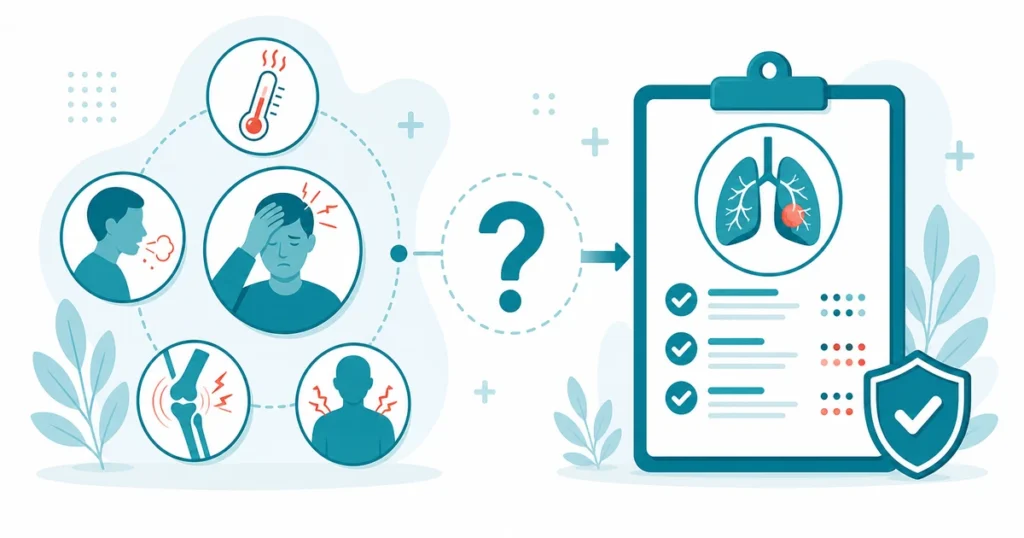
Signs and symptoms codes — found primarily in Chapter 18 (R00–R99) of ICD-10-CM — are among the most frequently used codes in outpatient settings and among the most frequently tested topics on the CPC exam. These codes describe clinical findings that have not yet been attributed to a definitive diagnosis: abnormal lab results, pain in various locations, fever, nausea, shortness of breath, and hundreds of other clinical presentations.
The coding guidelines have specific rules about when signs and symptoms should be coded, when they should not be coded, and how they interact with definitive diagnoses. Getting these rules wrong leads to overcoding (reporting symptoms alongside the diagnosis that explains them) or undercoding (failing to report symptoms when no definitive diagnosis has been established). Both errors appear as answer choices on the CPC exam.
This guide covers the complete set of rules for signs and symptoms coding, including the critical connection to the outpatient uncertain diagnosis rule and the relationship between symptoms and definitive diagnoses. For a broader overview of the coding framework, start with the ICD-10-CM coding guidelines.
What Are Signs and Symptoms Codes?
Signs and symptoms are clinical findings that the physician documents but that have not been linked to a specific underlying diagnosis. ICD-10-CM distinguishes between:
- Signs — Objective findings observed or measured by the clinician (elevated blood pressure reading, palpable mass, abnormal lab value, audible heart murmur)
- Symptoms — Subjective complaints reported by the patient (headache, chest pain, fatigue, dizziness, nausea)
Both are coded from Chapter 18 (Symptoms, Signs, and Abnormal Clinical and Laboratory Findings, Not Elsewhere Classified), which spans categories R00 through R99. However, some signs and symptoms are classified in body-system-specific chapters rather than Chapter 18 — for example, pain codes may appear in the musculoskeletal chapter for joint pain.
| Category Range | Description | Examples |
|---|---|---|
| R00–R09 | Circulatory and respiratory symptoms | Tachycardia, chest pain, cough, dyspnea |
| R10–R19 | Digestive and abdominal symptoms | Abdominal pain, nausea, vomiting, dysphagia |
| R20–R23 | Skin and subcutaneous tissue symptoms | Numbness, rash, skin changes |
| R25–R29 | Nervous and musculoskeletal symptoms | Tremor, abnormal gait, muscle spasm |
| R30–R39 | Urinary system symptoms | Dysuria, urinary frequency, retention |
| R40–R46 | Cognition, perception, and behavior symptoms | Altered consciousness, dizziness, nervousness |
| R47–R49 | Speech and voice symptoms | Dysphasia, dysarthria, voice disturbances |
| R50–R69 | General symptoms and signs | Fever, fatigue, syncope, malaise, edema |
| R70–R89 | Abnormal findings on examination of blood, urine, and other body fluids | Elevated ESR, abnormal glucose, proteinuria |
| R90–R94 | Abnormal findings on diagnostic imaging and function studies | Abnormal ECG, abnormal findings on CT/MRI |
| R97 | Abnormal tumor markers | Elevated PSA, elevated CA-125 |
| R99 | Ill-defined and unknown cause of mortality | Death NOS |
The Core Rule: When to Code Signs and Symptoms
The fundamental rule has two parts:
Code signs and symptoms when no definitive diagnosis has been established. If the physician documents symptoms but has not identified or confirmed the underlying cause, report the signs and symptoms codes. This is the standard approach in outpatient settings where the encounter may end before a definitive diagnosis is reached.
Do not code signs and symptoms when they are integral to a confirmed definitive diagnosis. If the physician has identified the underlying condition that explains the symptom, and the symptom is a routine part of that condition, you code only the definitive diagnosis. The symptom is considered “integral” — it is inherently part of the disease process and does not provide additional useful information.
Integral vs Non-Integral Symptoms
This distinction is where most coding errors occur.
Integral symptoms are signs and symptoms that are routinely associated with a disease and are expected to be present. They do not provide additional clinical information beyond what the definitive diagnosis already communicates.
Example: A patient diagnosed with pneumonia who has a cough and fever. Cough and fever are integral to pneumonia — you code only the pneumonia. Adding separate codes for cough (R05.-) and fever (R50.9) would be overcoding.
Non-integral symptoms are signs and symptoms that are not routinely associated with the diagnosed condition, or that represent a separate clinical concern.
Example: A patient diagnosed with type 2 diabetes who also has unexplained weight loss. While weight loss can occur with diabetes, it is not a routine finding that is always present. If the physician documents the weight loss as a separate concern requiring evaluation, it may be coded additionally.
The ICD-10-CM guidelines do not provide a definitive list of which symptoms are integral to which diagnoses. This requires clinical knowledge and judgment. However, the CPC exam typically makes the distinction clear in the scenario — if the symptom is obviously explained by the confirmed diagnosis, do not code it separately.
The Outpatient Uncertain Diagnosis Connection
Signs and symptoms coding is directly linked to the outpatient uncertain diagnosis rule from Section IV of the guidelines. This connection is tested on virtually every CPC exam.
The rule: In outpatient settings, you never code diagnoses documented as “probable,” “suspected,” “questionable,” “rule out,” “compatible with,” “consistent with,” or “working diagnosis.” Instead, you code the signs and symptoms to the highest degree of certainty.
How it works in practice:
A patient presents to the physician’s office with right upper quadrant abdominal pain. The physician examines the patient, orders an ultrasound, and documents “suspected cholecystitis — awaiting imaging results.”
- Correct outpatient coding: R10.11 (Right upper quadrant pain) — the confirmed symptom
- Incorrect outpatient coding: K81.9 (Cholecystitis, unspecified) — the suspected diagnosis that has not been confirmed
This rule means that signs and symptoms codes are the primary diagnostic codes in many outpatient encounters, particularly initial visits, emergency department encounters, and any encounter where testing is ordered but results are not yet available.
For the detailed comparison of how this rule differs in inpatient settings, see Outpatient vs Inpatient Coding Guidelines.
When Signs and Symptoms Codes ARE Reported with a Definitive Diagnosis
There are situations where you report both a definitive diagnosis and a signs/symptoms code. These exceptions are important for the CPC exam.
When the Symptom Is Not Explained by the Diagnosis
If a patient has a confirmed diagnosis plus a symptom that the diagnosis does not explain, code both. The symptom represents a separate clinical concern that the definitive diagnosis does not account for.
Example: A patient diagnosed with urinary tract infection (N39.0) who also has unexplained chest pain (R07.9). The chest pain is not a symptom of UTI, so it is coded separately if it is evaluated or managed during the encounter.
When a Code First / Use Additional Code Instruction Requires It
Some definitive diagnosis codes have “Use additional code” instructions directing you to add a signs/symptoms code. In these cases, the symptom code is mandatory as a secondary code.
Example: Certain neurological condition codes instruct “Use additional code to identify the type of seizure or convulsion.” Here, the symptom code (the seizure type) is added as a secondary code per the Tabular List instruction, even though a definitive diagnosis is established.
When the Symptom Provides Additional Important Clinical Information
If a symptom is clinically significant and not fully captured by the definitive diagnosis code, it may be reported additionally. This applies when the symptom affects patient management in a way not communicated by the diagnosis code alone.
Coding Abnormal Findings (R70–R94)
Categories R70 through R94 cover abnormal findings on laboratory tests, imaging studies, and function studies. These codes have specific usage rules:
Code abnormal findings when no definitive diagnosis has been established. If a lab test returns an abnormal result and the physician has not yet determined the cause, the abnormal finding code is appropriate.
Do not code abnormal findings when a definitive diagnosis has been established. If the abnormal lab result has been attributed to a specific condition, code the condition instead of the abnormal finding.
Example: A patient’s blood work shows elevated glucose (R73.09). If the physician has not diagnosed diabetes, R73.09 is the appropriate code. If the physician has confirmed type 2 diabetes, code E11.65 (Type 2 diabetes with hyperglycemia) or the appropriate diabetes code — not the abnormal glucose finding.
Do not code abnormal findings that are part of normal variation or that are not clinically significant. Not every out-of-range lab value warrants a code. The physician must document the abnormality as clinically significant or must order further workup based on it.
How the CPC Exam Tests Signs and Symptoms Coding
Pattern 1 — Symptom vs Definitive Diagnosis
The scenario presents a patient with documented symptoms and a confirmed diagnosis. One answer choice includes both the symptom and the diagnosis codes. Another includes only the diagnosis code. The correct answer is typically the diagnosis code alone — because the symptom is integral to the confirmed diagnosis.
Pattern 2 — Uncertain Diagnosis in Outpatient Setting
The scenario describes an outpatient encounter with a “suspected” or “rule out” diagnosis. One answer choice codes the uncertain diagnosis. Another codes the signs and symptoms. The correct answer is always the signs and symptoms in outpatient settings.
Pattern 3 — Multiple Symptoms, No Diagnosis
The scenario describes a patient presenting with multiple symptoms and no definitive diagnosis established during the encounter. The correct answer codes all relevant signs and symptoms that were evaluated. The first-listed diagnosis is the symptom chiefly responsible for the encounter.
Pattern 4 — Non-Integral Symptom
The scenario presents a confirmed diagnosis plus a symptom that is clearly unrelated to that diagnosis. The correct answer includes both codes — the definitive diagnosis and the non-integral symptom — because the symptom represents a separate clinical concern. This tests whether you know that symptoms are sometimes appropriately coded alongside a definitive diagnosis.
Common Signs and Symptoms Tested on the CPC Exam
| Code | Description | Common Scenario |
|---|---|---|
| R07.9 | Chest pain, unspecified | Rule out MI or cardiac workup |
| R10.9 | Unspecified abdominal pain | Rule out appendicitis, gallbladder disease |
| R50.9 | Fever, unspecified | Fever workup with no confirmed source |
| R51.9 | Headache, unspecified | Headache evaluation, rule out migraine |
| R05.9 | Cough, unspecified | Cough workup without confirmed pneumonia |
| R06.00 | Dyspnea, unspecified | Shortness of breath, cause undetermined |
| R11.2 | Nausea with vomiting, unspecified | GI evaluation without definitive diagnosis |
| R42 | Dizziness and giddiness | Vertigo workup |
| R55 | Syncope and collapse | Fainting episode, cause undetermined |
| R73.09 | Other abnormal glucose | Elevated glucose, diabetes not yet diagnosed |
Common Mistakes
Coding symptoms alongside the definitive diagnosis that explains them. If the physician confirms pneumonia, do not also code the cough and fever. The symptoms are integral.
Coding an uncertain diagnosis instead of symptoms in the outpatient setting. “Suspected cholecystitis” in an outpatient encounter means you code the abdominal pain, not cholecystitis.
Not coding symptoms when no definitive diagnosis exists. Some coders hesitate to use R-codes, but they are the correct choice when no definitive diagnosis has been established. Signs and symptoms codes are legitimate, billable codes — not placeholder codes.
Using unspecified symptom codes when more specific codes exist. Always code to the highest level of specificity. If the documentation specifies right upper quadrant abdominal pain, code R10.11 — not R10.9 (unspecified abdominal pain). See How ICD-10-CM Codes Are Built for specificity requirements.
5 quick questions drawn from this guide. Click an answer to check it — explanations appear as you go.
1. Signs and symptoms codes are generally NOT reported when:
2. In OUTPATIENT coding, an uncertain diagnosis (‘probable,’ ‘rule out’) is handled by:
3. Most signs and symptoms codes are found in ICD-10-CM Chapter 18, the:
4. A symptom that is NOT routinely associated with a confirmed disease should be:
5. An abnormal finding (e.g., abnormal blood chemistry) with no definitive diagnosis codes to:
Frequently Asked Questions
When should I code signs and symptoms instead of a diagnosis?
Code signs and symptoms when no definitive diagnosis has been established or confirmed. This is especially common in outpatient settings where the encounter may end before test results are available. In outpatient coding, you never code uncertain diagnoses (probable, suspected, rule out) — you code the confirmed signs and symptoms instead.
Can I code symptoms and a definitive diagnosis together?
Only when the symptom is not explained by the definitive diagnosis or when a Tabular List instruction directs you to add a symptom code. If the symptom is integral to the confirmed diagnosis — meaning it is a routine part of that disease — you code only the definitive diagnosis. If the symptom represents a separate, unexplained clinical concern, you code both.
What does “integral” mean in signs and symptoms coding?
A symptom is integral to a diagnosis when it is a routine, expected part of that disease process. For example, cough and fever are integral to pneumonia. Integral symptoms are not coded separately because the definitive diagnosis already communicates their presence. Coding integral symptoms separately is considered overcoding.
Are signs and symptoms codes (R-codes) billable?
Yes. Signs and symptoms codes from Chapter 18 (R00–R99) are legitimate, billable diagnosis codes. They are the appropriate codes to use when no definitive diagnosis has been established. They are not placeholder codes and should not be avoided when the clinical situation warrants them.
How does the CPC exam test signs and symptoms coding?
The CPC exam tests signs and symptoms coding in several ways: asking whether to code a symptom alongside a confirmed diagnosis (test integral vs non-integral), presenting an outpatient uncertain diagnosis scenario where symptoms are the correct answer, and offering answer choices with both symptoms and definitive diagnoses in different combinations. Knowing when symptoms replace uncertain diagnoses and when they are integral to confirmed diagnoses covers most exam patterns.