Table of Contents
- Diagnostic vs. Surgical Arthroscopy
- Joint Arthroscopy Code Ranges
- Hip Arthroscopy and Femoroacetabular Impingement
- Understanding the Global Package for Joint Procedures
- Common Knee Arthroscopy Procedures
- Compartments and Multiple Procedures Within the Same Joint
- Open vs. Arthroscopic Conversion
- Shoulder Arthroscopy Nuances
- Loose Body Removal and Synovectomy
- Modifiers Commonly Used in Joint Procedure Coding
- How the CPC Exam Tests Joint and Arthroscopy Coding
- Common Mistakes
- Frequently Asked Questions
Joint procedures — both open surgery and arthroscopy — make up a substantial portion of the Musculoskeletal subsection of CPT surgery codes and are heavily tested on the CPC exam because they combine several coding concepts at once: approach selection, bundling rules, laterality, and compartment-specific anatomy. Coding these procedures accurately requires understanding both the anatomy of each joint and the specific conventions CPT uses for arthroscopic versus open procedures. This guide walks through the code structure for major joints, the key rules distinguishing diagnostic from surgical arthroscopy, common bundling scenarios, and the modifiers most frequently needed. For the general operative report reading skills this applies, see Surgery Coding for Beginners. Because joint procedures span nearly every major joint in the body, mastering the general principles covered here transfers directly across shoulder, knee, hip, elbow, wrist, and ankle scenarios alike, rather than requiring separate memorization for each joint in isolation.
Diagnostic vs. Surgical Arthroscopy
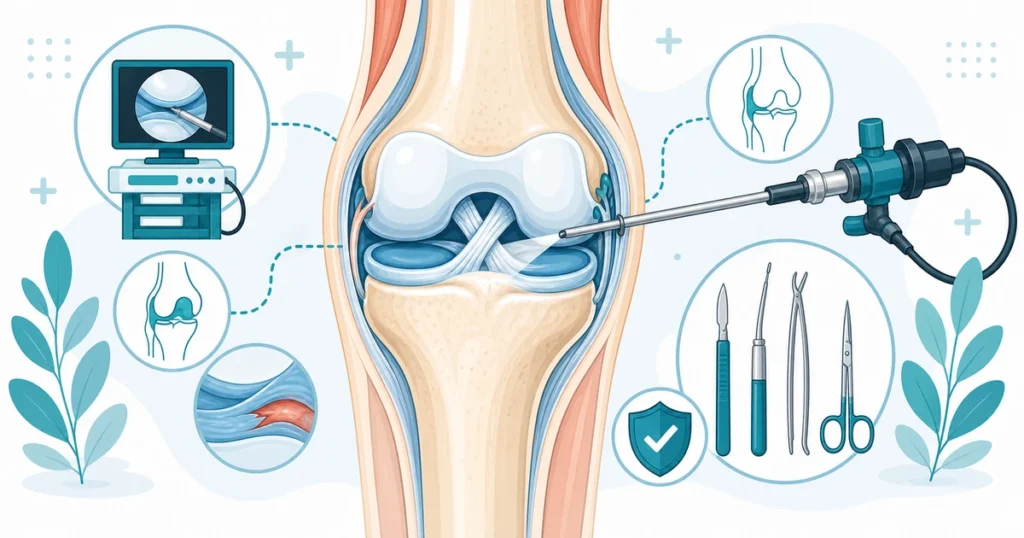
Arthroscopy is a minimally invasive technique in which a surgeon inserts a small camera (arthroscope) into a joint to visualize, and often treat, structures inside it. A critical CPT convention governs how diagnostic and surgical arthroscopy relate to each other: a diagnostic arthroscopy that is followed by a surgical arthroscopic procedure in the same joint during the same operative session is not separately reportable. The diagnostic arthroscopy is considered included in the surgical procedure, since visualizing the joint is a necessary first step of nearly every arthroscopic surgical procedure.
Diagnostic arthroscopy is only separately reportable when it is performed as a stand-alone procedure with no surgical intervention performed in that same joint during the same session. Recognizing this distinction — surgical arthroscopy always includes the diagnostic component, but diagnostic arthroscopy alone is only coded when nothing else was done — is one of the most frequently tested concepts in this coding area.
Joint Arthroscopy Code Ranges
Arthroscopic procedure codes are organized by joint within the Musculoskeletal subsection of CPT.
| Joint | Approximate Code Range | Common Procedures |
|---|---|---|
| Shoulder | 29805–29828 | Rotator cuff repair, labral repair (SLAP repair), subacromial decompression |
| Elbow | 29834–29838 | Loose body removal, synovectomy, debridement |
| Wrist | 29840–29848 | Synovectomy, triangular fibrocartilage complex (TFCC) repair, carpal tunnel release |
| Hip | 29914–29916 | Femoroacetabular impingement (FAI) correction, labral repair |
| Knee | 29866–29889 | Meniscectomy, meniscus repair, chondroplasty, ACL/PCL reconstruction |
| Ankle | 29891–29898 | Debridement, loose body removal, ankle fusion assistance |
Within each joint’s code range, individual codes are further differentiated by the specific structure treated and the technique used, which is why reading the full procedure description in the operative report — not just the joint and general procedure name — is essential to selecting the correct code.
Hip Arthroscopy and Femoroacetabular Impingement
Hip arthroscopy is a newer and increasingly common procedure category, most frequently performed to correct femoroacetabular impingement (FAI), a condition in which abnormal contact between the femoral head and the acetabulum causes pain and cartilage damage. FAI correction often involves reshaping the femoral head-neck junction (cam lesion), the acetabular rim (pincer lesion), or both, and may be performed alongside labral repair when the labrum has been damaged by the impingement. Because hip arthroscopy codes are relatively newer additions to CPT compared to knee and shoulder codes, coders should pay particular attention to annual code updates in this area, since code descriptions and bundling relationships have continued to evolve as the procedure has become more common.
Understanding the Global Package for Joint Procedures
Like all CPT surgical codes, joint procedure and arthroscopy codes carry a global surgical package, discussed in more detail in Global Surgical Package, that includes routine postoperative care for a defined period. Routine follow-up visits to check healing, remove sutures, or review normal postoperative imaging are included in the global package and not separately billable. However, a complication requiring a return to the operating room, or an unrelated new problem arising during the global period, may be separately reportable with the appropriate modifier, following the same general global-period logic that applies across all surgical specialties.
Common Knee Arthroscopy Procedures
The knee is the most frequently coded joint for arthroscopy and deserves particular attention. A partial meniscectomy (removing damaged meniscus tissue) and a meniscus repair (suturing a tear to preserve the tissue) are coded differently, and a coder must read the operative note carefully to determine which was actually performed — a meniscus that is deemed unrepairable and partially removed is a meniscectomy, while a meniscus tear sutured back together is a repair. Chondroplasty (smoothing damaged cartilage) is frequently performed alongside other knee procedures and has specific rules about whether it is separately reportable depending on the compartment involved and what else was done during the same session. ACL and PCL reconstruction codes are distinct from meniscus and cartilage procedure codes, and when combined during the same operative session, each may be separately reportable depending on NCCI bundling edits.
Compartments and Multiple Procedures Within the Same Joint
The knee, in particular, is anatomically divided into compartments — medial, lateral, and patellofemoral — and procedures performed in different compartments during the same session may or may not be separately reportable depending on the specific codes involved and current NCCI edits. This is a nuanced area where a coder needs to check both the code descriptions themselves (some codes explicitly state “one or more compartments”) and the NCCI edit tables, discussed in more depth in Bundled Codes and NCCI Edits, rather than assuming that treating multiple compartments automatically justifies multiple codes.
Open vs. Arthroscopic Conversion
Occasionally, a surgeon begins a procedure arthroscopically but converts to an open approach due to findings during the procedure. When this occurs, only the open procedure code is reported — the arthroscopic approach is not separately coded, since it represents an incomplete attempt that was superseded by the open technique actually completed. This is a commonly tested scenario, since it requires recognizing that the “approach” documented at the end of the operative note, not the approach initially attempted, governs code selection.
Shoulder Arthroscopy Nuances
Shoulder arthroscopy carries its own set of frequently tested nuances. Rotator cuff repair codes are differentiated by whether the repair is arthroscopic or open, and by the size of the tear in some code descriptions, so reading the operative note for the specific technique and extent is essential. Subacromial decompression, often performed alongside rotator cuff repair to relieve impingement, has its own bundling considerations — when performed during the same session as a rotator cuff repair, it is frequently, though not always, included in the repair code rather than separately reportable, depending on the exact codes involved and current NCCI edits.
Labral repairs, including SLAP (superior labrum anterior to posterior) repairs, are also distinct from rotator cuff repair codes, and a shoulder operative note describing both a labral repair and a rotator cuff repair may support separate codes for each, provided both are clearly documented as distinct procedures rather than components of a single repair technique.
Loose Body Removal and Synovectomy
Loose body removal and synovectomy (removal of inflamed joint lining) are common adjunct procedures performed during arthroscopy of nearly any joint. Whether these are separately reportable alongside a more extensive procedure in the same joint depends heavily on NCCI bundling edits and the specific combination of codes involved — a loose body removal performed incidentally during a more extensive procedure in the same joint is frequently bundled, while one performed as the primary and only intervention is coded on its own. This is another area where the general principle discussed in Bundled Codes and NCCI Edits applies directly: more extensive, definitive procedures typically include simpler exploratory or incidental work performed in the same anatomic area during the same session.
Modifiers Commonly Used in Joint Procedure Coding
| Modifier | Application in Joint Procedures |
|---|---|
| -RT / -LT | Specifies which side a unilateral joint procedure was performed on |
| -50 | Indicates the same procedure was performed bilaterally (both knees, both shoulders, etc.) |
| -51 | Indicates multiple distinct procedures performed during the same operative session |
| -59 / -XS | Indicates a procedure performed on a separate structure or compartment that would otherwise be bundled |
| -52 | Indicates a reduced or partial service relative to the full code description |
Selecting between modifier -51 and -59 depends on whether payer-specific billing rules require -51 for informational purposes about multiple procedures, versus -59 (or its more specific X-modifiers) to override an NCCI bundling edit specifically. Understanding which situation applies requires knowing both the procedures involved and whether an NCCI edit exists between them, which reinforces why checking the current NCCI edit tables should be a routine part of coding any multi-procedure joint case rather than an occasional afterthought.
How the CPC Exam Tests Joint and Arthroscopy Coding
Pattern 1 — Diagnostic vs. Surgical Arthroscopy Recognition
The scenario describes both a diagnostic examination and a surgical intervention in the same joint during the same session, testing whether you recognize that only the surgical procedure is coded.
Pattern 2 — Distinguishing Meniscectomy from Meniscus Repair
The operative note describes treatment of a meniscus tear, and you must determine from the documented technique (removal versus suture repair) which code family applies.
Pattern 3 — Open Conversion Scenarios
The scenario describes an arthroscopic procedure that converts to an open approach, testing whether you correctly code only the completed open procedure.
Pattern 4 — Compartment and Bundling Rules
The scenario describes procedures in multiple compartments of the same joint, testing your understanding of which combinations are separately reportable versus bundled under current NCCI edits.
Common Mistakes
Coding a diagnostic arthroscopy separately from a surgical procedure in the same joint. When a surgical arthroscopic procedure is performed, the diagnostic component is included and not separately reportable.
Confusing meniscectomy and meniscus repair. These are coded differently based on the technique documented — removal versus suture repair — and cannot be determined from the procedure title alone.
Coding both the arthroscopic and open approach after a conversion. Only the completed open procedure is reported when a case converts from arthroscopic to open.
Assuming multiple compartments always justify multiple codes. Some knee arthroscopy codes already account for one or more compartments within their description; check the code language and NCCI edits before assigning separate codes.
Missing the correct laterality or bilateral modifier. Joint procedures are almost always unilateral or bilateral, and omitting -RT, -LT, or -50 when required can result in claim processing errors.
Overlooking recent code updates for newer procedure categories. Hip arthroscopy and certain shoulder procedures have seen more frequent code and guideline changes than older, more established joint procedure codes, making annual update review especially important in these areas.
5 quick questions drawn from this guide. Click an answer to check it — explanations appear as you go.
1. When a diagnostic arthroscopy converts to a surgical arthroscopy of the same joint, you report:
2. An arthroscopic procedure that is converted to an OPEN procedure is coded as:
3. The knee has how many compartments relevant to separate arthroscopic procedures?
4. Removal of a loose body and a separate meniscectomy in different compartments may be:
5. Joint procedures carry a global package that includes:
Frequently Asked Questions
Is diagnostic arthroscopy ever coded separately from a surgical arthroscopic procedure?
No, not when both are performed in the same joint during the same session. The diagnostic examination is considered a necessary first step of the surgical procedure and is included in the surgical code. Diagnostic arthroscopy is only separately reportable when no surgical intervention is performed in that joint during the same session.
What is the difference between a meniscectomy and a meniscus repair?
A meniscectomy involves removing damaged meniscus tissue that is deemed unrepairable, while a meniscus repair involves suturing a tear to preserve the tissue. These are coded with different codes, and the operative note’s description of the technique performed determines which applies.
How do you code a procedure that starts arthroscopic but converts to open?
Only the completed open procedure is reported. The initial arthroscopic attempt is not separately coded, since it was superseded by the open technique that was actually completed.
Can procedures in different knee compartments be coded separately?
It depends on the specific codes and current NCCI edits. Some knee arthroscopy codes already describe treatment of “one or more compartments” within a single code, while others may be separately reportable across compartments. Checking both the code descriptions and NCCI edit tables is necessary before assigning multiple codes.
Which modifiers are most commonly used with joint procedure codes?
Modifiers -RT and -LT indicate laterality, -50 indicates a bilateral procedure, -51 indicates multiple procedures, and -59 (or the more specific X-modifiers) indicates a distinct procedural service that would otherwise be bundled under NCCI edits.