Table of Contents
- How the Nervous System Subsection Is Organized
- Cranial Procedures: Burr Holes, Craniotomy, and Shunts
- Spinal Punctures and CSF Procedures
- The Epidural Injection Grid (62320–62327)
- Facet Joints and Transforaminal Injections
- Nerve Blocks, Neurolysis, and Chemodenervation
- Neurostimulators
- Peripheral Nerve Decompression and Repair
- The Spinal Injection Families at a Glance
- Worked Example: A Pain Clinic Encounter
- Worked Example 2: A Shunt Revision Encounter
- How the CPC Exam Tests Nervous System Coding
- Common Mistakes
- Final Exam Strategy for This Section
- Frequently Asked Questions
The nervous system subsection of CPT (61000–64999) runs from the skull to the fingertips: cranial surgery, cerebrospinal fluid shunts, spinal cord decompression, the pain-management injection families, and peripheral nerve procedures. On the CPC exam it contributes a steady handful of questions, and most concentrate in two areas — the spinal injection codes, whose selection axes trip up even experienced coders, and the decompression procedures that pair with the bony spine work covered in Spine Surgery Coding CPT. This guide maps the subsection onto the anatomy from Nervous System Anatomy and Neurological Coding and drills the code-selection grids the exam actually tests.
How the Nervous System Subsection Is Organized
The subsection has three anatomic zones. Skull, meninges, and brain codes (61000–62258) cover taps and punctures, burr holes, craniectomy and craniotomy, tumor excisions, and skull repair. The spine and spinal cord range (62263–63746) holds the injection and catheter families, decompression procedures, and CSF shunt work for the spine. The extracranial nerves and peripheral nerve range (64400–64999) contains the nerve block families, neurolytic destruction, chemodenervation, and peripheral nerve repair. The organizing logic is location plus purpose — diagnostic tap, therapeutic injection, decompression, excision — and the exam’s vignettes always supply both.
Cranial Procedures: Burr Holes, Craniotomy, and Shunts
The cranial codes scale with invasiveness. A twist drill or burr hole is a small opening for drainage, biopsy, or catheter placement; a craniectomy removes a portion of skull; a craniotomy creates a bone flap that is replaced. Code families then divide by purpose — evacuating a hematoma (with subdural and epidural sites distinguished), excising a tumor (supratentorial versus infratentorial location matters), or clipping an aneurysm. Cerebrospinal fluid shunt codes are a reliable exam item: creation of a ventriculoperitoneal shunt is 62223, with separate codes for replacement, revision, and removal — and the vignette’s verb (created, revised, replaced) is the selector. The clinical vocabulary — hydrocephalus, subdural hematoma, midline shift — comes straight from the pathophysiology base in Pathophysiology for Medical Coders.
Spinal Punctures and CSF Procedures
The spine range opens with the diagnostic and therapeutic punctures: lumbar puncture for diagnosis (62270), therapeutic drainage of CSF (62272), and blood patch for post-dural-puncture headache (62273) — three neighbors distinguished purely by purpose, which makes them a classic one-fact exam question. Myelography injection codes and disc procedures (percutaneous discectomy, decompression) follow, and implanted intrathecal catheter and pump systems for chronic pain or spasticity have their own implantation, refill, and analysis families.
The Epidural Injection Grid (62320–62327)
The epidural and subarachnoid injection codes are an eight-code grid built on three binary axes, and the exam tests the grid directly. Axis one: spinal region — cervical/thoracic versus lumbar/sacral. Axis two: single injection versus continuous infusion or intermittent bolus via indwelling catheter. Axis three: without versus with imaging guidance (fluoroscopy or CT). So 62321 is a cervical/thoracic single injection with imaging; 62323 is its lumbar/sacral twin; 62326 and 62327 are the catheter versions. Read the vignette for exactly those three facts and the code assembles itself — and note that when imaging is included in the code, it is never separately reported.
Facet Joints and Transforaminal Injections
Two more injection families complete the pain-management core, and distinguishing them from epidurals is the exam’s favorite move. Facet joint injections (64490–64495) target the paravertebral facet joints: codes are per level, with the first level, second level, and third-and-any-additional levels as separate codes, split cervical/thoracic versus lumbar/sacral — and imaging guidance is included in the codes. Transforaminal epidural injections (64479–64484) deliver medication at the nerve root as it exits the foramen: again first level then each additional level, cervical/thoracic versus lumbar/sacral. The vocabulary is decisive: “interlaminar” points to the 62320s, “facet” or “medial branch” to 64490s, “transforaminal” to 64479s. Add-on level codes follow the mechanics in Add-On Codes in CPT.
Nerve Blocks, Neurolysis, and Chemodenervation
Somatic nerve block codes (64400 series) are organized by the nerve injected — trigeminal, intercostal, sciatic, femoral, brachial plexus — and the exam simply requires matching the named nerve to its code. Sympathetic blocks are a separate family: the stellate ganglion block (64510), lumbar sympathetic block (64520), and celiac plexus block (64530) are the tested trio. Destruction by neurolytic agent (chemical, thermal, or radiofrequency) parallels the injection families at higher code numbers — the paravertebral facet joint nerve destruction codes (64633–64636) are the radiofrequency-ablation counterparts of the facet injections. Chemodenervation codes report therapeutic botulinum toxin injections by target: cervical dystonia, blepharospasm, extremity muscles — with the drug itself reported separately as a HCPCS J-code per the HCPCS Level II Coding Guide. These procedural blocks are distinct from anesthesia services reported with anesthesia codes, as covered in Anesthesia Coding Basics.
Neurostimulators
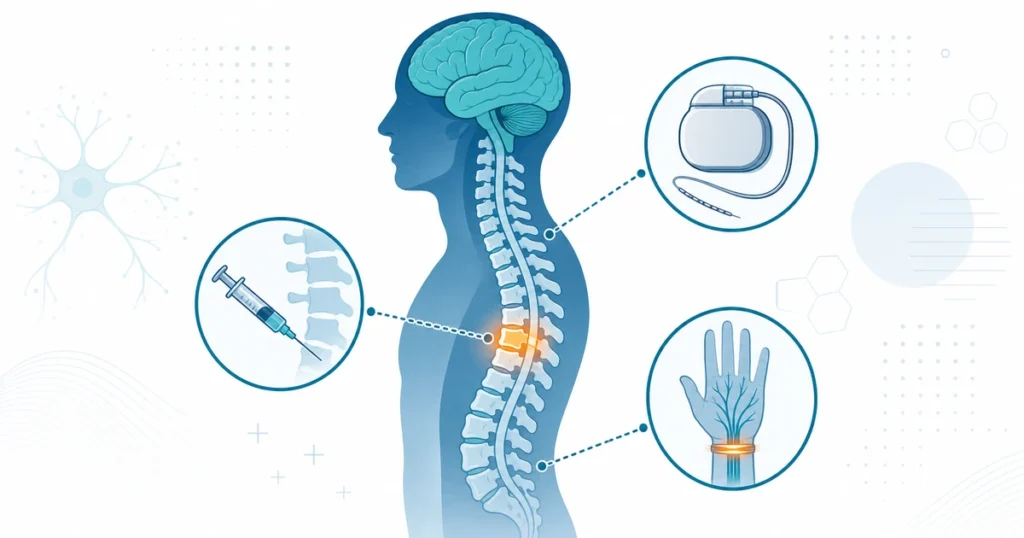
Spinal cord stimulation for chronic pain generates a small, testable family: percutaneous implantation of neurostimulator electrode arrays (63650), laminectomy-based paddle electrode placement (63655), and pulse generator implantation (63685), with revision and removal codes alongside. The exam pattern distinguishes the trial — percutaneous electrodes placed temporarily — from the permanent implant with generator, and the operative note’s language (“trial,” “permanent,” “generator pocket”) makes the call.
Peripheral Nerve Decompression and Repair
The most famous code in the subsection is 64721 — neuroplasty of the median nerve at the carpal tunnel, the open carpal tunnel release. Its trap is its endoscopic twin: endoscopic carpal tunnel release is 29848, which lives in the musculoskeletal endoscopy family, not the nervous system subsection. An exam question that says “endoscopic” has left the 64000s entirely. Other tested decompressions include the ulnar nerve at the elbow (cubital tunnel) and the tarsal tunnel. Nerve repair codes scale from suture of a digital nerve to grafting for larger gaps, and neuroma excision rounds out the family. Global period rules for these procedures follow the Global Surgical Package, and the surgical framing sits within Surgery Coding for Beginners.
The Spinal Injection Families at a Glance
The three injection families are the section’s center of gravity, so keep their differences in one view:
| Family | Code Range | Unit of Service | Imaging | Vignette Signal |
|---|---|---|---|---|
| Interlaminar epidural / subarachnoid | 62320–62327 | Per injection or per catheter placement | Separate codes for with vs without imaging | “Epidural,” “interlaminar,” “loss of resistance” |
| Facet joint / medial branch | 64490–64495 | Per level (first, second, third+ as add-ons) | Included in the codes | “Facet,” “medial branch,” “z-joint” |
| Transforaminal epidural | 64479–64484 | Per level (first, each additional as add-ons) | Included in the codes | “Transforaminal,” “nerve root,” “foramen” |
Every family also splits cervical/thoracic versus lumbar/sacral, and bilateral injections at one level take modifier 50 rather than a second level code. Radiofrequency destruction of the facet nerves (64633–64636) mirrors the facet injection structure at ablation-level work — same per-level logic, same regional split.
Worked Example: A Pain Clinic Encounter
A pain specialist performs fluoroscopically guided facet joint injections at L4-L5 and L5-S1, bilaterally. Build the coding: facet family (the word “facet” excludes the epidural and transforaminal grids), lumbar region, two levels — 64493 for the first lumbar level and add-on 64494 for the second, each with modifier 50 for bilateral injection. Imaging is included in the facet codes, so no guidance code is added. The distractors will offer the transforaminal codes, a fluoroscopy code as a separate line, and a per-injection count of four codes instead of per-level coding — each violating exactly one rule of the family.
Worked Example 2: A Shunt Revision Encounter
A patient with a ventriculoperitoneal shunt placed two years ago for hydrocephalus presents with recurrent headache and vomiting; imaging confirms shunt malfunction, and the neurosurgeon replaces the obstructed valve and distal peritoneal catheter, leaving the ventricular catheter in place. Work the verbs before the codes. Creation (62223) is wrong — nothing new was created. Removal of the complete shunt system without replacement (62256) is wrong — the system stayed in. Removal with replacement of the entire system (62258) overstates the work, because only components were exchanged. Replacement or revision of the shunt valve or distal catheter is 62230, and that is the answer. Two neighboring services complete the family and supply the exam’s distractors. Reprogramming a programmable shunt valve (62252) is a non-incisional service — a bedside adjustment with an external programmer — and a vignette describing an adjustment without an incision never leaves that code. Irrigation or aspiration of the shunt to test patency, performed alone, is likewise a lesser service rather than a revision. The pattern generalizes across the subsection: every device family — shunts, intrathecal pumps, neurostimulators — assigns distinct codes to create, revise, replace, reprogram or refill, and remove, so the operative note’s verb, not its diagnosis line, selects the code. Underline the verb first, every time, and this family’s questions become one-fact items.
How the CPC Exam Tests Nervous System Coding
Pattern 1 — Which Injection Family?
The vignette describes a spinal injection in clinical language. “Interlaminar epidural” routes to 62320–62327, “facet” or “medial branch” to 64490–64495, “transforaminal” to 64479–64484 — then region, levels, and catheter status finish the code.
Pattern 2 — Puncture Purpose
Lumbar puncture, CSF drainage, or blood patch: three adjacent codes split only by purpose. The one clinical fact in the stem is the answer.
Pattern 3 — The Endoscopic Carpal Tunnel Trap
Open release is 64721 in the nervous system; endoscopic release is 29848 in musculoskeletal endoscopy. The single word “endoscopic” moves the answer across subsections.
Pattern 4 — Shunt and Stimulator Verbs
Created, revised, replaced, removed — shunt and neurostimulator families assign a distinct code to each verb, and trial versus permanent placement splits the stimulator codes.
Common Mistakes
Reporting imaging guidance separately with codes that include it. The facet injection codes and the with-imaging epidural codes build fluoroscopic or CT guidance into their descriptions.
Counting injections instead of levels. Facet and transforaminal codes are per level with add-on codes for additional levels — bilateral injections at one level take modifier 50, not a second level code.
Choosing an epidural code for a transforaminal injection. The interlaminar epidural grid and the transforaminal family are separate code sets split by approach to the epidural space.
Coding endoscopic carpal tunnel release with 64721. The open release is 64721; the endoscopic procedure is 29848 in the musculoskeletal section.
Missing the cervical/thoracic versus lumbar/sacral split. Nearly every spinal injection family divides on region — the vignette’s named level (C7, L4) decides it.
Confusing somatic and sympathetic blocks. Stellate ganglion, lumbar sympathetic, and celiac plexus blocks are sympathetic codes, not the somatic nerve family.
Reporting the botulinum toxin drug inside the chemodenervation code. The injection service and the toxin are two codes — CPT for the work, HCPCS J-code for the drug with units calculated by dose.
Final Exam Strategy for This Section
Master three grids and the section is done: the eight-cell epidural grid (region × single/catheter × imaging), the per-level facet and transforaminal families with their included imaging, and the puncture-purpose trio. Add the carpal tunnel open/endoscopic split and the shunt verbs, park it all on one review card beside the CPC Exam Cheat Sheet, and run injection vignettes through the drill loop in the CPC Exam Study Guide. The section rewards coders who slow down for exactly three facts per question — family, region, level count — and punishes everyone who pattern-matches on the word “epidural.”
5 quick questions drawn from this guide. Click an answer to check it — explanations appear as you go.
1. A fluoroscopically guided “transforaminal” injection at the L4 nerve root belongs to code family:
2. Is fluoroscopic guidance separately reported with facet joint injections?
3. Endoscopic carpal tunnel release is coded:
4. Bilateral facet injections at a single level are reported with:
5. An obstructed VP shunt valve and distal catheter are replaced; the ventricular catheter stays. Code:
Frequently Asked Questions
What is the difference between epidural, facet, and transforaminal injections?
Interlaminar epidural injections (62320–62327) deliver medication into the epidural space between the laminae. Facet joint injections (64490–64495) target the paravertebral facet joints and are coded per level. Transforaminal injections (64479–64484) reach the nerve root at the foramen and are also per level. Each family splits by cervical/thoracic versus lumbar/sacral region.
Is fluoroscopic guidance billed separately with facet injections?
No. The facet joint injection codes include imaging guidance in their descriptions, as do the with-imaging epidural codes. Reporting a separate fluoroscopy code with them is unbundling.
What CPT code is carpal tunnel release?
Open carpal tunnel release — neuroplasty of the median nerve at the carpal tunnel — is 64721. Endoscopic carpal tunnel release is 29848, located in the musculoskeletal endoscopy family rather than the nervous system subsection.
What is CPT 62223?
62223 reports creation of a ventriculoperitoneal (VP) shunt, which drains cerebrospinal fluid from the brain’s ventricles to the peritoneal cavity to treat hydrocephalus. Revision, replacement, and removal of shunt systems carry separate codes.
What is a stellate ganglion block?
A stellate ganglion block (64510) is an injection of the sympathetic ganglion at the base of the neck, used for sympathetically mediated pain of the head, neck, and upper extremity. It belongs to the sympathetic block family along with lumbar sympathetic (64520) and celiac plexus (64530) blocks.