Table of Contents
- What is a CPT Code in Medical Terms
- What is a CPT Code Used For
- What is a CPT Code in Medical Billing
- What is a CPT Code for Insurance
- What is a CPT Code in Healthcare — The Three Categories
- What is a CPT Code vs ICD Code — Key Differences
- What is a CPT Code Modifier
- What is a CPT Code for Physical Therapy
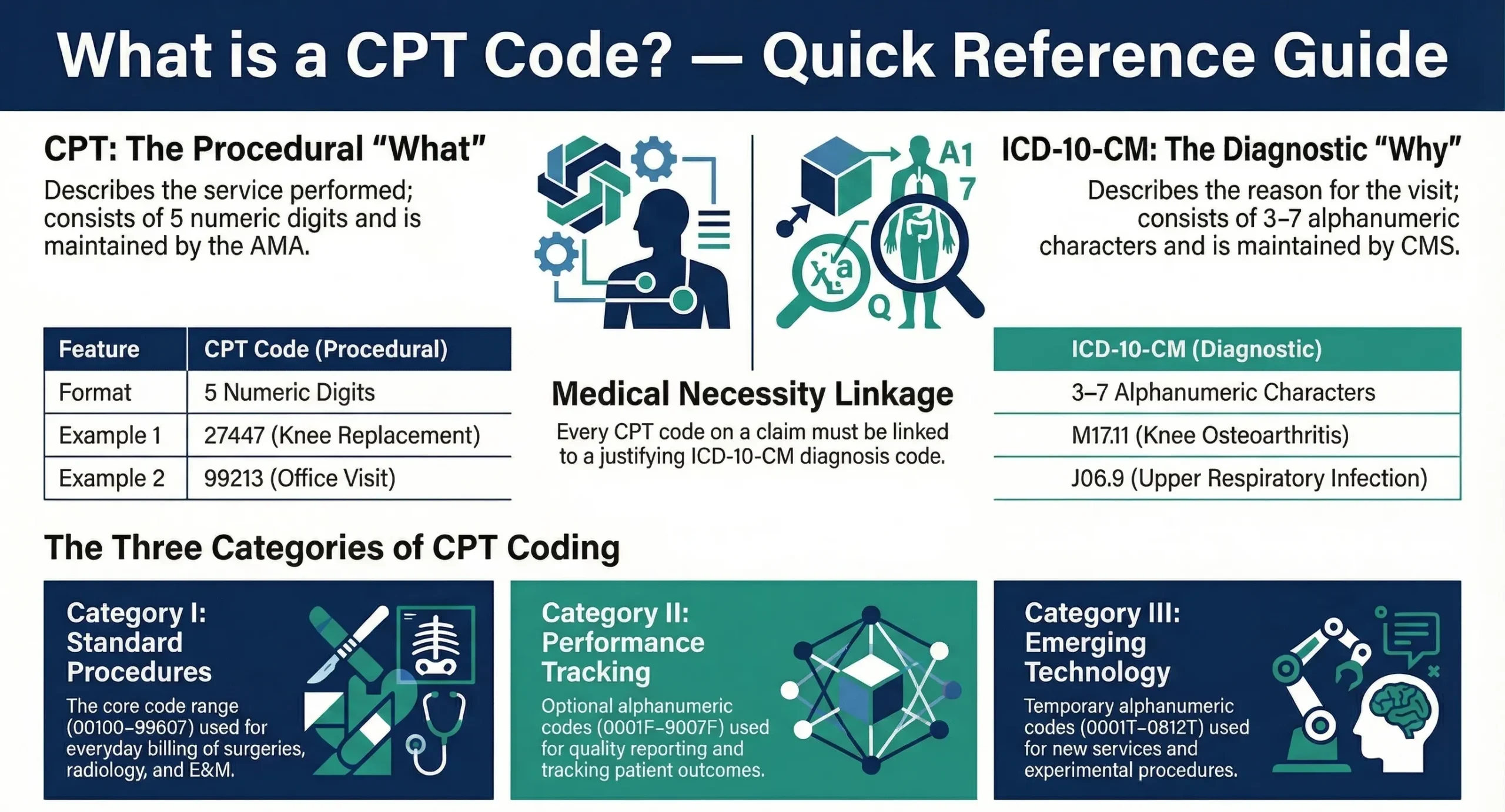
A CPT code is a five-digit numeric code used to describe a medical procedure or service performed by a healthcare provider. CPT stands for Current Procedural Terminology. These codes are the universal language of medical billing — every time a doctor, surgeon, or therapist provides a service, a CPT code is assigned to that service so it can be billed to insurance or paid by the patient.
If you are studying for the CPC exam, working in medical billing, or simply trying to understand a medical bill, understanding what a CPT code is and how it works is the foundation of everything else.
What is a CPT Code in Medical Terms
In medical terms, a CPT code is a standardised five-digit code that identifies a specific medical, surgical, or diagnostic service. The full name — Current Procedural Terminology — tells you exactly what these codes do: they describe current medical procedures using consistent, agreed-upon terminology across the entire US healthcare system.
Every CPT code has three components that make it useful:
- A unique five-digit number — for example, 99213 (established patient office visit) or 27447 (total knee replacement)
- A descriptor — a written description of exactly what the procedure involves
- Guidelines and notes — instructions on when to use the code, what is included, and what cannot be reported separately
Who Uses CPT Codes
- Physicians and surgeons — to document and bill for services provided
- Medical coders — to translate clinical documentation into billable codes
- Medical billers — to submit claims to payers using the assigned codes
- Insurance companies — to process claims and determine reimbursement
- Government programs — Medicare and Medicaid use CPT codes to administer benefits
- Hospitals and clinics — to track services, measure productivity, and report data
What is a CPT Code Used For
CPT codes serve several critical functions in the US healthcare system. Understanding what CPT codes are used for helps explain why accuracy in coding matters so much.
Medical Billing and Reimbursement
The primary use of CPT codes is billing. When a provider performs a service, the medical coder assigns the appropriate CPT code. That code is submitted on a claim to the patient’s insurance company or government payer. The payer looks up the CPT code in their fee schedule, determines the allowable payment amount, and processes the reimbursement. Without accurate CPT codes, providers do not get paid correctly.
Healthcare Data and Research
CPT codes are also used to track which procedures are being performed across the country, how frequently they are used, and what they cost. This data informs healthcare policy decisions, research studies, and quality improvement programs.
Compliance and Auditing
Government agencies and insurance companies use CPT codes to audit claims for fraud, waste, and abuse. Patterns of unusual coding — such as always billing the highest-level E&M code or frequent unbundling — trigger audits. Accurate CPT coding is a compliance requirement, not just a billing preference.
What is a CPT Code in Medical Billing
In medical billing, a CPT code is the procedure identifier on a claim form. Every claim submitted to an insurance company must include at least one CPT code describing the service that was performed, along with at least one ICD-10-CM diagnosis code explaining why the service was medically necessary.
How CPT Codes Flow Through the Billing Process
- Patient receives care — physician documents the service in the medical record
- Medical coder reviews the documentation and assigns the correct CPT code(s)
- Claim is created — CPT codes, diagnosis codes, and patient information are combined into a claim
- Claim is submitted to the insurance company or government payer
- Payer adjudicates — looks up the CPT code, checks the diagnosis, applies the fee schedule
- Payment is issued or the claim is denied with a reason code
- If denied — the biller reviews the denial, corrects coding errors, and resubmits
A single incorrect CPT code can cause a claim to be denied, underpaid, or flagged for audit. This is why medical coding accuracy is a valued skill across every healthcare setting. For a deeper dive into the coding pathway, see our full CPC exam syllabus which maps every CPT section to the exam domains.
What is a CPT Code for Insurance
For insurance purposes, a CPT code tells the insurance company exactly what service was performed so they can determine whether it is a covered benefit and how much to pay. Insurance companies maintain their own fee schedules — a list of allowable payment amounts for each CPT code — and these amounts vary by payer, plan, and geographic region.
How Insurance Uses CPT Codes
- Coverage determination: The insurance plan checks whether the CPT code is a covered service under the patient’s benefits
- Medical necessity: The payer checks whether the diagnosis code (ICD-10-CM) justifies the CPT procedure as medically necessary
- Fee schedule lookup: The payer applies the contracted rate or Medicare fee schedule rate for that CPT code
- Prior authorisation: Some high-cost CPT codes require advance approval from the insurer before the procedure is performed
- Coordination of benefits: When a patient has multiple insurance plans, CPT codes help determine which plan pays first and how much
What Happens When a CPT Code is Wrong on an Insurance Claim
If the wrong CPT code is submitted to insurance, several things can happen — none of them good. The claim may be denied outright, paid at the wrong rate, or flagged for audit. The provider must then correct the code and resubmit, which delays payment and increases administrative work. In some cases, using an incorrect CPT code that results in a higher payment can constitute fraud, even if the error was unintentional.
What is a CPT Code in Healthcare — The Three Categories
In the broader healthcare context, CPT codes are organised into three categories. Each category serves a different purpose and appears in different parts of the CPT code book.
| Category | Code Range | Purpose | Examples |
|---|---|---|---|
| Category I | 00100–99607 | Standard procedures and services — the codes used in everyday medical billing | Surgery, E&M, Radiology, Pathology, Medicine, Anesthesia |
| Category II | 0001F–9007F | Performance measurement tracking codes — optional, used for quality reporting | Blood pressure measurement, tobacco use screening |
| Category III | 0001T–0812T | Emerging technology and experimental procedures — temporary codes for new services | New surgical techniques, telemedicine services |
For the CPC exam and for most medical billing purposes, Category I codes are what you need to master. Category II and III codes appear occasionally but are not the primary focus of the exam.
How CPT Codes Are Structured Within Category I
Category I CPT codes are organised into six main sections:
| Section | Code Range | What It Covers |
|---|---|---|
| Evaluation & Management | 99202–99607 | Office visits, hospital, ED, consultations, preventive care |
| Anesthesia | 00100–01999 | Anaesthesia services for surgical procedures |
| Surgery | 10004–69990 | All surgical procedures by body system — the largest section |
| Radiology | 70010–79999 | Imaging, radiation oncology, nuclear medicine |
| Pathology & Laboratory | 80047–89398 | Lab tests, surgical pathology, cytology |
| Medicine | 90281–99199 | Vaccines, psychiatry, dialysis, ophthalmology, physical therapy |
What is a CPT Code vs ICD Code — Key Differences
This is one of the most common points of confusion for anyone new to medical coding. CPT codes and ICD codes are both used on medical claims, but they describe completely different things. You need both to submit a complete, valid claim.
| Feature | CPT Code | ICD-10-CM Code |
|---|---|---|
| What it describes | The procedure or service performed | The diagnosis or reason for the visit |
| Answers the question | “What did the doctor DO?” | “WHY did the doctor do it?” |
| Maintained by | American Medical Association (AMA) | Centers for Medicare & Medicaid Services (CMS) |
| Format | 5 numeric digits (e.g. 27447) | 3–7 alphanumeric characters (e.g. M17.11) |
| Updated | Annually by AMA (January) | Annually by CMS (October) |
| Example | 27447 — Total knee arthroplasty | M17.11 — Primary osteoarthritis, right knee |
How CPT and ICD Codes Work Together
On a claim, the ICD-10-CM diagnosis code must justify the CPT procedure code. This relationship is called medical necessity. If the diagnosis does not support the procedure — for example, billing a knee replacement (27447) with a diagnosis of a common cold — the claim will be denied. The diagnosis must clinically explain why the procedure was performed.
What is a CPT Code Modifier
A CPT modifier is a two-digit code appended to a CPT code to indicate that the service was somehow different from the standard code description — without changing the code itself. Modifiers provide additional context that affects how a claim is processed and paid.
For example, if a surgeon performs the same procedure on both knees at the same session, modifier -50 (Bilateral Procedure) is added to tell the payer that the procedure was performed bilaterally. The CPT code itself stays the same — only the modifier changes to reflect the circumstances.
We cover every major CPT modifier in detail in our dedicated guide: CPT Modifiers Explained — Complete Guide With Examples. That article covers modifiers 25, 51, 59, 22, 57, 26, TC, and more — with clinical examples for each.
What is a CPT Code for Physical Therapy
In physical therapy, CPT codes are used to bill for evaluation, therapeutic exercises, manual therapy, and other rehabilitation services. Physical therapy CPT codes fall primarily in the Medicine section of the CPT book (97000 series) and the Evaluation and Management section for initial evaluations.
Common Physical Therapy CPT Codes
| CPT Code | Description | Time |
|---|---|---|
| 97110 | Therapeutic exercises — strength, endurance, range of motion | 15 min units |
| 97112 | Neuromuscular re-education — movement, balance, coordination | 15 min units |
| 97140 | Manual therapy — mobilisation, manipulation, traction | 15 min units |
| 97530 | Therapeutic activities — functional tasks and simulated activities | 15 min units |
| 97035 | Ultrasound therapy | 15 min units |
| 97161 | Physical therapy evaluation — low complexity | Per encounter |
| 97162 | Physical therapy evaluation — moderate complexity | Per encounter |
| 97163 | Physical therapy evaluation — high complexity | Per encounter |
Physical therapy codes in the 97000 series are time-based — billed in 15-minute units. Knowing how to calculate units from documented treatment time is a key skill for coders working in rehabilitation settings.
What does CPT stand for in medical coding?
CPT stands for Current Procedural Terminology. It is a standardised system of five-digit codes developed and maintained by the American Medical Association (AMA) to describe medical, surgical, and diagnostic services performed by healthcare providers across the United States.
What is the difference between a CPT code and an ICD code?
A CPT code describes the procedure or service performed — what the doctor did. An ICD-10-CM code describes the diagnosis — why the doctor did it. Both are required on a medical claim. The diagnosis code must establish medical necessity for the procedure code. CPT codes are maintained by the AMA; ICD-10-CM codes are maintained by CMS.
How many CPT codes are there?
There are approximately 10,000 CPT codes in the current edition of the code book, covering Category I (standard procedures), Category II (performance measures), and Category III (emerging technology). The AMA adds, revises, and deletes codes annually, so the exact number changes each year. The CPC exam uses the current edition of the CPT code book.
Can a patient look up their own CPT codes?
Yes. CPT codes appear on Explanation of Benefits (EOB) documents sent by insurance companies after a claim is processed. Patients can look up any CPT code on the AMA website or ask their provider’s billing office to explain what each code represents. Understanding your own medical bill starts with understanding the CPT codes on it.
What is a CPT code used for in physical therapy?
In physical therapy, CPT codes from the 97000 series are used to bill for therapeutic exercises, manual therapy, neuromuscular re-education, and rehabilitation services. Most physical therapy codes are time-based — billed in 15-minute increments. The number of units billed must match the documented treatment time in the patient’s record.