Table of Contents
- Understanding Coding-Specific Stressors
- Managing Productivity Pressure Sustainably
- Physical Health Considerations
- Managing Cognitive Load and Mental Fatigue
- Managing Decision Fatigue
- Taking Genuine Time Off
- Setting Boundaries, Especially When Working Remotely
- Keeping Continuing Education Sustainable
- Building Support Systems
- Recognizing When Something Needs to Change
- Common Mistakes
- Frequently Asked Questions
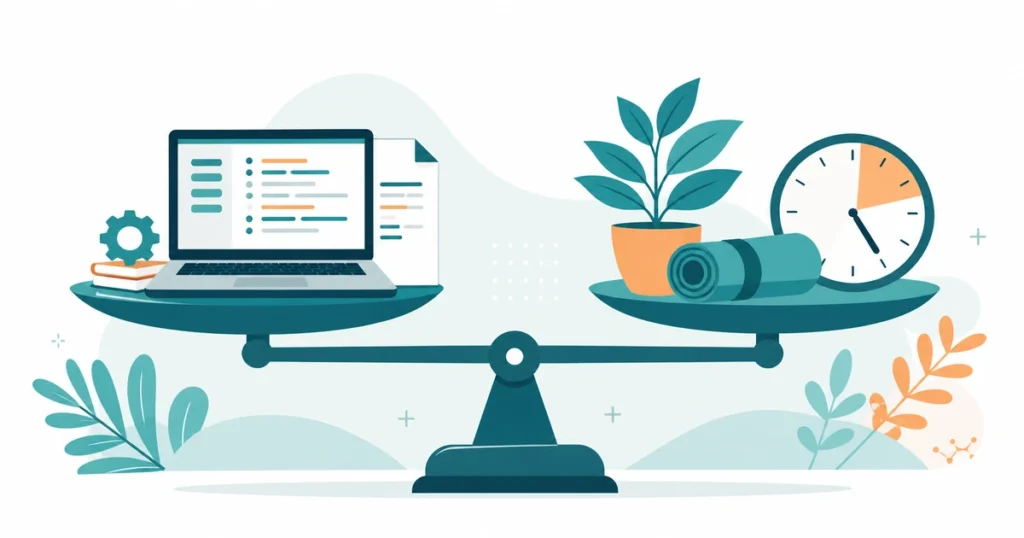
Medical coding combines several features that make sustainable work-life balance a real, ongoing challenge rather than an abstract concern: quota-driven productivity expectations, close attention to detail for hours at a time, largely sedentary desk work, and an obligation to continuously learn new codes and guidelines every year just to stay current. None of these features are inherently unmanageable, but coders who don’t approach them deliberately often find themselves burning out or developing physical strain well before a long career should reasonably produce either. This guide covers the specific stressors coding work introduces, practical approaches to managing productivity pressure sustainably, physical health strategies suited to a desk-based, detail-intensive job, and how to keep continuing education from becoming another source of burnout. For how these considerations shift in a remote setting, see Remote Medical Coding Jobs.
Understanding Coding-Specific Stressors
Coding work carries a distinct combination of pressures that differ from many other office roles.
| Stressor | Source |
|---|---|
| Productivity quotas | Charts-per-hour or similar throughput targets set by the employer |
| Accuracy pressure | Errors can affect reimbursement and compliance, creating pressure to be both fast and precise |
| Repetitive, detail-intensive work | Reviewing dense documentation for extended periods produces mental fatigue |
| Sedentary posture | Long periods at a desk and screen contribute to physical strain over time |
| Continuous learning requirements | Annual code updates and CEU requirements never fully stop, even for experienced coders |
| Isolation (especially remote) | Solitary, independent work can reduce day-to-day social interaction |
Recognizing these as structural features of the job — rather than personal failings when they become difficult — is the first step toward addressing them deliberately rather than simply pushing through and hoping the difficulty resolves on its own.
Managing Productivity Pressure Sustainably
Production quotas are a permanent feature of most coding roles, but the way individual coders relate to that pressure varies considerably. Coders who pace their work deliberately across a shift — rather than working in exhausting bursts followed by periods of catching up — tend to sustain both accuracy and output more consistently over the long run than those who treat every hour as equally intense. Building in short, scheduled breaks throughout the day, rather than only stopping when fatigue has already set in, helps maintain the concentration that accuracy depends on.
It’s also worth distinguishing between a temporarily heavy workload — a backlog after time off, an unusually complex batch of charts — and a chronically unsustainable quota that never lets up. The first is a normal part of the job that most coders can absorb periodically; the second is a structural problem worth raising directly with a supervisor, since chronic unsustainable pressure tends to produce declining accuracy over time regardless of effort, which ultimately works against the employer’s own interests as much as the coder’s.
Physical Health Considerations
Coding is a desk-based job, and the physical toll of prolonged sitting, screen time, and repetitive keyboard and mouse use accumulates gradually rather than announcing itself all at once.
| Strategy | Purpose |
|---|---|
| Ergonomic desk setup (monitor height, chair support, keyboard position) | Reduces strain on the neck, back, and wrists during long work sessions |
| Scheduled movement breaks | Counteracts the health effects of prolonged sitting |
| 20-20-20 rule for eye strain (every 20 minutes, look 20 feet away for 20 seconds) | Reduces digital eye strain from sustained screen focus |
| Wrist and hand stretches | Helps prevent repetitive strain injuries from prolonged typing and clicking |
| Adjustable or standing desk options | Allows position changes throughout the day rather than static sitting |
These strategies are worth treating as a standard part of the job rather than an optional extra, since the physical demands of coding, while less obvious than a physically active job, are real and cumulative over a multi-decade career.
Managing Cognitive Load and Mental Fatigue
Coding requires sustained, detail-oriented attention, and this kind of cognitive demand produces a distinct form of fatigue that isn’t always recognized as work-related exhaustion in the same way physical labor is. Reviewing dense clinical documentation for hours, making precise judgment calls about sequencing and specificity, and maintaining accuracy under a productivity clock all draw on the same limited pool of mental focus. Coders who schedule their most complex or unfamiliar cases for times of day when they’re naturally most alert, and save more routine work for periods when focus is naturally lower, often manage this fatigue more effectively than those who tackle cases in whatever order they arrive.
Taking genuine breaks away from screens — not just a change of task, but an actual pause — also matters more for coding than it might for less detail-intensive work, since the kind of sustained attention coding requires doesn’t fully recover without a real interruption.
Managing Decision Fatigue
Every chart a coder reviews requires a series of judgment calls — which code best reflects the documentation, whether a symptom is integral to a diagnosis or should be coded separately, how to sequence multiple conditions correctly — and each of these small decisions draws on the same finite mental resource. Over the course of a full shift, this steady accumulation of judgment calls can produce a distinct kind of fatigue often called decision fatigue, where later decisions in the day are made with less careful deliberation than earlier ones, even when a coder doesn’t consciously feel tired.
Structuring a shift to front-load the most complex or ambiguous charts earlier in the day, when decision-making capacity is freshest, and reserving simpler or more routine charts for later hours, is one practical way to work with this pattern rather than against it. Similarly, batching similar types of decisions together — reviewing a run of charts from the same specialty or with similar documentation patterns — tends to be less mentally taxing than constantly switching between very different types of cases, since each switch requires re-establishing context.
Taking Genuine Time Off
Coders sometimes hesitate to take full vacation time or fully disconnect during time off, particularly when a backlog is waiting or a productivity quota looms on return. This hesitation is understandable but often counterproductive: research on cognitive performance consistently shows that genuine breaks from detail-intensive work improve accuracy and sustained focus afterward, meaning time away is better understood as an investment in your longer-term output rather than a pure cost against it. Coders who consistently under-use available time off, or who remain partially engaged with work during time meant to be off, tend to experience the cumulative fatigue discussed throughout this guide more acutely over time.
Where possible, planning ahead for backlog coverage before taking time off — communicating with a supervisor about workload distribution rather than simply hoping it resolves itself — makes genuine disconnection easier to achieve without the lingering anxiety of an unaddressed queue.
Setting Boundaries, Especially When Working Remotely
Remote coders face a particular boundary-setting challenge: without the natural signal of leaving an office, the workday can quietly expand well past its intended hours. Establishing a consistent start and stop time, physically stepping away from your workspace at the end of the day, and resisting the urge to check work messages during off hours all help maintain the boundary that an office commute used to provide automatically. This is discussed in more detail in the context of remote work generally in Remote Medical Coding Jobs, but it’s worth emphasizing as a work-life balance issue specifically: the flexibility remote work offers only translates into genuine balance if boundaries are actively maintained rather than assumed.
Keeping Continuing Education Sustainable
CEU requirements and annual code updates are a permanent, recurring obligation for certified coders, discussed in more detail in Getting Certified — CPC and Beyond, and treating this obligation as a single stressful scramble each year tends to be far more draining than spreading it out deliberately. Coders who build a small, regular habit of reading policy updates or working through CEU content throughout the year generally find the requirement far less burdensome than those who leave it until a renewal deadline is imminent. Framing ongoing learning as a normal, incremental part of the job — rather than a separate burden layered on top of it — makes the requirement considerably easier to sustain over a long career.
Building Support Systems
Coding can be a solitary profession day-to-day, particularly for remote coders, and this isolation compounds the other stressors discussed above if left unaddressed. Building relationships with other coders — through professional organizations, online communities, or informal peer connections — provides both practical support for difficult cases and a sense of shared experience that helps normalize the challenges of the job rather than experiencing them in isolation. This is covered in more depth in Professional Networking for Medical Coders. Coders who are also pursuing advancement, discussed in Advancing Your Career, benefit especially from this kind of peer support, since balancing stretch responsibilities against sustainable workload is easier with others who understand the specific pressures involved.
Recognizing When Something Needs to Change
Occasional stress and fatigue are a normal part of any demanding job, but persistent exhaustion, declining accuracy despite consistent effort, or a growing sense of dread about work are signals worth taking seriously rather than pushing through indefinitely. These patterns are often addressable through changes within your control — adjusting your pacing, addressing an ergonomic issue, building better boundaries — but when they persist despite genuine effort to address them, raising the issue directly with a supervisor, or considering whether a different role, specialty, or work arrangement might be a better fit, is a reasonable and often necessary next step rather than a sign of failure.
Common Mistakes
Treating physical strain as an inevitable cost of the job. Ergonomic adjustments and movement breaks meaningfully reduce cumulative physical strain and are worth prioritizing rather than dismissing as unavoidable.
Cramming CEU requirements into a last-minute scramble. Spreading continuing education throughout the year is considerably less stressful than treating it as an annual crisis.
Failing to set boundaries when working remotely. Without the natural cutoff of leaving an office, remote work can quietly expand to fill all available time unless boundaries are actively maintained.
Working through complex or unfamiliar cases during low-focus periods. Scheduling demanding work for your naturally more alert hours, when possible, supports both accuracy and sustainable focus.
Isolating from other coders. Losing professional connection removes both practical support for difficult cases and the perspective that normalizes the shared challenges of the job.
Under-using available time off. Skipping or only partially disconnecting during vacation time removes one of the most effective tools available for recovering from sustained detail-intensive work, and tends to compound fatigue over the course of a career rather than preventing it.
5 quick questions drawn from this guide. Click an answer to check it — explanations appear as you go.
1. A coding-specific stressor is:
2. A sustainable way to manage productivity pressure is to:
3. To reduce physical strain, remote coders should prioritize:
4. A healthy boundary for remote coders is:
5. Recognizing that “something needs to change” might look like:
Frequently Asked Questions
Why is work-life balance particularly challenging in medical coding?
Coding combines productivity quotas, sustained detail-oriented attention, sedentary desk work, and ongoing continuing education requirements, all of which accumulate gradually and can lead to burnout or physical strain if not managed deliberately.
How can coders reduce physical strain from desk-based work?
An ergonomic desk setup, scheduled movement breaks, the 20-20-20 rule for eye strain, wrist and hand stretches, and adjustable seating or standing options all help reduce the cumulative physical toll of prolonged sitting and screen time.
How can remote coders maintain better work-life boundaries?
Establishing a consistent start and stop time, physically stepping away from the workspace at day’s end, and avoiding work messages during off hours all help replace the natural boundary that commuting to an office used to provide.
How can I keep up with CEU requirements without burning out?
Spreading continuing education throughout the year in small, regular increments is far less draining than treating it as a single stressful scramble before a renewal deadline. Building it into a normal, ongoing habit makes it considerably more sustainable.
What should I do if I’m consistently exhausted despite trying to manage my workload?
Persistent exhaustion or declining accuracy despite genuine effort are signals worth taking seriously. Raising the issue directly with a supervisor, or considering whether a different role, specialty, or work arrangement might better fit your needs, is a reasonable next step rather than something to push through indefinitely.