Table of Contents
- The Four Hypertension Categories
- I10 — Essential Hypertension
- The Presumed Causal Relationship Rule
- I11 — Hypertensive Heart Disease
- I12 — Hypertensive Chronic Kidney Disease
- I13 — Hypertensive Heart Disease and CKD
- Hypertensive Crisis — I16
- Step-by-Step Coding Decision Tree
- Common CPC Exam Scenarios
- Frequently Asked Questions
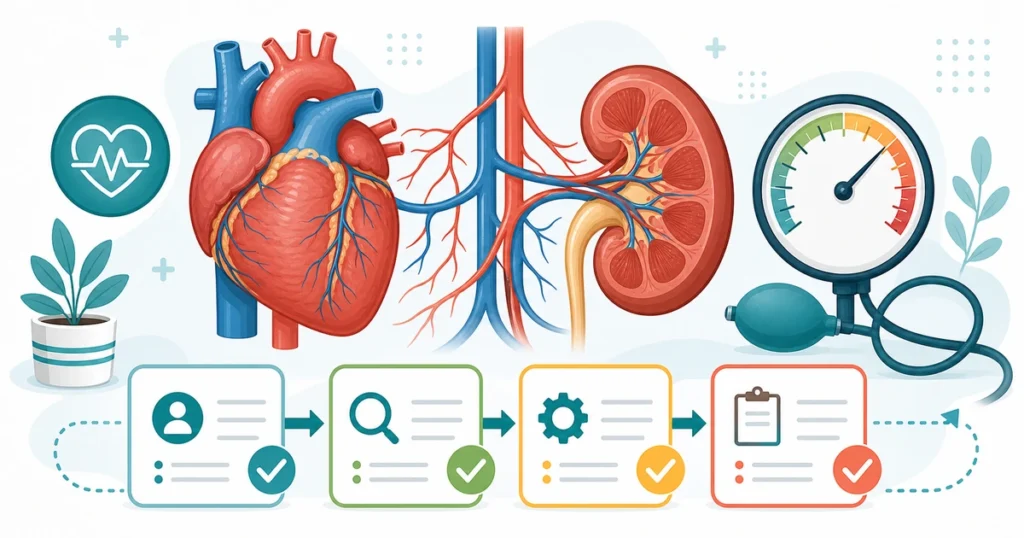
Hypertension is one of the most commonly coded conditions in outpatient and inpatient settings. It is also one of the most error-prone areas in ICD-10-CM because coding hypertension is not just about finding the right blood pressure code — it requires understanding presumed causal relationships, combination code logic, and sequencing rules that trip up even experienced coders.
This guide walks through every hypertension category in ICD-10-CM, explains the unique “presumed causal” relationship rule, and provides clinical scenarios that mirror CPC exam questions.
The Four Hypertension Categories
ICD-10-CM organizes hypertension into four main categories. Each one covers a different combination of conditions. The category a patient falls into depends on what coexisting conditions are documented alongside the hypertension:
| Category | Description | When to Use |
|---|---|---|
| I10 | Essential (primary) hypertension | Hypertension alone — no documented heart disease or CKD |
| I11.- | Hypertensive heart disease | Hypertension WITH heart disease (heart failure, cardiomyopathy, cardiomegaly) |
| I12.- | Hypertensive chronic kidney disease | Hypertension WITH CKD stages 1–5 or ESRD |
| I13.- | Hypertensive heart disease and CKD | Hypertension WITH BOTH heart disease AND CKD |
Understanding ICD-10 code structure helps you see how these categories branch. I10 is a standalone code (no additional characters needed). I11, I12, and I13 require additional characters to specify severity and whether heart failure is present.
I10 — Essential Hypertension
I10 is the simplest hypertension code. Use it when the patient has primary (essential) hypertension with no documented heart disease or chronic kidney disease. I10 covers high blood pressure, hypertension NOS, hypertensive vascular disease, and systemic arterial hypertension.
I10 does NOT require additional characters — it is a complete, billable code on its own.
What I10 Does Not Cover
I10 does not cover secondary hypertension (I15.-), hypertensive crisis (I16.-), pulmonary hypertension (I27.-), or hypertension complicating pregnancy (O10–O16). These are separate categories with their own coding rules. Secondary hypertension always requires two codes — one from I15 for the hypertension, and one for the underlying cause.
The Presumed Causal Relationship Rule
This is the single most important rule in hypertension coding — and one of the most frequently tested concepts on the CPC exam.
When a patient has both hypertension and heart disease, ICD-10-CM presumes the heart disease is caused by the hypertension. You do not need the provider to explicitly state “hypertensive heart disease” in the documentation. If the patient has hypertension and heart failure documented in the same record, assign a code from I11.- unless the provider specifically documents that the heart condition is NOT due to hypertension.
The same presumed-causal relationship applies to hypertension and chronic kidney disease. If a patient has both hypertension and CKD stages 1–5 or ESRD, assign a code from I12.- regardless of whether the provider states a causal link.
When the Relationship Is NOT Assumed
There are specific conditions where the causal link is NOT presumed, even when documented alongside hypertension:
| Condition | Presumed Causal? | Documentation Required |
|---|---|---|
| Heart failure / cardiomyopathy / cardiomegaly | Yes — always presumed | No explicit link needed |
| CKD stages 1–5 / ESRD | Yes — always presumed | No explicit link needed |
| Cerebrovascular disease (stroke, TIA) | No — NOT presumed | Provider must document “due to hypertension” |
| Peripheral vascular disease | No — NOT presumed | Provider must document causal link |
| Retinopathy | No — NOT presumed | Provider must document causal link |
| Acute kidney injury (AKI) | No — NOT presumed | AKI is not CKD; I12 does not apply |
Clinical Example: A patient record documents “hypertension, heart failure, and stroke.” For the hypertension and heart failure, the causal relationship IS presumed — code I11.0 (hypertensive heart disease with heart failure). For the stroke, the provider must explicitly document “stroke due to hypertension” or “hypertensive cerebrovascular disease” before you can code a causal relationship. Without that documentation, code the stroke and hypertension separately.
I11 — Hypertensive Heart Disease
Category I11 is used when a patient has hypertension with heart disease (heart failure, cardiomyopathy, or cardiomegaly). It has two subcategories:
| Code | Description | Additional Code Required |
|---|---|---|
| I11.0 | Hypertensive heart disease with heart failure | Yes — assign an additional code from I50.- to specify the type of heart failure |
| I11.9 | Hypertensive heart disease without heart failure | No additional code needed |
The distinction between I11.0 and I11.9 hinges entirely on whether heart failure is present. If the patient has hypertension with cardiomegaly but no heart failure, use I11.9. If heart failure is documented, use I11.0 plus a code from I50.- to specify systolic, diastolic, or combined heart failure and whether it is acute, chronic, or acute on chronic.
Clinical Example: Patient documented with “hypertension and diastolic heart failure, chronic.” Correct coding: I11.0 (hypertensive heart disease with heart failure) + I50.32 (chronic diastolic heart failure).
I12 — Hypertensive Chronic Kidney Disease
Category I12 is used when a patient has both hypertension and CKD. The causal relationship is presumed — no explicit link is needed in the documentation. I12 has two subcategories based on CKD stage:
| Code | CKD Stage | Additional Code Required |
|---|---|---|
| I12.0 | Stage 5 CKD or ESRD | Yes — N18.5 (stage 5) or N18.6 (ESRD) |
| I12.9 | Stages 1–4 or unspecified | Yes — N18.1 through N18.4, or N18.9 |
Always assign an additional code from N18.- to identify the stage of CKD. This is a mandatory “use additional code” instruction. Without the N18 code, the claim is incomplete and does not communicate CKD severity.
Clinical Example: Patient has hypertension and stage 3 CKD documented. Correct coding: I12.9 (hypertensive CKD, stage 1–4) + N18.3 (CKD stage 3, unspecified). There is no need for the provider to say “CKD due to hypertension” — the causal relationship is presumed.
I13 — Hypertensive Heart Disease and CKD
Category I13 is the most complex hypertension category. It applies when a patient has all three conditions: hypertension, heart disease, and CKD. The presumed causal relationship applies to both the heart disease and the CKD.
| Code | Description | Additional Codes Required |
|---|---|---|
| I13.0 | Hypertensive heart and CKD with heart failure AND CKD stage 1–4 or unspecified | I50.- (heart failure type) + N18.1–N18.4 or N18.9 |
| I13.10 | Hypertensive heart and CKD WITHOUT heart failure, CKD stage 1–4 or unspecified | N18.1–N18.4 or N18.9 |
| I13.11 | Hypertensive heart and CKD WITHOUT heart failure, CKD stage 5 or ESRD | N18.5 or N18.6 |
| I13.2 | Hypertensive heart and CKD WITH heart failure AND CKD stage 5 or ESRD | I50.- (heart failure type) + N18.5 or N18.6 |
I13 codes require up to two additional codes — one from I50.- if heart failure is present, and one from N18.- for CKD stage. This means a single patient encounter may require three codes total to fully describe the hypertensive condition.
Clinical Example: Patient documented with hypertension, systolic heart failure (acute on chronic), and stage 4 CKD. Correct coding: I13.0 (hypertensive heart and CKD with heart failure, stage 1–4) + I50.23 (acute on chronic systolic heart failure) + N18.4 (CKD stage 4).
Hypertensive Crisis — I16
Hypertensive crisis is coded separately from chronic hypertension. Category I16 covers acute, dangerously elevated blood pressure:
I16.0 is hypertensive urgency — severely elevated blood pressure without acute organ damage. I16.1 is hypertensive emergency — severely elevated blood pressure WITH acute organ damage (encephalopathy, pulmonary edema, acute kidney injury, aortic dissection). I16.9 is hypertensive crisis, unspecified.
For all I16 codes, assign an additional code to identify the underlying chronic hypertension type (I10, I11, I12, or I13). This follows ICD-10 sequencing rules — the acute condition (I16) is listed first, followed by the chronic condition.
Step-by-Step Coding Decision Tree
Follow this sequence when coding hypertension:
Step 1 — Confirm the type of hypertension. Is it primary/essential or secondary? If secondary, use I15.- with a code for the underlying cause. If primary, continue.
Step 2 — Check for coexisting heart disease. Is heart failure, cardiomyopathy, or cardiomegaly documented? If no heart disease and no CKD → use I10. If heart disease present → continue to step 3.
Step 3 — Check for coexisting CKD. If heart disease present but no CKD → use I11 (with I50.- if heart failure). If CKD present but no heart disease → use I12 (with N18.-). If BOTH heart disease AND CKD → use I13 (with I50.- if heart failure AND N18.-).
Step 4 — Check for hypertensive crisis. If acute blood pressure crisis is documented → assign I16.0 or I16.1 first, then the appropriate chronic hypertension code.
Step 5 — Assign all required additional codes. For I50.- (heart failure type and acuity) and N18.- (CKD stage). Missing either additional code results in an incomplete claim.
Common CPC Exam Scenarios
Understanding how these rules apply to exam-style questions is critical. Here are patterns that appear frequently:
Scenario 1: Patient with hypertension and congestive heart failure. Answer: I11.0 + I50.9 (heart failure unspecified). The causal relationship is presumed — no documentation of “hypertensive heart failure” is needed.
Scenario 2: Patient with hypertension and stage 3 CKD and systolic heart failure. Answer: I13.0 + I50.20 + N18.3. All three conditions are present, so I13 is correct. Both I50 and N18 additional codes are required.
Scenario 3: Patient with hypertension and a stroke. Answer: I10 + the stroke code (I63.-). The causal relationship between hypertension and cerebrovascular disease is NOT presumed. Unless the provider documents “hypertensive cerebrovascular disease,” code them separately.
Scenario 4: Patient with hypertension and acute kidney injury. Answer: I10 + N17.- (AKI code). The presumed causal rule does NOT apply to AKI — only to CKD. Code separately.
Hypertension coding connects directly to other ICD-10 concepts. Understanding combination codes helps explain why I11, I12, and I13 exist — they capture multiple conditions in a single code. The diabetes coding guide covers similar presumed-causal logic for diabetic complications. And knowing when to assign a code for signs and symptoms versus an established diagnosis is important when blood pressure readings are elevated but no hypertension diagnosis has been confirmed.
5 quick questions drawn from this guide. Click an answer to check it — explanations appear as you go.
1. Uncomplicated essential hypertension is reported with:
2. ICD-10-CM presumes a causal relationship (without physician linkage) between hypertension and:
3. A patient has hypertensive heart disease WITH heart failure. You report I11.0 plus:
4. Hypertension with both heart disease and CKD is captured by which category?
5. Hypertensive crisis, unspecified (urgency vs emergency not stated) is coded as:
Frequently Asked Questions
Does ICD-10 presume hypertension causes heart disease?
Yes. ICD-10-CM Official Guidelines Section I.C.9.a states that when hypertension and heart disease (heart failure, cardiomyopathy, cardiomegaly) are both documented, a causal relationship is presumed. Assign a code from I11.- without requiring the provider to explicitly state “hypertensive heart disease.” This presumed relationship also applies to hypertension and CKD.
When do I use I13 instead of both I11 and I12?
Whenever a patient has hypertension with BOTH heart disease AND chronic kidney disease, use I13 — not I11 plus I12. I13 is a single combination category that captures all three conditions. Assigning I11 and I12 together is incorrect coding.
Can I use I12 for acute kidney injury?
No. I12 (hypertensive chronic kidney disease) applies only to chronic kidney disease — codes N18.1 through N18.6 and N18.9. Acute kidney injury (N17.-) is not included in the presumed causal relationship. Code acute kidney injury and hypertension separately.
What is the difference between hypertensive urgency and hypertensive emergency?
Hypertensive urgency (I16.0) is severely elevated blood pressure WITHOUT evidence of acute organ damage. Hypertensive emergency (I16.1) is severely elevated blood pressure WITH acute organ damage such as encephalopathy, acute heart failure, acute kidney injury, or aortic dissection. Both require an additional code identifying the underlying chronic hypertension type.
How do I code hypertension controlled by medication?
A patient whose hypertension is controlled by medication still has hypertension. Assign the appropriate hypertension code (I10, I11, I12, or I13) regardless of whether the condition is currently controlled. The fact that medication is managing the blood pressure does not change the diagnosis or the code assignment.