Table of Contents
Pathophysiology is the study of how disease disrupts normal body function — the mechanism connecting a cause to the signs, symptoms, and complications a physician documents. Medical coders are not expected to diagnose or treat disease, but understanding pathophysiology at a foundational level dramatically improves coding accuracy, because it explains why certain codes are linked together, why some combination codes exist, and why documentation contains the specific clinical language it does.
A coder who understands that diabetes damages small blood vessels over time will immediately understand why diabetic retinopathy, diabetic nephropathy, and diabetic neuropathy are all coded as related complications rather than coincidental, unconnected findings. This guide covers the core pathophysiology concepts that show up repeatedly across coding scenarios, connecting disease mechanism to coding logic. For terminology that pairs directly with this content, see Medical Terminology for Coders, and for lab-based confirmation of disease processes, see Laboratory Values for Medical Coders.
Why Pathophysiology Matters for Coding
Three areas of coding depend directly on understanding disease mechanism.
Combination codes. ICD-10-CM’s combination codes exist because certain conditions are mechanistically linked — one condition causes or strongly predisposes to another. Understanding the mechanism (why diabetes damages kidneys, why hypertension strains the heart) explains why the “with” convention assumes causation for these specific pairings and not others.
Etiology/manifestation coding. When one condition (the etiology) produces a downstream effect in a different organ system (the manifestation), understanding the causal pathway explains why the etiology is always sequenced first — it is the origin of the pathological process, and the manifestation cannot exist without it.
Recognizing integral vs non-integral symptoms. Understanding a disease’s typical clinical picture allows a coder to recognize when a symptom is an expected part of that disease process (and therefore not separately coded) versus when it represents something unexpected or unrelated (and therefore should be coded additionally). This connects directly to the rules in Coding Signs and Symptoms.
Core Disease Mechanisms
Inflammation
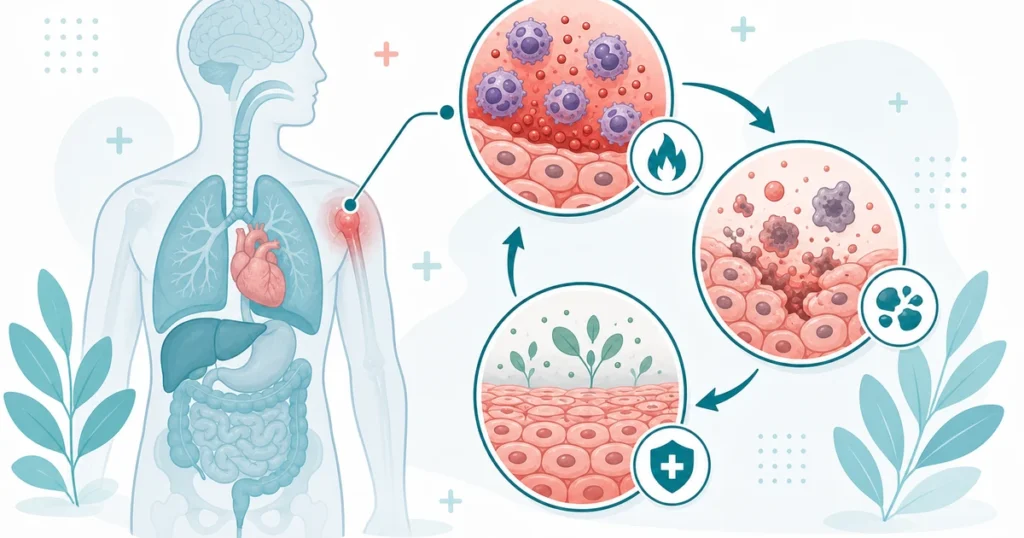
Inflammation is the body’s protective response to injury, infection, or irritation, and it is the underlying mechanism behind an enormous number of conditions coders encounter — from arthritis to appendicitis to pneumonia. The classic signs of inflammation are redness, heat, swelling, pain, and loss of function, produced by increased blood flow, immune cell activity, and fluid accumulation at the site of injury.
Acute inflammation is short-term and typically resolves once the triggering cause is removed. Chronic inflammation persists over time and is associated with a different category of conditions — autoimmune diseases, chronic degenerative conditions, and long-term tissue damage. Recognizing whether documentation describes an acute or chronic inflammatory process often determines which code family applies, since ICD-10-CM frequently distinguishes acute from chronic forms of the same condition with entirely separate codes.
Ischemia and Infarction
Ischemia is a restriction of blood supply to tissue, causing a shortage of oxygen and nutrients needed for cellular function. If ischemia persists long enough, the affected tissue dies — this tissue death is called infarction. This mechanism underlies some of the most common and serious conditions in medicine.
Myocardial infarction (heart attack) occurs when blood flow to part of the heart muscle is blocked, typically by a clot in a coronary artery, causing that portion of heart muscle to die. Cerebral infarction (ischemic stroke) occurs through the same mechanism in the brain. Bowel ischemia occurs when blood flow to a segment of intestine is compromised, which can progress to bowel infarction if not treated. Understanding that ischemia precedes infarction — and that infarction represents irreversible tissue death — helps a coder recognize the clinical severity implied by each term and select the correspondingly specific code.
Neoplasia
Neoplasia refers to abnormal, uncontrolled cell growth, forming a mass of tissue called a neoplasm or tumor. Neoplasms are classified along a spectrum of behavior that directly maps to ICD-10-CM’s Table of Neoplasms:
| Behavior | Pathophysiologic Meaning |
|---|---|
| Benign | Grows locally, does not invade surrounding tissue or spread to distant sites |
| Malignant (primary) | Invades surrounding tissue and has the capacity to spread; cancerous at the site of origin |
| Malignant (secondary/metastatic) | Cancer cells that have spread from the primary site to a distant location |
| Carcinoma in situ | Abnormal cells present but have not yet invaded through the basement membrane into surrounding tissue |
| Uncertain behavior | Pathologist cannot determine, based on tissue examination, whether the growth is benign or malignant |
Understanding that “metastatic” describes cancer that has spread — and that a metastatic tumor is coded as a secondary malignancy at the new site while still being the same cancer cell type as the primary — prevents a common coding error of treating a metastasis as an unrelated new primary cancer.
Infection and the Immune Response
An infection occurs when a pathogenic organism (bacteria, virus, fungus, or parasite) invades the body and begins to multiply, triggering an immune response. The severity and systemic spread of that immune response is what distinguishes a localized infection from sepsis, discussed in detail in Sepsis Coding Guidelines. A localized infection stays confined to a specific site (such as a wound or the urinary tract), while sepsis represents the infection triggering a dysregulated, body-wide inflammatory response that can damage organs far from the original infection site.
Autoimmune Disease
Autoimmune disease occurs when the immune system mistakenly attacks the body’s own healthy tissue, treating it as a foreign threat. Rheumatoid arthritis (immune attack on joint tissue), type 1 diabetes (immune destruction of insulin-producing pancreatic cells), Hashimoto’s thyroiditis (immune attack on the thyroid), and systemic lupus erythematosus (immune attack affecting multiple organ systems) are all autoimmune processes. Recognizing the autoimmune mechanism explains why these conditions often have multi-system manifestations requiring several codes to capture the full clinical picture, and why they are frequently chronic, progressive conditions rather than single, resolvable events.
Degenerative Processes
Degenerative conditions involve the progressive breakdown of tissue structure and function over time, typically associated with aging, mechanical wear, or chronic metabolic stress. Osteoarthritis (breakdown of joint cartilage), degenerative disc disease (breakdown of intervertebral discs), and many forms of dementia are degenerative processes. Unlike acute injuries, degenerative conditions develop gradually, which is why documentation for these conditions often uses terms like “chronic,” “progressive,” or specific staging language reflecting the degree of tissue breakdown.
Compensation and Decompensation
Many chronic conditions progress through a compensated stage, where the body adapts and maintains normal function despite underlying damage, before eventually reaching a decompensated stage, where those adaptive mechanisms fail and clinical symptoms become apparent. Heart failure is the clearest example: the heart initially compensates for reduced pumping efficiency by enlarging and increasing heart rate, maintaining adequate circulation without symptoms. Once these compensatory mechanisms are exhausted, the patient develops the fluid overload, shortness of breath, and fatigue characteristic of decompensated heart failure. Recognizing whether documentation describes a compensated or decompensated (acute) state is directly relevant to code selection, since many chronic conditions have distinct codes reflecting acuity and severity along this same compensated-to-decompensated spectrum.
How Pathophysiology Explains Combination Coding
Understanding mechanism directly explains several of ICD-10-CM’s most heavily tested combination code relationships.
Diabetes and Its Complications
Chronically elevated blood glucose damages blood vessels and nerves throughout the body over time. This single mechanism explains why diabetes has so many distinct combination codes: damaged small blood vessels in the kidney produce diabetic nephropathy; damaged small blood vessels in the eye produce diabetic retinopathy; damaged nerves produce diabetic neuropathy. Because all of these complications stem from the same underlying vascular and neural damage caused by diabetes, ICD-10-CM assumes a causal link between diabetes and these complications under the “with” convention.
Hypertension and Organ Damage
Chronically elevated blood pressure forces the heart to work harder and damages the delicate blood vessels within the kidneys over time. This mechanism explains the combination codes for hypertensive heart disease and hypertensive kidney disease — the elevated pressure is understood to be a direct contributing cause of the organ damage, which is why ICD-10-CM assumes the relationship rather than requiring the physician to explicitly state causation.
How Pathophysiology Explains Etiology/Manifestation Coding
Etiology/manifestation coding requires sequencing the underlying disease first and the resulting condition in a different body system second. This structure mirrors the actual disease mechanism: the etiology is the origin of the pathological process, and the manifestation is a downstream effect that cannot occur without it. Parkinson’s disease (a neurodegenerative disorder affecting movement) can cause dementia as a downstream neurological manifestation — the dementia arises from and depends on the underlying Parkinson’s pathology, which is exactly why the etiology is always coded first.
Pathophysiology and Provider Queries
Understanding disease mechanism also sharpens a coder’s sense of when documentation is incomplete rather than simply brief. If a chart documents diabetes and a finding of protein in the urine but never states a causal relationship, a coder who understands the vascular mechanism behind diabetic nephropathy will recognize that the missing link may be a documentation gap worth querying, rather than two unrelated findings to be coded independently. This is a recurring theme across pathophysiology-driven coding: the mechanism does not let a coder assign a code the provider hasn’t documented, but it does sharpen the coder’s eye for when a query is likely to be useful.
How the CPC Exam Tests Pathophysiology Knowledge
Pattern 1 — Recognizing Related vs Unrelated Conditions
The scenario presents a patient with a chronic disease and a second condition, and you must determine whether the second condition is a plausible complication of the first (based on the disease mechanism) or an unrelated finding that should be coded separately.
Pattern 2 — Ischemia vs Infarction Terminology
The question distinguishes between a reversible ischemic process and irreversible tissue death (infarction), testing whether you understand that these represent different points along the same pathological process and may require different codes reflecting severity.
Pattern 3 — Neoplasm Behavior Classification
The scenario describes a tumor’s pathology report, and you must select the correct Table of Neoplasms column (malignant primary, malignant secondary, benign, uncertain behavior) based on the described behavior.
Pattern 4 — Acute vs Chronic Disease Process
The question presents a condition and asks you to identify whether the documentation describes an acute or chronic process, which determines the correct code family, since many conditions have entirely separate codes for acute and chronic presentations.
Common Mistakes
Treating all comorbidities as unrelated. When two conditions are documented together, consider whether one is a plausible pathophysiologic complication of the other before assuming they require separate, unrelated codes.
Confusing metastatic cancer with a new primary cancer. A metastasis is the same cancer, spread to a new location — it is coded as a secondary malignant neoplasm of the new site, not as a new primary cancer of that organ.
Missing the acute/chronic distinction. Many conditions have separate codes for acute and chronic presentations. Failing to note which the documentation describes can lead to selecting a code that misrepresents the disease stage.
Assuming autoimmune conditions only affect one organ system. Autoimmune diseases frequently have systemic effects. Documentation describing multiple organ involvement in a patient with a known autoimmune condition may require multiple codes to fully capture the clinical picture.
Overlooking the mechanism behind combination codes. Coders sometimes memorize which conditions have combination codes without understanding why. Understanding the underlying disease mechanism makes it easier to recognize new or less familiar combination code relationships.
5 quick questions drawn from this guide. Click an answer to check it — explanations appear as you go.
1. Understanding pathophysiology helps a coder primarily to:
2. Diabetes with chronic kidney disease is a classic example of:
3. Etiology/manifestation pairs exist because:
4. When documentation is unclear about a causal link the guidelines do not presume, the coder should:
5. Sepsis is important pathophysiologically because it represents:
Frequently Asked Questions
Why do medical coders need to understand pathophysiology?
Understanding pathophysiology helps coders recognize which conditions are mechanistically related (supporting combination codes and etiology/manifestation sequencing), distinguish integral symptoms from unrelated findings, and interpret clinical documentation accurately. Coders are not diagnosing disease, but understanding disease mechanism improves the accuracy and confidence of code selection.
What is the difference between ischemia and infarction?
Ischemia is a restriction of blood flow to tissue, causing an oxygen and nutrient shortage. Infarction is the death of tissue that results when ischemia is severe or prolonged enough. Ischemia represents a potentially reversible state, while infarction represents irreversible tissue death, and these distinct stages are often reflected in different diagnosis codes.
How does pathophysiology explain ICD-10-CM combination codes?
Combination codes exist for condition pairs that are mechanistically linked — one condition is understood to directly cause or contribute to the other. Diabetes damaging blood vessels and nerves over time explains why diabetic complications have combination codes, and hypertension straining the heart and kidneys explains hypertensive heart and kidney disease combination codes.
What is the difference between a benign and malignant neoplasm?
A benign neoplasm grows locally and does not invade surrounding tissue or spread to distant sites. A malignant neoplasm invades surrounding tissue and has the capacity to spread to other parts of the body, a process called metastasis. This behavioral distinction determines which column of the ICD-10-CM Table of Neoplasms applies.
What is an autoimmune disease?
An autoimmune disease occurs when the immune system mistakenly attacks the body’s own healthy tissue. Examples include rheumatoid arthritis, type 1 diabetes, and systemic lupus erythematosus. These conditions are often chronic and can affect multiple organ systems, which may require multiple codes to fully capture the documented clinical picture.