Table of Contents
- Bone Classification
- Joint Classification
- Muscle Tissue and Terminology
- Movement Terminology
- How Musculoskeletal Anatomy Connects to CPT Code Selection
- How Musculoskeletal Terminology Connects to ICD-10-CM
- Spinal Anatomy Within the Musculoskeletal System
- Common Musculoskeletal Conditions and Coding Context
- How the CPC Exam Tests Musculoskeletal Anatomy
- Common Mistakes
- Frequently Asked Questions
The musculoskeletal system — bones, joints, muscles, tendons, and ligaments — generates the single largest volume of CPT surgical codes of any body system, spanning code range 20100–29999 in the CPT manual. Fracture care, joint procedures, tendon repairs, and spinal surgery all depend on precise musculoskeletal terminology, and a coder who does not understand the anatomical relationships between bones, joints, and soft tissue structures will consistently misread operative reports and select the wrong code.
This guide builds the anatomical and terminological foundation coders need before tackling specific musculoskeletal procedure coding. It covers bone classification, joint types, muscle and movement terminology, and how these concepts connect to both CPT and ICD-10-CM code selection. For the broader CPT surgical framework this system sits within, see Surgery Coding for Beginners, and for fracture-specific ICD-10-CM rules, see Injury Coding and 7th Characters.
Bone Classification
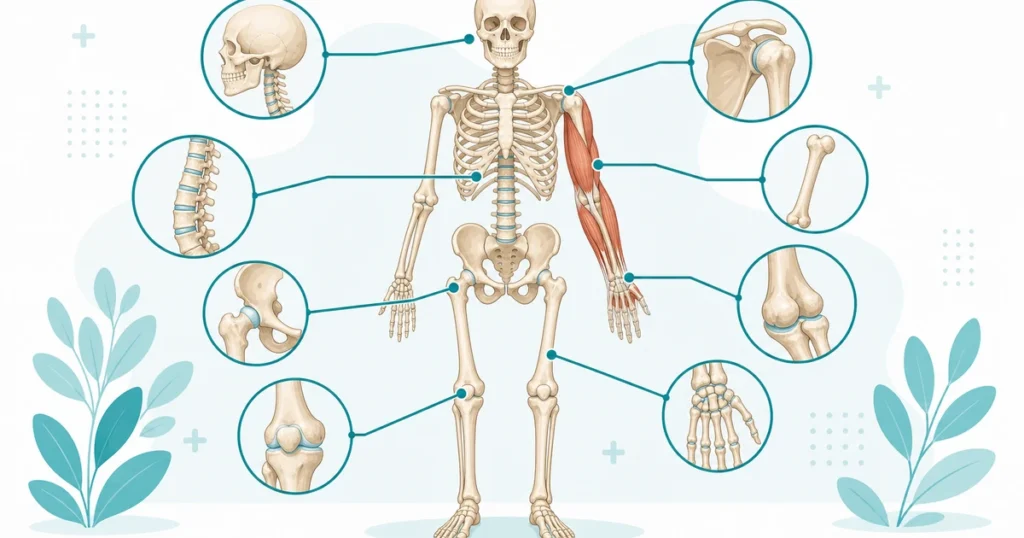
The skeleton is organized into two major divisions: the axial skeleton (skull, vertebral column, rib cage — the central axis of the body) and the appendicular skeleton (the limbs, plus the shoulder and pelvic girdles that attach them to the axial skeleton). Bones themselves are classified by shape, which correlates with their function.
| Bone Type | Shape Characteristic | Examples | Function |
|---|---|---|---|
| Long bones | Longer than wide, with a shaft and two ends | Femur, humerus, tibia, radius | Support and leverage for movement |
| Short bones | Roughly cube-shaped | Carpals (wrist), tarsals (ankle) | Stability with limited movement |
| Flat bones | Thin, flattened, often curved | Skull, sternum, ribs, scapula | Protection of internal organs, broad muscle attachment |
| Irregular bones | Complex, non-uniform shape | Vertebrae, facial bones | Specialized functions specific to location |
| Sesamoid bones | Small, embedded within a tendon | Patella (kneecap) | Reduces friction, improves mechanical advantage |
Parts of a Long Bone
Long bone anatomy has its own specific vocabulary that appears constantly in fracture documentation. The diaphysis is the shaft, or main body, of the bone. The epiphysis is each rounded end of the bone, covered in articular cartilage where it meets another bone at a joint. The metaphysis is the transitional region between the diaphysis and epiphysis, and in growing children contains the growth plate (epiphyseal plate). The periosteum is the fibrous membrane covering the outer surface of the bone, and the medullary cavity is the hollow center of the shaft containing bone marrow.
Fracture location terminology — proximal, mid-shaft, distal — maps directly onto this anatomy and is a required element for selecting the correct ICD-10-CM fracture code, which is specific not just to the bone but often to the exact anatomical segment involved.
Joint Classification
Joints (articulations) are the points where two or more bones meet, and they are classified by the degree of movement they permit.
| Joint Type | Movement | Examples |
|---|---|---|
| Synarthrosis (fibrous) | Immovable or nearly immovable | Skull sutures |
| Amphiarthrosis (cartilaginous) | Slightly movable | Vertebral discs, pubic symphysis |
| Diarthrosis (synovial) | Freely movable | Knee, shoulder, hip, elbow |
Synovial Joint Subtypes
Because synovial joints are the type most commonly involved in surgical procedures, coders benefit from knowing their subtypes. Ball-and-socket joints (hip, shoulder) allow movement in nearly all directions. Hinge joints (elbow, knee) allow movement primarily in one plane, like a door hinge. Pivot joints (the joint between the first and second cervical vertebrae) allow rotational movement. Saddle joints (the base of the thumb) allow movement in two planes. Gliding joints (between carpal bones in the wrist) allow limited sliding movement. Condyloid joints (the wrist joint between the radius and carpal bones) allow movement in two planes without rotation.
Every synovial joint is enclosed by a joint capsule and lined with synovial membrane, which produces synovial fluid to lubricate the joint and reduce friction between the articulating bone surfaces.
Muscle Tissue and Terminology
Skeletal muscle is the tissue type responsible for voluntary movement, and it attaches to bone through tendons. Each skeletal muscle has an origin (the more fixed attachment point, usually proximal) and an insertion (the attachment point that moves, usually distal) — understanding origin and insertion helps explain how a given muscle produces a specific movement when it contracts.
Tendons connect muscle to bone. Ligaments connect bone to bone, providing joint stability. This distinction is one of the most frequently confused terms among new coders and directly affects code selection, since CPT has entirely separate code families for tendon repair versus ligament repair — using the wrong term when interpreting an operative note leads directly to the wrong procedure code.
Bursae are small, fluid-filled sacs located near joints that reduce friction between bone, tendon, and skin. Bursitis (inflammation of a bursa) and the procedures used to treat it (aspiration, injection) are distinct from joint or tendon procedures and require their own specific code selection.
Movement Terminology
Musculoskeletal movement terms describe the direction and type of motion at a joint, and operative reports frequently use this vocabulary to describe both the injury mechanism and the surgical correction performed.
| Movement Term | Description | Opposite Term |
|---|---|---|
| Flexion | Decreasing the angle at a joint (bending) | Extension |
| Extension | Increasing the angle at a joint (straightening) | Flexion |
| Abduction | Moving a limb away from the midline | Adduction |
| Adduction | Moving a limb toward the midline | Abduction |
| Rotation | Turning a bone around its own axis | — |
| Circumduction | Circular movement combining flexion, extension, abduction, and adduction | — |
| Pronation | Rotating the forearm so the palm faces down/back | Supination |
| Supination | Rotating the forearm so the palm faces up/forward | Pronation |
| Dorsiflexion | Flexing the ankle so the foot points upward | Plantarflexion |
| Plantarflexion | Extending the ankle so the foot points downward | Dorsiflexion |
| Inversion | Turning the sole of the foot inward | Eversion |
| Eversion | Turning the sole of the foot outward | Inversion |
How Musculoskeletal Anatomy Connects to CPT Code Selection
The Musculoskeletal System subsection of CPT (20100–29999) is organized primarily by anatomical site, moving generally from head to foot, and secondarily by procedure type within each site (incision, excision, repair/revision/reconstruction, fracture and dislocation treatment, arthrodesis, amputation, and application of casts/splints/strapping). Correctly identifying the anatomical site described in the operative note — down to the specific bone, joint, or soft tissue structure — is the first and most important step in code selection.
Fracture Care Terminology
Fracture treatment codes distinguish between closed treatment (the fracture site is not surgically opened) and open treatment (the fracture site is surgically exposed), and further by whether manipulation (reduction — realigning the bone) was performed. Closed treatment without manipulation is used when the fracture is already in acceptable alignment; closed treatment with manipulation involves realigning the bone without opening the skin; open treatment involves surgical exposure of the fracture site, often with internal fixation using plates, screws, or rods. Understanding this terminology is essential because it determines the correct CPT code family — the anatomical site alone is not sufficient.
Arthroscopy vs Open Joint Procedures
Many joint procedures can be performed either through an open incision or arthroscopically (through small portals using a camera and specialized instruments). CPT maintains largely separate code sets for arthroscopic versus open approaches to the same joint, so correctly identifying the approach documented in the operative note is essential to selecting the correct code family.
How Musculoskeletal Terminology Connects to ICD-10-CM
Musculoskeletal ICD-10-CM codes live primarily in Chapter 13 (Diseases of the musculoskeletal system and connective tissue, M00–M99) for non-traumatic conditions such as osteoarthritis, and in Chapter 19 (Injury, poisoning, S00–T88) for fractures and other traumatic injuries. Fracture codes require the 7th character extension to indicate the encounter type (initial, subsequent, sequela) and often the healing status (routine healing, delayed healing, nonunion, malunion) for subsequent encounters.
Laterality (right, left, sometimes unspecified) is also required for the majority of musculoskeletal codes, since paired bones and joints exist on both sides of the body. Correctly applying directional and laterality terminology is therefore directly tied to accurate musculoskeletal ICD-10-CM coding.
Spinal Anatomy Within the Musculoskeletal System
The vertebral column deserves separate attention because it combines bone, joint, and soft tissue anatomy in a way that generates its own distinct CPT code family, separate from general musculoskeletal procedures. The spine is divided into five regions: cervical (7 vertebrae, C1–C7), thoracic (12 vertebrae, T1–T12), lumbar (5 vertebrae, L1–L5), sacral (5 fused vertebrae forming the sacrum), and coccygeal (the fused coccyx, or tailbone).
Between most vertebrae sits an intervertebral disc, a cartilaginous cushion made of a tough outer ring (annulus fibrosus) surrounding a gel-like center (nucleus pulposus). A herniated disc occurs when the nucleus pulposus pushes through a tear in the annulus fibrosus, potentially compressing an adjacent spinal nerve root and causing radiculopathy. Spinal fusion procedures (arthrodesis), disc procedures, and decompression procedures are all coded based on the specific vertebral level, the number of levels involved, and the surgical approach — anterior, posterior, or a combined approach — making precise level and approach documentation essential to correct code selection.
Common Musculoskeletal Conditions and Coding Context
| Condition | Structure Affected | ICD-10-CM Category |
|---|---|---|
| Osteoarthritis | Joint cartilage | M15–M19 |
| Rheumatoid arthritis | Joint synovium (autoimmune) | M05–M06 |
| Osteoporosis | Bone density | M80–M81 |
| Rotator cuff tear | Shoulder tendons | M75.1- |
| Fracture (traumatic) | Bone | S02, S12, S22, S32, S42, S52, S62, S72, S82, S92 (by site) |
A key distinction for coders is that osteoarthritis is a degenerative joint condition coded from the musculoskeletal chapter (M00–M99), while a traumatic fracture is coded from the injury chapter (S00–T88) and requires the 7th character extension. The same joint or bone can appear in either chapter depending on whether the condition is degenerative or traumatic in origin — the coder must read the documentation carefully to determine which applies.
How the CPC Exam Tests Musculoskeletal Anatomy
Pattern 1 — Tendon vs Ligament Identification
The scenario describes a repair procedure and the answer choices include both tendon repair and ligament repair codes. You must correctly identify from the documentation whether the structure repaired connects muscle to bone (tendon) or bone to bone (ligament) to select the correct code family.
Pattern 2 — Movement Term Application
The question describes a specific joint movement and asks you to identify the correct terminology (flexion, abduction, pronation, and so on), or asks which movement is being restored or restricted based on a described injury or procedure.
Pattern 3 — Open vs Closed Fracture Treatment
The scenario describes a fracture treatment procedure with specific details about whether the skin was surgically opened and whether manipulation was performed. The correct answer depends on correctly classifying the treatment type from these details, not just identifying the fractured bone.
Pattern 4 — Anatomical Site Precision
The question provides an operative note referencing a specific bone segment (proximal, mid-shaft, distal) or a specific joint subtype, and the answer choices include codes for adjacent but distinct anatomical sites. The correct answer requires precisely matching the documented site to the code description.
Common Mistakes
Confusing tendons and ligaments. Tendons connect muscle to bone; ligaments connect bone to bone. CPT has separate code families for each, so misreading which structure was repaired leads directly to an incorrect code.
Assuming all joint injuries are the same regardless of approach. Arthroscopic and open procedures on the same joint typically use different CPT code ranges. The approach documented in the operative note must be verified before code selection.
Overlooking bone segment specificity. Many fracture codes require identifying not just the bone but the specific segment (proximal, shaft, distal) involved. Selecting a code for the wrong segment of the correct bone is still an incorrect code.
Missing required laterality. Because most musculoskeletal structures are paired, laterality (right, left) is required for the majority of ICD-10-CM musculoskeletal and fracture codes. Omitting or defaulting laterality when it is documented is a common accuracy error.
Confusing open and closed fracture treatment with open and closed fracture type. Whether a fracture is “open” or “closed” (referring to whether the skin is broken at the injury) is a different concept from whether the treatment approach is “open” or “closed” (referring to whether the fracture site is surgically exposed during repair). These are related but distinct classifications that are often conflated.
5 quick questions drawn from this guide. Click an answer to check it — explanations appear as you go.
1. Which is an example of a long bone?
2. A joint that allows the widest range of motion (e.g., shoulder, hip) is a:
3. The movement that decreases the angle of a joint is:
4. Which term means “moving a limb away from the midline of the body”?
5. The tissue connecting muscle to bone is a:
Frequently Asked Questions
What is the difference between a tendon and a ligament?
A tendon connects muscle to bone and transmits the force of muscle contraction to produce movement. A ligament connects bone to bone and provides stability at a joint. This distinction matters for coding because CPT maintains separate code families for tendon repair and ligament repair, so correctly identifying the structure in an operative note is essential to selecting the right code.
What are the parts of a long bone?
A long bone consists of the diaphysis (the shaft), the epiphysis (each rounded end covered in cartilage), the metaphysis (the transitional region between shaft and end, containing the growth plate in children), the periosteum (the outer fibrous covering), and the medullary cavity (the hollow center containing bone marrow). Fracture location terminology is based directly on these anatomical segments.
What types of joints allow the most movement?
Synovial joints (diarthroses) allow the most movement and include subtypes such as ball-and-socket joints (hip, shoulder), hinge joints (elbow, knee), and pivot joints. Fibrous joints (synarthroses) like skull sutures are essentially immovable, and cartilaginous joints (amphiarthroses) like vertebral discs allow only slight movement.
What is the difference between open and closed fracture treatment?
Closed treatment means the fracture site is not surgically opened, whether or not manipulation (realignment) is performed. Open treatment means the fracture site is surgically exposed, often to place internal fixation hardware such as plates, screws, or rods. This is a different concept from whether the fracture itself is open or closed, which refers to whether the skin was broken at the time of injury.
Why does laterality matter in musculoskeletal ICD-10-CM coding?
Most musculoskeletal structures — bones, joints, and connective tissue — exist as paired structures on the right and left sides of the body. ICD-10-CM requires a laterality character (right, left, sometimes unspecified) for the majority of these codes, so accurately identifying and reporting the correct side documented is essential for correct code assignment.