Table of Contents
- The Endocrine Glands and Their Functions
- Common Endocrine Disorders and Their ICD-10-CM Chapter
- Diabetes Mellitus — The Most Heavily Tested Endocrine Topic
- Thyroid Disorders and Coding Considerations
- Adrenal Disorders and Coding Considerations
- How Endocrine and Diabetes Topics Are Tested on the CPC Exam
- Common Mistakes
- Frequently Asked Questions
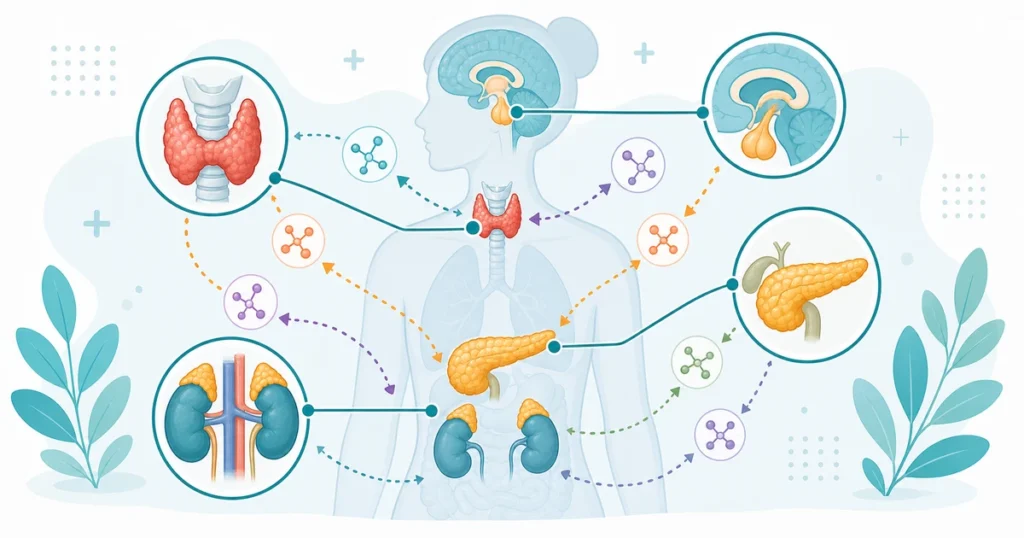
The endocrine system is a network of glands that produce and secrete hormones directly into the bloodstream, regulating nearly every major process in the body — metabolism, growth, reproduction, stress response, and blood sugar control. For medical coders, understanding endocrine anatomy is not academic background; it is the foundation for correctly interpreting documentation about thyroid disorders, adrenal conditions, pituitary dysfunction, and — most heavily tested of all — diabetes mellitus.
Endocrine conditions generate some of the most frequently coded diagnoses in outpatient medicine, and diabetes alone accounts for a significant share of CPC exam questions related to ICD-10-CM combination coding. This guide covers the major endocrine glands and their disorders, then walks through the complete diabetes coding framework in detail. For the complete rule set on diabetes-specific combination codes, see Diabetes Coding in ICD-10-CM.
The Endocrine Glands and Their Functions
The endocrine system consists of several glands distributed throughout the body, each producing specific hormones that regulate distinct physiological processes.
| Gland | Location | Key Hormones | Primary Function |
|---|---|---|---|
| Pituitary | Base of the brain | Growth hormone, TSH, ACTH, prolactin, ADH | “Master gland” — regulates other endocrine glands |
| Thyroid | Anterior neck | T3, T4, calcitonin | Regulates metabolism and calcium balance |
| Parathyroid | Behind the thyroid (4 glands) | Parathyroid hormone (PTH) | Regulates calcium levels in the blood |
| Adrenal | Superior to each kidney | Cortisol, aldosterone, epinephrine, norepinephrine | Stress response, blood pressure, electrolyte balance |
| Pancreas (endocrine portion) | Behind the stomach | Insulin, glucagon | Regulates blood glucose |
| Pineal | Center of the brain | Melatonin | Regulates sleep-wake cycles |
| Gonads (ovaries/testes) | Pelvis / scrotum | Estrogen, progesterone, testosterone | Reproductive function and secondary sex characteristics |
The Pituitary Gland — The Master Regulator
The pituitary gland sits at the base of the brain and is often called the “master gland” because it produces hormones that control the activity of most other endocrine glands. The anterior pituitary produces thyroid-stimulating hormone (TSH), adrenocorticotropic hormone (ACTH), growth hormone, and prolactin. The posterior pituitary releases antidiuretic hormone (ADH) and oxytocin, which are actually produced by the hypothalamus and stored in the posterior pituitary.
Pituitary dysfunction can cause a cascade of downstream endocrine problems because so many other glands depend on pituitary signaling. A pituitary tumor, for example, can disrupt TSH production and secondarily cause thyroid dysfunction — a relationship coders must recognize when sequencing related conditions.
The Thyroid Gland
The thyroid, located in the anterior neck, produces triiodothyronine (T3) and thyroxine (T4), which regulate the body’s metabolic rate. Hyperthyroidism (excess thyroid hormone) causes symptoms like weight loss, rapid heart rate, and heat intolerance. Hypothyroidism (insufficient thyroid hormone) causes weight gain, fatigue, and cold intolerance. The thyroid also produces calcitonin, which helps regulate blood calcium levels alongside the parathyroid glands.
The Parathyroid Glands
Four small parathyroid glands sit behind the thyroid and produce parathyroid hormone (PTH), which raises blood calcium levels by stimulating calcium release from bone, increasing calcium absorption in the intestines, and reducing calcium loss in the kidneys. Hyperparathyroidism causes elevated calcium (hypercalcemia), while hypoparathyroidism causes low calcium (hypocalcemia).
The Adrenal Glands
Each adrenal gland sits atop a kidney and has two distinct regions: the adrenal cortex, which produces cortisol (stress hormone), aldosterone (regulates sodium and potassium balance), and small amounts of sex hormones; and the adrenal medulla, which produces epinephrine and norepinephrine (the “fight or flight” hormones). Addison’s disease results from adrenal cortex insufficiency, while Cushing’s syndrome results from excess cortisol.
The Pancreas
The pancreas has both an endocrine and an exocrine function. The endocrine portion consists of clusters of cells called the islets of Langerhans, which contain beta cells that produce insulin and alpha cells that produce glucagon. Insulin lowers blood glucose by allowing cells to absorb glucose from the bloodstream; glucagon raises blood glucose by triggering the liver to release stored glucose. This insulin/glucagon balance is the physiological basis for diabetes mellitus, which occurs when this system fails to regulate blood glucose properly.
Common Endocrine Disorders and Their ICD-10-CM Chapter
Endocrine, nutritional, and metabolic diseases are classified in ICD-10-CM Chapter 4, categories E00–E89. This chapter includes thyroid disorders, diabetes, disorders of other glands, and metabolic disorders such as obesity and malnutrition. For the general rules governing how any ICD-10-CM chapter is structured and applied, see ICD-10-CM Coding Guidelines.
| Condition | ICD-10-CM Category | Affected Gland |
|---|---|---|
| Hyperthyroidism | E05.- | Thyroid |
| Hypothyroidism | E03.- | Thyroid |
| Diabetes mellitus | E08–E13 | Pancreas |
| Cushing’s syndrome | E24.- | Adrenal cortex |
| Addison’s disease | E27.1–E27.2 | Adrenal cortex |
| Hyperparathyroidism | E21.- | Parathyroid |
| Hypoparathyroidism | E20.- | Parathyroid |
| Obesity | E66.- | Metabolic (not gland-specific) |
Diabetes Mellitus — The Most Heavily Tested Endocrine Topic
Diabetes coding deserves separate, detailed treatment because of how frequently it appears on the CPC exam and because of its unique combination code structure.
The Diabetes Category Structure
ICD-10-CM organizes diabetes into distinct categories based on the type and cause of the diabetes:
| Category | Diabetes Type |
|---|---|
| E08 | Diabetes mellitus due to underlying condition |
| E09 | Drug or chemical induced diabetes mellitus |
| E10 | Type 1 diabetes mellitus |
| E11 | Type 2 diabetes mellitus |
| E13 | Other specified diabetes mellitus |
Note that E12 (gestational diabetes classified elsewhere) does not exist as a category in the current classification — gestational diabetes is coded from category O24 within the pregnancy chapter, not the endocrine chapter, because it is considered a complication of pregnancy rather than a primary endocrine disorder.
Combination Codes Are the Rule, Not the Exception
Diabetes coding relies heavily on combination codes that capture both the type of diabetes and any associated complication in a single code. This is one of the most consistently tested coding conventions on the CPC exam. Within each diabetes category, the code structure branches by complication type — for example, E11.21 (Type 2 diabetes with diabetic nephropathy), E11.22 (Type 2 diabetes with diabetic chronic kidney disease), E11.40 (Type 2 diabetes with diabetic neuropathy, unspecified), and E11.65 (Type 2 diabetes with hyperglycemia).
The word “with” in these code titles carries an assumed causal relationship under ICD-10-CM conventions — when documentation states a patient has diabetes and a complication that is capable of being caused by diabetes, the coder may assume the relationship even if the physician does not explicitly state “diabetic” before the complication, unless the documentation states the conditions are unrelated. This is one of the clearest applications of the combination code philosophy that runs throughout ICD-10-CM. For the complete rule set on diabetes combination codes, sequencing multiple complications, and required additional codes, see Diabetes Coding in ICD-10-CM.
Diabetes documentation also relies on precise clinical vocabulary — polyuria, polydipsia, glycosuria, ketoacidosis — that coders should be comfortable recognizing on sight. For a broader review of clinical vocabulary that appears across body systems, see Medical Terminology for Coders.
Type 1 vs Type 2 — The Documentation Distinction
Type 1 diabetes results from autoimmune destruction of the insulin-producing beta cells, requiring insulin therapy for survival. Type 2 diabetes results from insulin resistance and relative insulin deficiency and may be managed with lifestyle changes, oral medications, or insulin. A critical coding point: the use of insulin does NOT automatically mean a patient has Type 1 diabetes. Many Type 2 diabetics use insulin as part of their treatment regimen. If documentation does not specify the type, ICD-10-CM guidelines default to Type 2 unless the patient is stated to be insulin-dependent Type 1 or the documentation otherwise indicates Type 1.
When a Type 2 diabetic patient uses insulin, an additional code Z79.4 (Long-term (current) use of insulin) is required to indicate ongoing insulin dependence — this code is not used for Type 1 diabetics, since insulin use is inherent to that diagnosis.
Multiple Complications Require Multiple Codes
When a diabetic patient has more than one documented complication, the coder assigns as many diabetes combination codes as necessary to fully capture the clinical picture — there is no single code that captures every possible complication simultaneously. A patient with documented diabetic nephropathy and diabetic retinopathy requires two separate combination codes, one for each complication category.
Thyroid Disorders and Coding Considerations
Thyroid disorders are coded based on the specific dysfunction documented — hyperthyroidism, hypothyroidism, thyroiditis, goiter, or thyroid nodules — and further specified by cause when known (such as toxic nodular goiter or Hashimoto’s thyroiditis, an autoimmune form of hypothyroidism). Postsurgical hypothyroidism, resulting from thyroidectomy, has its own specific code (E89.0) distinct from other forms of hypothyroidism, because it reflects an iatrogenic (treatment-caused) condition rather than a primary disease process.
Adrenal Disorders and Coding Considerations
Adrenal disorders are coded by the specific dysfunction and, where relevant, the causative mechanism. Cushing’s syndrome codes are further specified by cause — pituitary-dependent (Cushing’s disease), adrenal, ectopic ACTH-producing tumor, or drug-induced (from long-term corticosteroid therapy). Recognizing that Cushing’s syndrome can be iatrogenic — caused by a patient’s own long-term steroid medication rather than a tumor — is an important distinction that changes which code and which additional codes (such as a code identifying the causative drug) are required.
How Endocrine and Diabetes Topics Are Tested on the CPC Exam
Pattern 1 — Diabetes Combination Code Selection
The scenario describes a diabetic patient with one or more documented complications, and the answer choices present different combinations of diabetes codes with or without the complication captured. The correct answer uses the combination code that fully captures the type and the complication in one code, rather than reporting the diabetes and complication as two separate, unrelated codes.
Pattern 2 — Insulin Use vs Diabetes Type
The scenario describes a diabetic patient who uses insulin, and the answer choices include a Type 1 code option and a Type 2 code with Z79.4 option. Insulin use alone does not indicate Type 1 — the correct answer depends on what type is actually documented, and Z79.4 is added only for Type 2 patients on long-term insulin.
Pattern 3 — Assumed Causal Relationship (“With”)
The scenario documents a diabetic patient with a condition that could be a diabetic complication, without the physician explicitly linking the two. The correct answer applies the “with” convention and codes them as related unless the documentation states otherwise.
Pattern 4 — Endocrine Gland Identification
The question describes a hormone or a clinical presentation (excess cortisol, low PTH, elevated T4) and asks which gland is responsible or which condition is being described. This tests basic anatomical and physiological knowledge of the endocrine system.
Common Mistakes
Assuming insulin use means Type 1 diabetes. This is the single most common error in diabetes coding. Many Type 2 patients require insulin. Code based on the documented type, and add Z79.4 for Type 2 patients on long-term insulin.
Failing to code every documented complication. Diabetes with multiple complications requires multiple combination codes — one code per complication category. Omitting a documented complication under-codes the encounter.
Not applying the “with” convention. When a diabetic patient has a condition that can be causally linked to diabetes, code it as a diabetic complication unless documentation explicitly states the conditions are unrelated.
Coding gestational diabetes from the endocrine chapter. Gestational diabetes is coded from category O24 in the obstetric chapter, not from E08–E13, because it is classified as a pregnancy complication rather than a primary endocrine disease.
Missing the postsurgical hypothyroidism distinction. Hypothyroidism resulting from thyroid surgery has its own specific code (E89.0), separate from other hypothyroidism codes, because it reflects a different underlying cause (iatrogenic rather than primary disease).
5 quick questions drawn from this guide. Click an answer to check it — explanations appear as you go.
1. The most heavily tested endocrine topic on the CPC exam is:
2. The thyroid gland primarily regulates:
3. Graves’ disease causes:
4. The adrenal glands are located:
5. Endocrine, nutritional, and metabolic diseases classify to ICD-10-CM Chapter:
Frequently Asked Questions
What glands make up the endocrine system?
The major endocrine glands are the pituitary, thyroid, parathyroid glands, adrenal glands, the endocrine portion of the pancreas, the pineal gland, and the gonads (ovaries or testes). Each produces hormones that regulate specific body functions, and the pituitary gland is often called the “master gland” because it controls the activity of several other glands.
Does using insulin mean a patient has Type 1 diabetes?
No. Many patients with Type 2 diabetes also use insulin as part of their treatment. Diabetes type is coded based on what is specifically documented, not based on insulin use alone. When a Type 2 diabetic patient is on long-term insulin, code Z79.4 is added to indicate this, but the diabetes itself remains coded as Type 2.
What is a diabetes combination code?
A diabetes combination code captures both the type of diabetes and an associated complication in a single ICD-10-CM code, such as E11.22 for Type 2 diabetes with diabetic chronic kidney disease. When a patient has multiple documented complications, multiple combination codes are assigned — one for each complication category.
Which gland regulates blood calcium levels?
The parathyroid glands, four small glands located behind the thyroid, produce parathyroid hormone (PTH), which raises blood calcium by stimulating bone calcium release, increasing intestinal absorption, and reducing kidney calcium loss. The thyroid also contributes to calcium regulation through calcitonin, which works in the opposite direction of PTH.
Is gestational diabetes coded from the endocrine chapter?
No. Gestational diabetes is coded from category O24 within the pregnancy, childbirth, and the puerperium chapter, not from the E08–E13 diabetes categories in the endocrine chapter. This is because gestational diabetes is classified as a complication of pregnancy rather than a primary endocrine disorder.