Table of Contents
- Wound Repair Hierarchy: Understanding the Coding Ladder
- Recipient Site Preparation (CPT 15002–15005)
- 1. Free Skin Grafts (CPT 15040–15278)
- 2. Pedicle Flaps (CPT 15570–15738)
- 3. Free Flaps with Microvascular Anastomosis (CPT 15756–15758)
- Adjacent Tissue Transfer/Rearrangement (CPT 14000–14350)
- Donor Site Closure
- Real-World Coding Examples
- CPC Exam Tips for Skin Graft Coding
- Summary
- Frequently Asked Questions
Skin graft and flap procedures are among the most commonly tested integumentary topics on the CPC exam. Understanding the distinction between free skin grafts, pedicle flaps, and free flaps is essential for accurate coding. This comprehensive guide breaks down the key CPT code ranges, coding rules, and exam-tested scenarios for skin grafts and tissue transfer procedures.
Wound Repair Hierarchy: Understanding the Coding Ladder
Before diving into skin grafts and flaps, it is essential to understand the wound repair hierarchy. CPT organizes wound closure methods from simplest to most complex:
- Simple repair (12001–12021): Single-layer closure with sutures, staples, or tissue adhesive. Superficial wounds involving only epidermis, dermis, or subcutaneous tissue.
- Intermediate repair (12031–12057): Layered closure requiring deeper tissue repair or extensive cleaning/debridement of heavily contaminated wounds.
- Complex repair (13100–13160): Requires more than layered closure — involves scar revision, debridement of complicated lacerations, extensive undermining, stents, or retention sutures.
- Adjacent tissue transfer/rearrangement (14000–14350): Moving adjacent skin and subcutaneous tissue to cover a defect. Includes Z-plasty, W-plasty, V-Y plasty, rotation flaps, and advancement flaps.
- Skin grafts (15002–15278): Detaching skin from a donor site and placing it on a recipient site.
- Flap procedures (15570–15758): More complex tissue transfers involving pedicle flaps and free flaps with microvascular anastomosis.
Key Coding Rule: When a wound is closed using a method higher on this hierarchy, the simpler methods used during the same procedure are typically bundled into the more complex code. For example, if a wound requires a skin graft, you do not additionally report simple or intermediate repair codes for the closure of the graft edges — that work is included in the graft code.
Recipient Site Preparation (CPT 15002–15005)
Before placing a skin graft or flap, the recipient site (wound bed) often requires surgical preparation. CPT provides separate codes for this work:
- 15002: Surgical preparation or creation of recipient site by excision of open wounds, burn eschar, or scar; first 100 sq cm or each additional 100 sq cm of body area of infants and children, or first 100 sq cm of trunk, arms, legs.
- 15003: Each additional 100 sq cm (add-on to 15002).
- 15004: Surgical preparation; first 100 sq cm for face, scalp, eyelids, mouth, neck, ears, orbits, genitalia, hands, feet, and/or multiple digits.
- 15005: Each additional 100 sq cm (add-on to 15004).
Important: Recipient site preparation codes are reported separately only when the wound bed requires surgical preparation before graft or flap placement. Simple cleaning or wound irrigation is not separately reportable. The operative report must describe excision, debridement to viable tissue, or creation of a fresh wound bed.
1. Free Skin Grafts (CPT 15040–15278)
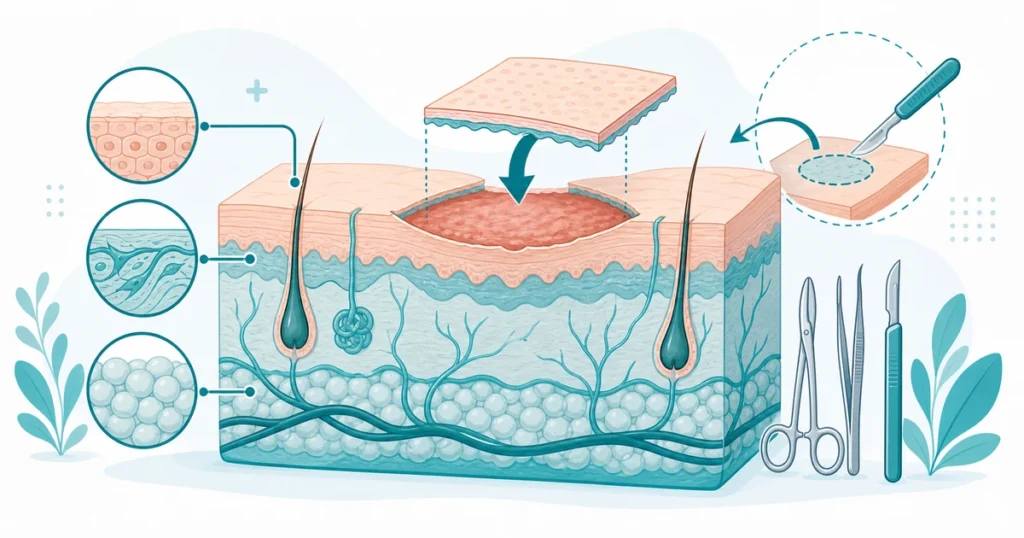
Free skin grafts involve completely detaching a section of skin from its blood supply at the donor site and transferring it to a recipient (defect) site. The graft relies on the recipient site’s blood supply to survive (a process called “take”). Free skin grafts are coded based on two factors: graft type (thickness) and anatomic location.
Split-Thickness Skin Grafts (STSG)
- CPT 15100–15121: Split-thickness autograft (patient’s own skin). Includes epidermis and part of the dermis. Common for large burn wounds and extensive skin loss.
- 15100: Trunk, arms, legs; first 100 sq cm or each additional 1% body area of infants and children.
- 15101: Each additional 100 sq cm (add-on to 15100).
- 15110: Epidermis (epidermal autograft); first 100 sq cm, trunk, arms, legs.
- 15111: Each additional 100 sq cm (add-on).
- 15120: Split-thickness autograft; face, scalp, eyelids, mouth, neck, ears, orbits, genitalia, hands, feet, and/or multiple digits; first 100 sq cm.
- 15121: Each additional 100 sq cm (add-on to 15120).
Coding by Area: STSG codes are divided by anatomic location. Trunk/arms/legs use one code set (15100–15101), while face/scalp/hands/feet/genitalia use another (15120–15121). The face/extremity codes typically reimburse at a higher rate due to the greater technical difficulty.
Full-Thickness Skin Grafts (FTSG)
- CPT 15200–15261: Full-thickness free autograft. Includes epidermis and the full dermis. Used when cosmetic outcome matters (face, hands) because FTSG provides better color match and texture.
- 15200: Trunk; first 20 sq cm or less.
- 15201: Each additional 20 sq cm (add-on).
- 15220: Scalp, arms, legs; first 20 sq cm or less.
- 15221: Each additional 20 sq cm (add-on).
- 15240: Face, eyelids, mouth, neck, ears, orbits, genitalia, hands, feet, and/or multiple digits; first 20 sq cm or less.
- 15241: Each additional 20 sq cm (add-on).
- 15260: Nose, ears, eyelids, and/or lips; first 20 sq cm or less.
- 15261: Each additional 20 sq cm (add-on).
Key Difference — STSG vs. FTSG sizing: Split-thickness grafts are measured in 100 sq cm increments. Full-thickness grafts are measured in 20 sq cm increments. This reflects the clinical reality that FTSG are used for smaller, cosmetically sensitive areas while STSG cover larger wound surfaces.
Skin Substitute Grafts
- CPT 15271–15278: Skin substitute graft (not autograft). These codes cover application of synthetic skin substitutes, acellular dermal matrices, or bioengineered skin products.
- 15271: Trunk, arms, legs; first 25 sq cm.
- 15272: Each additional 25 sq cm (add-on).
- 15273: Face, scalp, eyelids, mouth, neck, ears, orbits, genitalia, hands, feet, digits; first 100 sq cm.
- 15274: Each additional 100 sq cm (add-on).
- 15275: Face, scalp, eyelids, mouth, neck, ears, orbits, genitalia, hands, feet, digits; first 25 sq cm.
- 15276: Each additional 25 sq cm (add-on).
- 15277: Trunk, arms, legs; first 100 sq cm.
- 15278: Each additional 100 sq cm (add-on).
2. Pedicle Flaps (CPT 15570–15738)
Pedicle flaps remain partially attached to the donor site throughout the transfer, maintaining their original blood supply through a pedicle (stalk). This makes them more reliable than free grafts because they carry their own blood supply.
Key Pedicle Flap Coding Rules
- Coded by donor site location: Formation of a pedicle flap is coded by the donor site, not the recipient site. This is the opposite of skin grafts, which are coded by recipient site. This distinction is one of the most commonly tested coding rules on the CPC exam.
- 15570: Formation of direct or tubed pedicle, trunk.
- 15572: Formation of direct or tubed pedicle, scalp, arms, or legs.
- 15574: Formation of direct or tubed pedicle, forehead, cheeks, chin, mouth, neck, axillae, genitalia, hands, or feet.
- 15576: Formation of direct or tubed pedicle, eyelids, nose, ears, or lips.
Delayed Pedicle Flap Transfer
- 15600: Delay of flap or sectioning of flap, at trunk.
- 15610: Delay of flap or sectioning of flap, at scalp, arms, or legs.
- 15620: Delay of flap or sectioning of flap, at forehead, cheeks, chin, mouth, neck, axillae, genitalia, hands, or feet.
- 15630: Delay of flap or sectioning of flap, at eyelids, nose, ears, or lips.
If the flap requires a second surgery for final inset and division of the pedicle, report the delay/sectioning codes (15600–15630) for the second stage. This staged approach is common when the flap needs time to develop adequate blood supply from the recipient site before the pedicle can be divided.
Island Pedicle Flaps
- 15740: Flap; island pedicle requiring identification and dissection of an anatomically named axial vessel. This code involves isolating the blood vessel pedicle while tunneling the flap to the recipient site. More complex than a standard pedicle flap because it requires identification and preservation of a named blood vessel.
Muscle and Myocutaneous Flaps
- 15732: Muscle, myocutaneous, or fasciocutaneous flap; head and neck.
- 15734: Muscle, myocutaneous, or fasciocutaneous flap; trunk.
- 15736: Muscle, myocutaneous, or fasciocutaneous flap; upper extremity.
- 15738: Muscle, myocutaneous, or fasciocutaneous flap; lower extremity.
Muscle flaps include the muscle tissue with or without overlying skin. They are used for deep wound coverage where bulk is needed, such as pressure ulcers, radiation wounds, or traumatic tissue loss.
3. Free Flaps with Microvascular Anastomosis (CPT 15756–15758)
Free flaps are the most complex skin transfer procedures. The tissue is completely detached from the donor site and reattached using microsurgical techniques to connect blood vessels at the recipient site. These procedures require an operating microscope and specialized microvascular surgery skills.
- 15756: Free muscle or myocutaneous flap with microvascular anastomosis. Transfer of muscle (with or without skin) with reconnection of blood vessels.
- 15757: Free skin flap with microvascular anastomosis. Transfer of skin and subcutaneous tissue with reconnection of blood vessels.
- 15758: Free fascial flap with microvascular anastomosis. Transfer of fascia (connective tissue) with reconnection of blood vessels.
Important: Free flap codes include the microvascular anastomosis (blood vessel reconnection). Do not separately report microvascular anastomosis codes (e.g., 69990 for operating microscope) — this is bundled. However, if the surgeon must perform vein grafts to bridge a gap in blood vessels, those may be separately reportable.
Adjacent Tissue Transfer/Rearrangement (CPT 14000–14350)
Adjacent tissue transfer involves moving skin and subcutaneous tissue that is adjacent to the wound defect to cover it. Unlike grafts (which are detached from their blood supply), adjacent tissue transfer maintains its blood supply through the base of the flap.
- 14000: Adjacent tissue transfer or rearrangement, trunk; defect 10 sq cm or less.
- 14001: Adjacent tissue transfer or rearrangement, trunk; defect 10.1–30 sq cm.
- 14020: Adjacent tissue transfer, scalp, arms, and/or legs; defect 10 sq cm or less.
- 14021: Adjacent tissue transfer, scalp, arms, and/or legs; defect 10.1–30 sq cm.
- 14040: Adjacent tissue transfer, forehead, cheeks, chin, mouth, neck, axillae, genitalia, hands, and/or feet; defect 10 sq cm or less.
- 14041: Adjacent tissue transfer, forehead, cheeks, chin, mouth, neck, axillae, genitalia, hands, and/or feet; defect 10.1–30 sq cm.
- 14060: Adjacent tissue transfer, eyelids, nose, ears, and/or lips; defect 10 sq cm or less.
- 14061: Adjacent tissue transfer, eyelids, nose, ears, and/or lips; defect 10.1–30 sq cm.
- 14301: Adjacent tissue transfer, any area; defect 30.1–60 sq cm.
- 14302: Each additional 30 sq cm (add-on to 14301).
Key Rule: Adjacent tissue transfer codes include the excision of the lesion when performed. If a lesion is excised and the resulting defect is closed with adjacent tissue transfer, do not separately report the excision code — it is bundled into the tissue transfer code. The defect size for code selection includes the primary defect plus any secondary defects created by the tissue rearrangement.
Donor Site Closure
When a skin graft is harvested, the donor site wound must also be closed. The coding for donor site closure depends on the method used:
- Split-thickness donor sites heal by secondary intention (they re-epithelialize on their own) — no separate closure code is reported.
- Full-thickness donor sites are usually closed with simple or intermediate repair. These repair codes ARE separately reportable in addition to the graft code.
- If the donor site requires a skin graft itself, that additional graft is separately reportable.
Real-World Coding Examples
Example 1: Split-Thickness Skin Graft for Burn
Operative Report: A 45-year-old with a 150 sq cm third-degree burn on the right thigh. The burn eschar is excised down to viable tissue. A split-thickness skin graft is harvested from the left thigh and applied to the wound bed.
Correct Codes:
- 15002 — Recipient site preparation, trunk/arms/legs, first 100 sq cm
- 15003 — Each additional 100 sq cm of recipient site prep (for the remaining 50 sq cm)
- 15100 — STSG, trunk/arms/legs, first 100 sq cm
- 15101 — Each additional 100 sq cm of STSG (for remaining 50 sq cm)
Example 2: Full-Thickness Skin Graft to Nose
Operative Report: Excision of a 1.5 cm basal cell carcinoma from the nose, resulting in a 3 sq cm defect. A full-thickness skin graft is harvested from the postauricular area and sutured to the nasal defect. The postauricular donor site is closed with simple repair.
Correct Codes:
- 15260 — FTSG, nose/ears/eyelids/lips, first 20 sq cm. The excision of the lesion is bundled when performed with the graft at the same site.
- 12011 — Simple repair of the donor site (postauricular area) — separately reportable
Example 3: Pedicle Flap from Trunk
Operative Report: Formation of a pedicle flap from the abdomen (trunk) for coverage of a wound on the right hand. The flap is formed and inset into the hand defect. The hand is immobilized against the abdomen.
Correct Code: 15570 — Formation of pedicle flap, trunk. Remember: pedicle flaps are coded by the donor site (trunk), not the recipient site (hand).
CPC Exam Tips for Skin Graft Coding
- Grafts are coded by recipient site; pedicle flaps are coded by donor site. This is the most important distinction and the most commonly tested rule.
- Know the repair hierarchy: Simple → Intermediate → Complex → Adjacent tissue transfer → Skin graft → Flap. Simpler closures are bundled into more complex ones.
- STSG = 100 sq cm increments; FTSG = 20 sq cm increments. Match the graft type to the correct sizing increments.
- Recipient site prep is separate: Codes 15002–15005 are separately reportable when surgical preparation of the wound bed is documented.
- Adjacent tissue transfer includes excision: Do not separately code the excision when the defect is closed with adjacent tissue transfer.
- Donor site closure for FTSG is separately reportable; STSG donor sites heal by secondary intention and have no separate closure code.
- Free flaps include microvascular anastomosis: Do not separately report the vascular reconnection — it is bundled into the flap code.
- Measure the defect, not the graft: For adjacent tissue transfer, measure the primary and secondary defects combined, not just the lesion size.
Summary
Skin graft and flap coding requires understanding the wound repair hierarchy, graft types (split-thickness vs. full-thickness), tissue transfer methods (adjacent tissue transfer, pedicle flaps, free flaps), and the key distinction between coding by recipient site (grafts) vs. donor site (pedicle flaps). Always check for separately reportable recipient site preparation, and remember that adjacent tissue transfer codes include the lesion excision. Master these principles and skin graft coding questions will become straightforward on the CPC exam.
5 quick questions drawn from this guide. Click an answer to check it — explanations appear as you go.
1. A free skin graft (CPT 15040–15278) is selected based on:
2. Recipient site preparation (15002–15005) is coded:
3. A flap that keeps its own blood supply attached during transfer is a:
4. Free flaps with microvascular anastomosis are coded from:
5. Adjacent tissue transfer/rearrangement (14000–14350) codes are chosen by:
Frequently Asked Questions
Are skin grafts and pedicle flaps coded based on the same site?
No. Skin grafts are coded based on the recipient site (where the graft is placed), while pedicle flaps are coded based on the donor site (where the flap tissue originates). This is one of the most frequently tested distinctions in integumentary coding.
What is the difference in sizing between split-thickness and full-thickness skin grafts?
Split-thickness skin graft (STSG) codes are measured in 100 sq cm increments, while full-thickness skin graft (FTSG) codes are measured in 20 sq cm increments. This reflects that FTSG is typically used for smaller, cosmetically sensitive areas.
Is recipient site preparation separately reportable before a skin graft?
Yes, when the operative report documents surgical excision of the wound bed, burn eschar, or scar before graft placement, recipient site preparation codes (15002–15005) are separately reportable. Simple cleaning or irrigation alone does not qualify.
Does adjacent tissue transfer coding include the lesion excision?
Yes. When a lesion is excised and the resulting defect is closed with adjacent tissue transfer, the excision is bundled into the tissue transfer code and should not be reported separately.
Is donor site closure separately reportable after a skin graft?
It depends on the graft type. Split-thickness donor sites typically heal by secondary intention with no separate closure code. Full-thickness donor sites are usually closed with simple or intermediate repair, and that repair is separately reportable in addition to the graft code.