Table of Contents
- How the 50000 Series Is Organized
- Kidney and Ureter Procedures
- Cystourethroscopy: The Bundling Workhorse
- Prostate Procedures: TURP and Biopsy
- Male Genital Essentials
- Female Genital: From Colposcopy to LEEP
- Hysterectomy: The Three-Axis Code Selection
- Hysteroscopy and Laparoscopy
- Urodynamics and Incontinence Procedures
- The Approach Vocabulary Table
- Worked Example: One Operative Note, One Code
- How the CPC Exam Tests the 50000 Series
- Common Mistakes
- Final Exam Strategy for This Section
- Frequently Asked Questions
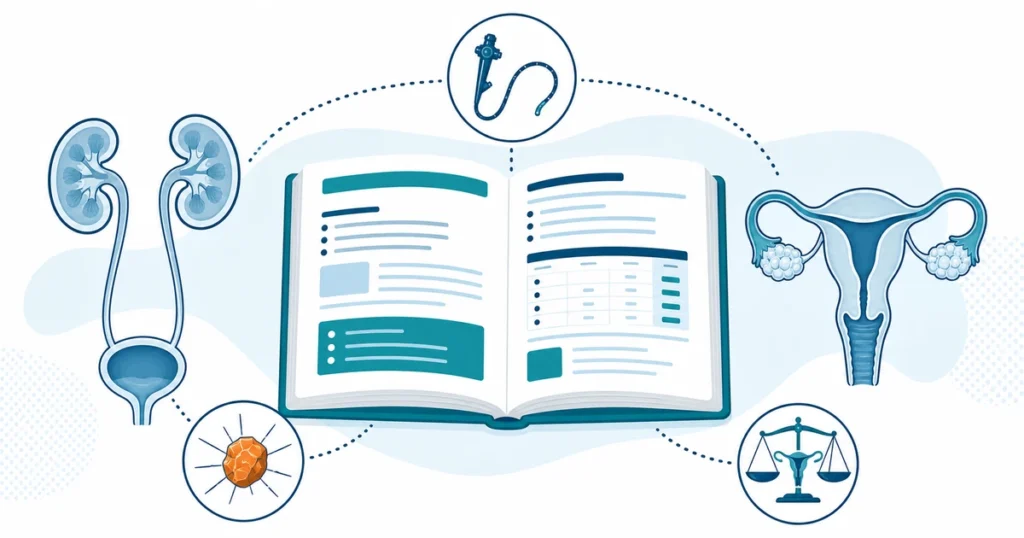
The 50000 series of CPT — urinary system, male genital system, and female genital system — supplies a dependable block of CPC exam questions, and nearly all of them turn on the same two decisions: which approach was used, and how much was removed. A hysterectomy question is really an approach-plus-extent question; a cystoscopy question is really a bundling question; a TURP question is vocabulary. This guide works through the three subsections in manual order, building on the anatomy in Renal and Urinary System Anatomy for Coders and the scope-coding fundamentals in Endoscopy Procedure Coding.
How the 50000 Series Is Organized
The urinary subsection (50010–53899) follows the path of urine: kidney, ureter, bladder, urethra, each divided into the standard CPT procedure families — incision, excision, introduction, repair, and endoscopy. The male genital subsection (54000–55899) covers the penis, testis, epididymis, vas deferens, spermatic cord, and prostate. The female genital subsection (56405–58999) runs anatomically upward: vulva, vagina, cervix, uterus, oviducts, and ovaries, ending just before the maternity codes covered in the Global OB Package & Maternity CPT Coding Guide. As throughout the Surgery section, the vignette’s anatomy fixes the code family; the technique details select within it, per the framework in Surgery Coding for Beginners.
Kidney and Ureter Procedures
The kidney codes divide by what is removed and how: partial nephrectomy, radical nephrectomy, and donor nephrectomy each carry distinct codes, with laparoscopic and open versions living in separate families. Stone management is the exam’s favorite territory because one clinical problem — a stone — has three coding pathways depending on technique. Extracorporeal shock wave lithotripsy (50590) fragments the stone from outside the body with no incision or scope. Percutaneous nephrostolithotomy removes stones through a tract into the kidney, coded by stone size. And ureteroscopic treatment approaches the stone from below through the urethra and bladder: ureteroscopy with lithotripsy is 52353, with stent insertion (52332) separately reportable when an indwelling stent is left. The technique words — “shock wave,” “percutaneous tract,” “ureteroscope advanced” — are the entire code selection.
Cystourethroscopy: The Bundling Workhorse
Diagnostic cystourethroscopy (52000) is the platform on which dozens of surgical scope codes are built, and the governing rule mirrors every endoscopy family: the diagnostic scope is included in any surgical cystoscopy performed at the same session. A cystourethroscopy with removal of a bladder stone, with biopsy, with fulguration of a bladder tumor (coded by tumor size: 52234 small, 52235 medium, 52240 large), or with insertion of a ureteral stent (52332) reports only the surgical code — never 52000 alongside it. Reporting both is the unbundling error pattern from Bundled Codes and NCCI Edits, and the exam builds distractors from exactly that combination.
Prostate Procedures: TURP and Biopsy
Transurethral resection of the prostate (52601) removes obstructing prostate tissue through the urethra with no external incision — the classic treatment for benign prostatic hyperplasia, and a pure vocabulary check on the exam: “resectoscope,” “transurethral,” and “chips of prostate tissue” all point to 52601. Note its home: TURP sits in the urinary subsection’s transurethral surgery family, not in the male genital codes. Prostate needle biopsy (55700) and the various open and laparoscopic prostatectomies for cancer live in the male genital subsection, and radical prostatectomy codes divide by approach — retropubic, perineal, or laparoscopic/robotic. The distinction the exam tests: TURP treats obstruction; radical prostatectomy treats cancer; the diagnosis in the vignette confirms the procedure family.
Male Genital Essentials
Beyond the prostate, three procedures dominate: circumcision (coded by method and age), orchiectomy (simple versus radical — radical, for testicular cancer, is performed through an inguinal incision, and that word is the exam signal), and vasectomy (55250, which includes postoperative semen analysis in its description). Hydrocele repair and orchiopexy for undescended testis round out the tested set. Laterality matters throughout — bilateral procedures take modifier 50 unless the code description already says bilateral, following the rules in CPT Modifiers Explained.
Female Genital: From Colposcopy to LEEP
The lower female genital codes are organized by anatomic level, and the cervical procedures are the most tested. Colposcopy — magnified examination of the cervix — has its own family, with codes distinguishing colposcopy alone from colposcopy with biopsy or with endocervical curettage. Loop electrode excision (LEEP) of the cervix divides on setting and extent: 57460 reports colposcopy with loop electrode biopsy of the cervix, while 57522 reports a loop electrode conization performed without colposcopic guidance. Dilation and curettage outside pregnancy is 58120 — remembering that D&C associated with abortion or delivery belongs to the maternity codes instead is a reliable exam point.
Hysterectomy: The Three-Axis Code Selection
Hysterectomy coding is the flagship skill of this section, and every code answers three questions. First, the approach: abdominal (open), vaginal, laparoscopic, or laparoscopically assisted vaginal — each its own code family. Second, the extent: total hysterectomy removes the uterus including the cervix, while supracervical removes the body of the uterus leaving the cervix. Third, for vaginal and laparoscopic families, the uterus weight: 250 grams or less versus more than 250 grams splits the codes. Removal of tubes and ovaries does not generate a separate code — the with-or-without removal of tubes and ovaries option is built into the hysterectomy code descriptions, so a total laparoscopic hysterectomy with bilateral salpingo-oophorectomy, uterus 180 grams, is a single code (58571), not a hysterectomy plus an oophorectomy. Coding a separate BSO alongside a hysterectomy code that already includes it is this section’s signature unbundling trap.
Hysteroscopy and Laparoscopy
Gynecologic endoscopy follows the same included-diagnostic-scope rule as cystoscopy. Diagnostic hysteroscopy (58555) is bundled into every surgical hysteroscopy: hysteroscopy with polypectomy and D&C (58558), with myomectomy, or with endometrial ablation each reports the single surgical code. On the laparoscopic side, tubal sterilization divides by method — fulguration of the oviducts (58670) versus occlusion with a ring, band, or clip (58671) — and ovarian work (cystectomy, oophorectomy) has laparoscopic codes distinct from the open family. The exam signal is always the scope-plus-verb combination: identify the scope type, find the surgical action, and select the one code that contains both.
Urodynamics and Incontinence Procedures
Two smaller families appear regularly. Urodynamic studies — cystometrogram, uroflowmetry, urethral pressure profile — are diagnostic tests of bladder function with their own codes, frequently performed as a battery, with each separately documented study separately reportable. Incontinence surgery is dominated by the sling: 57288 reports a sling operation for stress incontinence, and the exam expects recognition that slings, urethral suspension procedures, and injectable bulking agents are three different code families for one clinical complaint. Global periods and the E/M decision-making around these procedures follow Global Surgical Package rules.
The Approach Vocabulary Table
Because approach drives code selection across this entire section, the operative-note vocabulary deserves its own reference. These are the exam’s translation pairs:
| Operative Note Language | Approach | Typical Code Family |
|---|---|---|
| “Midline incision,” “Pfannenstiel incision” | Open / abdominal | Open nephrectomy, abdominal hysterectomy (58150) |
| “Trocar,” “insufflation,” “ports placed” | Laparoscopic | Laparoscopic nephrectomy, laparoscopic hysterectomy (58570–58573) |
| “Resectoscope,” “cystoscope advanced through urethra” | Transurethral | TURP (52601), TURBT, cystourethroscopy family |
| “Ureteroscope advanced,” “retrograde” | Ureteroscopic | 52353 lithotripsy, 52332 stent |
| “Hysteroscope,” “distension media” | Hysteroscopic | 58555–58565 |
| “Through the vaginal canal,” no abdominal incision | Vaginal | Vaginal hysterectomy (58260 family) |
| “Shock waves,” “no incision,” “fluoroscopic targeting” | Extracorporeal | ESWL (50590) |
| “Needle passed through the flank,” “tract dilated” | Percutaneous | Percutaneous nephrostolithotomy |
Reading the note for these phrases before opening the code book converts most questions in this section into simple lookups — the approach eliminates half the answer choices on its own.
Worked Example: One Operative Note, One Code
An operative report reads: “Total laparoscopic hysterectomy with bilateral salpingo-oophorectomy for symptomatic fibroids; uterus weighed 320 g.” Walk the three axes: approach laparoscopic; extent total (cervix removed); weight over 250 grams — landing on 58573 (total laparoscopic hysterectomy, uterus greater than 250 g, with removal of tubes and ovaries). The distractors will offer the under-250-gram code, the supracervical code, and — most tempting — the correct hysterectomy code plus a separate salpingo-oophorectomy code. One procedure, one code; the description already contains everything the surgeon did.
How the CPC Exam Tests the 50000 Series
Pattern 1 — The Hysterectomy Grid
The vignette supplies approach, cervix status, uterus weight, and tube/ovary removal. Every fact maps to one axis of the code description; the answer choices differ by exactly one axis each.
Pattern 2 — Surgical Scope Swallows Diagnostic Scope
A cystoscopy or hysteroscopy scenario performs a surgical intervention, and one answer adds the diagnostic scope code separately. The surgical code alone is correct.
Pattern 3 — Stone Technique Matching
A kidney or ureteral stone is treated by ESWL, percutaneously, or ureteroscopically. The technique language selects the family; a stent left indwelling adds 52332.
Pattern 4 — Same Organ, Different Disease
TURP versus radical prostatectomy, simple versus radical orchiectomy, sling versus suspension: the diagnosis (obstruction versus cancer, stress incontinence type) confirms the procedure family before you touch the code numbers.
Common Mistakes
Reporting a separate salpingo-oophorectomy with a hysterectomy. Tube and ovary removal is built into the hysterectomy code descriptions; select the with-removal version rather than adding a second code.
Adding 52000 or 58555 to a surgical scope code. The diagnostic cystoscopy or hysteroscopy is always included in the surgical version performed at the same session.
Ignoring uterus weight. Vaginal and laparoscopic hysterectomy codes split at 250 grams — the weight in the operative note is a code-selection fact, not clinical color.
Coding TURP from the male genital subsection. Transurethral prostate surgery lives in the urinary system’s transurethral family (52601), not with the open prostate codes.
Missing the separately reportable ureteral stent. An indwelling stent placed during ureteroscopic stone treatment adds 52332; a temporary stent removed at the end of the procedure does not.
Forgetting modifier 50 on bilateral procedures. Orchiopexy, hydrocele repair, and similar codes describe unilateral procedures unless the description states otherwise.
Coding obstetric D&C with 58120. The nonobstetric D&C code never applies to pregnancy-related evacuations, which belong to the maternity subsection.
Final Exam Strategy for This Section
Reduce the section to its grids: the hysterectomy three-axis table, the three stone techniques, the included-scope rule, and the disease-to-procedure pairs for prostate and testis. Write them onto one review card next to the CPC Exam Cheat Sheet tables, and drill operative-note scenarios using the loop in the CPC Exam Study Guide. Every question in this section is a reading test — the operative note always contains each axis explicitly, and the wrong answers each contradict exactly one of them.
5 quick questions drawn from this guide. Click an answer to check it — explanations appear as you go.
1. Operative hysteroscopy with polypectomy is performed. Is diagnostic hysteroscopy 58555 also reported?
2. Transurethral resection of the prostate for BPH is coded:
3. Ureteroscopic lithotripsy is completed and an indwelling ureteral stent is left in place. Code:
4. Vaginal and laparoscopic hysterectomy code families split on a uterus weight of:
5. A total hysterectomy includes removal of tubes and ovaries. Report:
Frequently Asked Questions
How do you choose the correct hysterectomy code?
Answer three questions from the operative note: the approach (abdominal, vaginal, laparoscopic, or laparoscopically assisted), the extent (total including cervix versus supracervical), and for vaginal and laparoscopic codes the uterus weight (250 g or less versus more). Tube and ovary removal is included as a with/without option in the code descriptions.
Is diagnostic cystoscopy billed with surgical cystoscopy?
No. Diagnostic cystourethroscopy (52000) is included in any surgical cystourethroscopy performed at the same session, such as tumor fulguration, stone removal, or stent insertion. Only the surgical code is reported.
What is CPT code 52601?
52601 reports transurethral resection of the prostate (TURP) — removal of obstructing prostate tissue through the urethra with a resectoscope, the standard surgical treatment for benign prostatic hyperplasia. It sits in the urinary system’s transurethral surgery family.
When is a ureteral stent separately billable?
When an indwelling ureteral stent is left in place during a cystoscopic or ureteroscopic procedure, insertion code 52332 is reported in addition to the primary procedure. Temporary stents placed and removed within the same operative session are not separately reported.
What is the difference between ESWL and ureteroscopic lithotripsy?
Extracorporeal shock wave lithotripsy (50590) fragments stones from outside the body with no incision or scope. Ureteroscopic lithotripsy (52353) reaches the stone through the urethra, bladder, and ureter with a scope and fragments it directly, with stent insertion separately reportable when indwelling.