Table of Contents
- Spine Surgery Code Categories
- 1. Decompression Procedures (CPT 63001–63091)
- 2. Arthrodesis / Fusion (CPT 22532–22634)
- 3. Instrumentation (CPT 22840–22870)
- Bone Graft Codes (CPT 20930–20938)
- Common Spine Surgery Combinations
- Coding Rules and Common Exam Traps
- Real-World Coding Examples
- CPC Exam Tips for Spine Surgery Coding
- Summary
- Frequently Asked Questions
Spine surgery coding is one of the most complex and heavily tested areas on the CPC exam. Procedures often involve multiple components — decompression, fusion, and instrumentation — each coded separately. Understanding how to correctly identify and sequence these components is essential for accurate spine surgery CPT coding and for passing the CPC exam.
Spine Surgery Code Categories
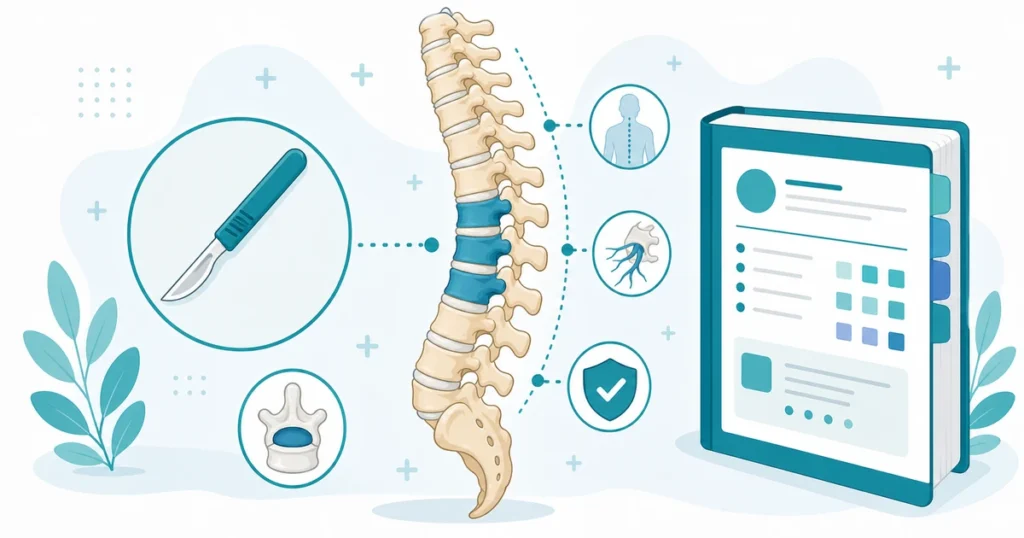
Spine procedures are divided into three major components that are often performed together but coded independently. Each component has its own CPT code family, and a single spine surgery may require codes from all three categories. Understanding this multi-component coding model is the key to spine surgery coding.
- Decompression (CPT 63001–63091): Relieving pressure on the spinal cord or nerve roots by removing bone, disc material, or other tissue.
- Arthrodesis/Fusion (CPT 22532–22634): Permanently joining two or more vertebrae together using bone graft to eliminate motion at a painful segment.
- Instrumentation (CPT 22840–22870): Installing hardware (screws, rods, cages, plates) to stabilize the spine during the fusion healing process.
Key Concept: These three components are independently reportable. A single operative session that involves decompression, fusion, and instrumentation will generate three separate CPT codes (or more, depending on the number of levels treated). This multi-code approach is unique to spine surgery and is the foundation of most CPC exam spine questions.
1. Decompression Procedures (CPT 63001–63091)
Decompression relieves pressure on the spinal cord or nerve roots by removing bone, disc material, or other tissue. The specific code depends on the technique used and the spinal region.
Laminectomy
- 63001: Laminectomy with exploration and/or decompression of spinal cord and/or cauda equina, without facetectomy, foraminotomy or discectomy; 1 or 2 vertebral segments, cervical.
- 63003: Same procedure, thoracic region.
- 63005: Same procedure, lumbar region (except for spondylolisthesis). This is one of the most commonly tested decompression codes.
- 63011: Laminectomy with exploration and decompression, sacral region.
- 63012: Laminectomy with removal of abnormal facets and/or pars interarticularis, lumbar. Used specifically for spondylolisthesis cases.
- 63015–63017: Laminectomy with facetectomy or foraminotomy, by spinal region (cervical, thoracic, lumbar). These are more extensive decompressions that include removal of part of the facet joint.
Coding Tip: Laminectomy codes are determined by the spinal region (cervical, thoracic, lumbar, sacral) and whether additional procedures like facetectomy or foraminotomy are performed. Always identify the region first, then determine the extent of the decompression.
Laminotomy (Hemilaminectomy)
- 63020: Laminotomy (hemilaminectomy) with decompression of nerve root, including partial facetectomy, foraminotomy, and/or discectomy; 1 interspace, cervical.
- 63030: Same procedure, 1 interspace, lumbar. This is the most commonly performed and most commonly tested laminotomy code.
- 63035: Each additional interspace, cervical or lumbar (add-on code). Report this for each additional level beyond the first. This is an add-on code — it cannot be reported alone.
Important: Discectomy is included in the laminotomy code when performed at the same level. Do not report a separate discectomy code. This bundling rule is frequently tested.
Foraminotomy
- 63040: Laminotomy with foraminotomy, single interspace, cervical. Enlargement of the neural foramen to relieve nerve root compression.
- 63042: Same procedure, lumbar region.
- 63043–63044: Each additional interspace (add-on codes for cervical and lumbar, respectively).
Anterior and Lateral Decompression
- 63075: Anterior discectomy with decompression, single interspace, cervical. Commonly performed as part of an anterior cervical discectomy and fusion (ACDF).
- 63076: Each additional cervical interspace (add-on).
- 63077: Anterior discectomy with decompression, single interspace, thoracic.
- 63081: Vertebral corpectomy, anterior approach, cervical. Removal of an entire vertebral body — more extensive than discectomy.
- 63085: Vertebral corpectomy, anterior approach, thoracic.
- 63087: Vertebral corpectomy, anterior approach, thoracolumbar.
- 63090: Vertebral corpectomy, anterior approach, lumbar.
Exam Tip: Anterior cervical discectomy (63075) is one of the most commonly tested decompression codes because it is frequently combined with anterior cervical fusion (22551) in the classic ACDF procedure. Know this combination well.
2. Arthrodesis / Fusion (CPT 22532–22634)
Fusion permanently joins two or more vertebrae together by placing bone graft material between them. Codes depend on the approach and the spinal region.
Anterior Approach Fusion
- 22551: Arthrodesis, anterior interbody, including disc space preparation, discectomy, osteophytectomy and decompression of spinal cord and/or nerve roots; cervical below C2, single interspace. This is the fusion component of the ACDF procedure.
- 22552: Each additional cervical interspace (add-on to 22551). Report for each additional level fused anteriorly.
- 22554: Arthrodesis, anterior interbody technique, single interspace; cervical below C2. An older code that does not include the decompression component — 22551 is preferred when decompression is also performed.
- 22556: Anterior interbody fusion, thoracic, single interspace.
- 22558: Anterior interbody fusion, lumbar, single interspace.
Posterior/Posterolateral Approach Fusion
- 22600: Arthrodesis, posterior or posterolateral technique, single interspace; cervical below C2.
- 22610: Same procedure, thoracic (with or without lateral transverse technique).
- 22612: Same procedure, lumbar (with or without lateral transverse technique), single interspace. This is the most commonly coded posterior lumbar fusion.
- 22614: Each additional interspace, lumbar (add-on to 22612).
- 22630: Posterior interbody fusion (PLIF), single interspace, lumbar. Different from posterolateral fusion — PLIF places the graft between the vertebral bodies from a posterior approach.
- 22632: Each additional interspace for PLIF (add-on).
Lateral Approach Fusion
- 22533: Lateral extracavitary approach, thoracic or lumbar, single interspace. Used for XLIF (extreme lateral interbody fusion) and DLIF (direct lateral interbody fusion) procedures.
- 22534: Each additional interspace (add-on).
360-Degree Fusion
When both anterior and posterior fusion are performed at the same level, report both the anterior fusion code and the posterior fusion code. This is called a 360-degree fusion or circumferential fusion. Both codes are separately reportable because they represent distinct approaches and distinct work.
3. Instrumentation (CPT 22840–22870)
Instrumentation codes cover the hardware (screws, rods, cages, plates) used to stabilize the spine during fusion. These are all add-on codes — they cannot be reported as standalone procedures.
- 22840: Posterior non-segmental instrumentation (e.g., Harrington rod). A single rod placed along the spine without attachment at each vertebral level.
- 22842: Posterior segmental instrumentation; 3–6 vertebral segments. Pedicle screws placed at multiple levels with connecting rods — the most common type of spinal instrumentation.
- 22843: Posterior segmental instrumentation; 7–12 vertebral segments.
- 22844: Posterior segmental instrumentation; 13 or more vertebral segments.
- 22845: Anterior instrumentation; 2–3 vertebral segments (e.g., anterior cervical plate). Commonly used in ACDF procedures.
- 22846: Anterior instrumentation; 4–7 vertebral segments.
- 22847: Anterior instrumentation; 8 or more vertebral segments.
- 22848: Pelvic fixation (in addition to posterior instrumentation). Add-on for extending instrumentation to the pelvis.
- 22849: Reinsertion of spinal fixation device (requiring a new surgical approach).
- 22853: Insertion of interbody biomechanical device (intervertebral cage), single interspace, with integral anterior instrumentation. Used for stand-alone anterior lumbar interbody fusion devices.
- 22859: Insertion of intervertebral biomechanical device, single interspace, with integral anterior instrumentation for device positioning (e.g., ALIF cage with built-in plate).
Key Rule: Instrumentation codes are always add-on codes. They must be reported with a primary fusion code. Never report an instrumentation code alone. The number of vertebral segments determines which instrumentation code to use.
Bone Graft Codes (CPT 20930–20938)
When bone graft is harvested and used during fusion, these add-on codes may apply:
- 20930: Allograft for spine surgery only; morselized. Donor bone in small pieces packed into the fusion site.
- 20931: Allograft for spine surgery only; structural. A shaped piece of donor bone used as a structural spacer.
- 20936: Autograft for spine surgery only; local (e.g., bone from the laminectomy site). Harvested from the surgical site itself — most commonly from the lamina removed during decompression.
- 20937: Autograft for spine surgery only; morselized, through separate skin or fascial incision (includes obtaining the graft). Bone harvested from a separate site, usually the iliac crest.
- 20938: Autograft for spine surgery only; structural, bicortical or tricortical (includes obtaining the graft). Larger structural pieces harvested from a separate site.
Exam Tip: Local autograft (20936) from the laminectomy site is the most commonly used graft type and is a separate add-on code. Allograft (donor bone) uses different codes than autograft (patient’s own bone). Always identify the graft type and source in the operative report.
Common Spine Surgery Combinations
ACDF (Anterior Cervical Discectomy and Fusion)
The most commonly tested spine procedure combination on the CPC exam. A typical single-level ACDF codes as:
- 22551: Anterior cervical fusion, single interspace (includes discectomy and decompression)
- 22845: Anterior instrumentation (cervical plate), 2–3 segments (add-on)
- 20931: Structural allograft (if allograft spacer is used) (add-on)
For a two-level ACDF, add 22552 (additional interspace) to the above codes.
Posterior Lumbar Fusion with Decompression
- 63005: Laminectomy, lumbar (decompression component)
- 22612: Posterior lumbar fusion, single interspace
- 22842: Posterior segmental instrumentation, 3–6 segments (add-on)
- 20936: Local autograft from laminectomy site (add-on)
Coding Rules and Common Exam Traps
Decompression Bundled with Fusion
When decompression is performed at the same level as an anterior fusion using CPT 22551, the decompression is included in the fusion code. Code 22551 specifically states it includes disc space preparation, discectomy, and decompression. Do not separately report 63075 (anterior cervical discectomy) with 22551 — this is one of the most common spine coding errors and a frequent exam trap.
However, posterior decompression (laminectomy, laminotomy) performed at the same level as a posterior fusion IS separately reportable. Posterior decompression codes are not bundled into posterior fusion codes.
Multi-Level Procedures
For multi-level spine procedures, use the primary code for the first level and the add-on code for each additional level. For example, a two-level posterior lumbar fusion: report 22612 for the first interspace and 22614 for the second interspace. Never report the primary code twice — use the designated add-on codes.
Approach Codes
Some spine procedures require a separate approach procedure to access the spine. For example, an anterior lumbar fusion may require a general surgeon to perform an anterior retroperitoneal approach (CPT 22900 series). The approach is separately reportable and may be performed by a different surgeon. Know that approach codes exist but are reported by the surgeon performing the approach, not the spine surgeon.
Real-World Coding Examples
Example 1: Single-Level ACDF
Operative Report: Anterior cervical discectomy at C5-C6 with decompression of the spinal cord and nerve roots. A PEEK interbody cage filled with allograft bone is placed. An anterior cervical plate is applied spanning C5-C6.
Correct Codes:
- 22551 — Anterior cervical fusion with discectomy and decompression, single interspace
- 22845 — Anterior instrumentation (cervical plate), 2–3 segments
- 20931 — Structural allograft
Note: Do NOT separately report 63075 for the discectomy — it is included in 22551.
Example 2: Posterior Lumbar Decompression and Fusion
Operative Report: L4-L5 laminectomy with decompression. Posterolateral fusion at L4-L5. Pedicle screws placed at L4 and L5 bilaterally with connecting rods. Local autograft bone from the laminectomy site used for fusion.
Correct Codes:
- 63005 — Laminectomy, lumbar, 1-2 segments
- 22612 — Posterior lumbar fusion, single interspace
- 22842 — Posterior segmental instrumentation, 3–6 segments
- 20936 — Local autograft
Example 3: Two-Level Posterior Cervical Fusion
Operative Report: Posterior cervical laminectomy C3-C5 (3 segments). Posterior cervical fusion C3-C4 and C4-C5. Lateral mass screws at C3, C4, and C5 with connecting rods bilaterally.
Correct Codes:
- 63001 — Laminectomy, cervical, 1-2 segments
- 63002 — Each additional cervical segment (add-on for C5)
- 22600 — Posterior cervical fusion, single interspace (C3-C4)
- 22614 — Each additional interspace (C4-C5)
- 22842 — Posterior segmental instrumentation, 3–6 segments
CPC Exam Tips for Spine Surgery Coding
- Three components: Always check for decompression, fusion, and instrumentation — each is coded separately.
- 22551 bundles decompression: Anterior cervical fusion (22551) includes the discectomy and decompression. Never add 63075 separately.
- Posterior decompression is separate: Posterior decompression codes are NOT bundled into posterior fusion codes. Report both.
- Instrumentation = add-on codes: All instrumentation codes (22840-22848) are add-on codes that require a primary fusion code.
- Count the levels: Use primary codes for the first level and add-on codes for each additional level. Never report the primary code twice.
- Identify the graft type: Local autograft (20936), morselized autograft from separate site (20937), structural allograft (20931) — each has its own code.
- Approach matters: Anterior, posterior, posterolateral, and lateral approaches use different code families. Identify the approach in the operative report first.
- 360-degree fusion: When both anterior and posterior fusion are performed at the same level, report both fusion codes — they are not bundled.
Summary
Spine surgery coding revolves around three independently coded components: decompression, fusion, and instrumentation. Always identify the approach (anterior, posterior, lateral), the spinal region (cervical, thoracic, lumbar), and the number of levels treated. Remember that anterior cervical fusion (22551) bundles the decompression, but posterior decompression is always separately reportable alongside posterior fusion. Instrumentation codes are always add-on codes. For multi-level procedures, use the primary code for the first level and add-on codes for additional levels. Master these principles and spine surgery coding questions will become manageable on the CPC exam.
5 quick questions drawn from this guide. Click an answer to check it — explanations appear as you go.
1. Spinal decompression procedures (e.g., laminectomy) are coded from:
2. Arthrodesis refers to:
3. Spinal instrumentation codes (22840–22870) are usually:
4. Bone graft codes (20930–20938) are:
5. A key exam trap in spine coding is:
Frequently Asked Questions
What are the three independently coded components of spine surgery?
Decompression, arthrodesis (fusion), and instrumentation are each coded independently. A single spine surgery may generate codes from all three categories, since each represents distinct surgical work even when performed during the same operative session.
Is decompression bundled into anterior cervical fusion code 22551?
Yes. Code 22551 already includes disc space preparation, discectomy, and decompression, so a separate anterior discectomy code (such as 63075) should not be reported alongside it. However, posterior decompression codes are not bundled into posterior fusion codes and remain separately reportable.
Can spinal instrumentation codes be reported on their own?
No. All spinal instrumentation codes (22840–22870) are add-on codes and must be reported alongside a primary fusion code. They can never be billed as a standalone procedure.
What is the difference between local autograft and structural allograft coding?
Local autograft, harvested from the laminectomy site itself, uses code 20936. Structural allograft, which is donor bone, uses a different code (20931). These represent different graft sources and are not interchangeable for coding purposes.
How do you code a multi-level spinal fusion?
Use the primary fusion code for the first interspace level and the designated add-on code for each additional level. The primary code should never be reported twice, even when multiple levels are fused.