Table of Contents
- The Critical Distinction: Fracture Type vs Treatment Type
- Closed Treatment: With vs Without Manipulation
- Open Treatment and Internal Fixation (ORIF)
- Percutaneous Skeletal Fixation
- Casting, Splinting, and Strapping Codes (29000 Series)
- The 90-Day Fracture Global Period
- Pairing with ICD-10: The Injury Side
- Worked Example: One Fracture, Three Encounters
- How the CPC Exam Tests Fracture Coding
- Common Mistakes
- Final Exam Strategy for This Section
- Frequently Asked Questions
Fracture care coding rests on a distinction so counterintuitive that the CPC exam can build a question on it every single administration: the type of fracture and the type of treatment are independent facts. A closed fracture can receive open treatment; an open fracture can receive closed treatment. Candidates who let the injury’s adjective choose the procedure code walk straight into the trap. This guide separates the two axes cleanly, then works through manipulation, percutaneous fixation, the casting and strapping codes, the 90-day global period, and the ICD-10 pairing that completes every fracture question, building on the terminology base in Musculoskeletal System Terminology and Anatomy and the surgical framework in Surgery Coding for Beginners.
The Critical Distinction: Fracture Type vs Treatment Type
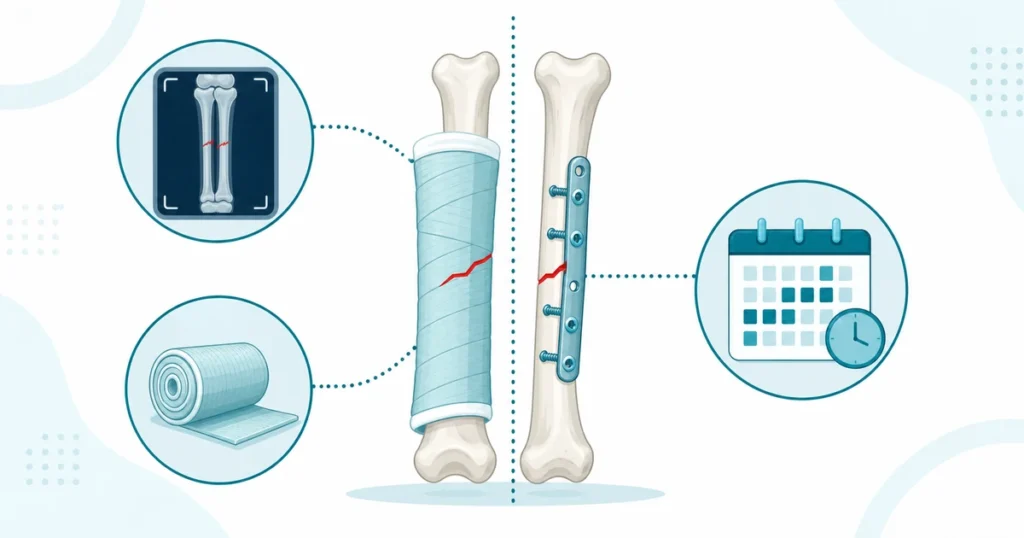
An open fracture is an injury description: the bone has broken through the skin, or a wound communicates with the fracture site. A closed fracture leaves the skin intact. Open treatment is a procedure description: the surgeon surgically opened the fracture site — exposed it through an incision — to treat it, or placed fixation through an opening remote from the fracture that still involved surgical exposure. Closed treatment means the fracture site was not surgically opened. The four combinations all occur in practice: a closed wrist fracture treated with open reduction and internal fixation is a closed fracture with open treatment; an open tibia fracture stabilized without surgical exposure of the fracture line is an open fracture with closed treatment. CPT codes select on the treatment axis; ICD-10 codes capture the injury axis. Keep the axes apart and half the exam’s fracture distractors disappear.
Closed Treatment: With vs Without Manipulation
Closed treatment codes divide on one word: manipulation, CPT’s term for reduction — physically restoring the bone fragments to alignment. Closed treatment without manipulation describes a stable or nondisplaced fracture that needs immobilization and monitoring but no repositioning; the physician applies a cast or splint and assumes the follow-up care. Closed treatment with manipulation adds the reduction, often under sedation or anesthesia, before immobilization. Each fracture site in the musculoskeletal section carries its own family of codes split along this line, so the vignette’s verbs are the code selectors: “reduced,” “restored alignment,” and “manipulated” point to with-manipulation codes; “immobilized in a splint” alone points to without-manipulation codes. The initial cast or splint application is included in the fracture care code — a bundling fact covered again below — and moderate sedation, when furnished, is separately reportable per the rules in Medicine Section CPT Coding.
Open Treatment and Internal Fixation (ORIF)
Open treatment codes apply when the fracture site is surgically exposed, and most include internal fixation — plates, screws, rods, wires — in the code description, the combination documented as ORIF (open reduction internal fixation). Two reading disciplines matter. First, check whether the specific code includes fixation or lists it as “with or without” — the descriptions vary by site, and the exam quotes them precisely. Second, intramedullary nailing of long-bone fractures is classified as open treatment even though the incision sits away from the fracture line, because the code descriptions define it that way. Hardware removal after healing is a separate procedure with its own codes, reported only outside the global period or with appropriate modifiers, following the staged-procedure logic covered in Global Surgical Package.
Percutaneous Skeletal Fixation
The third treatment category sits between the other two: percutaneous skeletal fixation places pins or screws across the fracture site through the skin, under imaging guidance, without surgically exposing the fracture. The fracture is typically reduced closed first, then fixed percutaneously. The vignette signature is unmistakable — “under fluoroscopic guidance, pins were placed across the fracture site through small stab incisions” — and the trap answers will be the open-treatment codes (because hardware was placed) and the closed-with-manipulation codes (because no exposure occurred). Neither fits: percutaneous fixation is its own axis value with its own codes.
Casting, Splinting, and Strapping Codes (29000 Series)
The application-of-casts-and-strapping codes exist for the situations fracture care codes do not cover, and the exam tests exactly two of them. First, when a provider applies an initial cast or splint as a temporizing measure without assuming restorative fracture care — the emergency department physician who splints a fracture and refers the patient to orthopedics for definitive management — that provider reports the casting/splinting code plus the E/M service, while the orthopedist who later assumes care reports the fracture care code. Second, replacement casts during the global period: the initial application is bundled into fracture care, but a replacement cast — soiled, damaged, or exchanged for a walking cast — is separately reportable with the 29000-series code. Supplies may be separately billable with HCPCS codes per payer policy, as covered in the HCPCS Level II Coding Guide.
The 90-Day Fracture Global Period
Restorative fracture care — open or closed, with or without manipulation — is major surgery for payment purposes and typically carries a 90-day global period. Included in the package: the initial cast or splint application, routine follow-up visits, and routine imaging review within the period, following the same architecture as Global Surgical Package. Separately reportable: the significant, separately identifiable E/M at the initial encounter with modifier 57 (the decision for major surgery — chosen over modifier 25 because the 90-day global makes fracture care “major”), replacement casts, treatment of complications per payer rules, and unrelated services with the appropriate global-period modifiers. The E/M-versus-fracture-care choice also runs one level deeper: when a provider furnishes only an evaluation and splint without restorative intent, the encounter is E/M plus casting code — no global package ever begins.
Pairing with ICD-10: The Injury Side
Every fracture procedure question carries a diagnosis thread, and ICD-10’s fracture defaults are exam staples in their own right. A fracture not documented as displaced or nondisplaced defaults to displaced; a fracture not documented as open or closed defaults to closed. The 7th-character set for most fracture codes extends beyond the basic A/D/S: A marks the initial encounter for a closed fracture, B the initial encounter for an open fracture (with additional characters for the Gustilo classification — the severity grading for open fractures — in the long-bone categories), D subsequent encounter with routine healing, G subsequent with delayed healing, K subsequent with nonunion, P subsequent with malunion, and S sequela. The nonunion and malunion characters do heavy exam work: a patient returning months later because the fracture failed to unite takes the original fracture code with 7th character K, not a new injury code. The full 7th-character system, including placeholder X mechanics, is covered in Injury Coding and 7th Characters, with the guideline context in ICD-10-CM Coding Guidelines.
Worked Example: One Fracture, Three Encounters
An adult falls and sustains a displaced distal radius fracture, skin intact. Encounter one, emergency department: the ED physician evaluates, splints, and refers — E/M with the splint application code; no fracture care package begins. Encounter two, orthopedics next morning: the surgeon performs closed reduction under sedation and applies a cast — the E/M with modifier 57 for the decision, plus the closed-treatment-with-manipulation code for the distal radius, which opens the 90-day global; the ICD-10 code is the displaced distal radius fracture with 7th character A, still initial because the patient remains in active treatment. Encounter three, week four: the cast is damaged and replaced — the 29000-series replacement cast code, with the fracture code now carrying 7th character D for routine healing follow-up. Three encounters, three different coding patterns, one fracture — and every fracture question on the exam is one of these three moments in isolation.
How the CPC Exam Tests Fracture Coding
Pattern 1 — Open Fracture, Closed Treatment (and Vice Versa)
The vignette pairs an injury adjective with a mismatched treatment description. Code the treatment actually performed; the fracture type lives in the ICD-10 code, not the CPT selection.
Pattern 2 — Manipulation Hunting
A closed-treatment scenario hides the reduction in clinical language. “Restored to anatomic alignment” means manipulation; “placed in a short-arm cast for immobilization” without reduction language means without manipulation.
Pattern 3 — Who Owns the Fracture Care
An ED-splint-and-refer scenario asks what the ED physician reports. Temporizing care without restorative intent is E/M plus a casting/strapping code; the definitive fracture care code belongs to the physician assuming the global care.
Pattern 4 — The Return Visit 7th Character
A healed-course question: routine follow-up takes D, delayed healing G, nonunion K, malunion P — and the original fracture code persists across all of them rather than being replaced by a new diagnosis.
Common Mistakes
Letting the fracture type choose the treatment code. Open fracture does not mean open treatment; the CPT code follows what the physician did, not what the injury looked like.
Missing buried manipulation language. Any documented reduction — “manipulated,” “reduced,” “realigned” — moves the code to the with-manipulation family.
Reporting fracture care plus a separate initial cast application. The first cast or splint is included in the restorative fracture care code; only replacements are separately reportable.
Coding percutaneous pinning as open treatment. Hardware placement without surgical exposure of the fracture site is percutaneous skeletal fixation, a distinct category.
Using modifier 25 instead of 57 at the decision encounter. Fracture care’s 90-day global makes it major surgery; the decision-for-surgery E/M takes modifier 57.
Assigning a new injury code for a nonunion. The original fracture code continues with 7th character K (nonunion) or P (malunion) — the encounter is a consequence of the same injury.
Forgetting the ICD-10 defaults. Undocumented displacement defaults to displaced; undocumented open/closed status defaults to closed.
Reporting fracture care for a temporizing splint-and-refer encounter. Without restorative intent and assumption of follow-up care, the service is E/M plus casting, and the global package never begins.
Final Exam Strategy for This Section
Run every fracture vignette through four sorted questions: What treatment was actually performed — closed, open, or percutaneous? Was there manipulation? Who assumed the restorative care and its global period? And which 7th character matches the encounter’s place in the healing course? The axes are few and the defaults are memorizable, so build them into your review materials alongside the CPC Exam Cheat Sheet, and drill mismatched fracture-type/treatment-type scenarios from the CPC Exam Study Guide until the trap loses its power. The related procedural territory — arthroscopy and joint procedures — extends this foundation in Joint Procedures and Arthroscopy CPT Coding.
5 quick questions drawn from this guide. Click an answer to check it — explanations appear as you go.
1. An open tibial shaft fracture is treated with reduction and casting only — no surgical exposure. The CPT treatment is:
2. The note reads: “the fracture was reduced and a short-arm cast applied.” Code closed treatment:
3. An ED physician applies a splint and refers the patient to orthopedics for definitive care. The ED physician reports:
4. A fracture fails to heal and is documented as nonunion. The 7th character is:
5. The initial cast applied with restorative fracture care is:
Frequently Asked Questions
Can a closed fracture have open treatment?
Yes. Fracture type and treatment type are independent: a closed fracture treated with open reduction and internal fixation receives an open treatment CPT code, while the ICD-10 code still reflects a closed fracture. The CPT code follows the procedure performed, not the injury description.
What is closed treatment with manipulation?
Closed treatment with manipulation means the physician reduced the fracture — physically restored the bone fragments to alignment — without surgically opening the fracture site, then immobilized it. Documentation words like “reduced” or “realigned” signal manipulation.
When can you bill casting separately?
In two situations: when a provider applies a cast or splint as temporizing care without assuming restorative fracture treatment — reported with E/M plus the casting code — and when a cast is replaced during the global period. The initial cast applied as part of restorative fracture care is always included.
What is the global period for fracture care?
Restorative fracture care typically carries a 90-day global period covering routine follow-up visits and the initial immobilization. The decision-for-surgery E/M is separately reportable with modifier 57, and replacement casts are billable during the period.
What does ORIF mean in coding?
ORIF stands for open reduction internal fixation: the fracture site is surgically exposed, the fragments are realigned, and hardware such as plates, screws, or rods is placed. ORIF scenarios code to open treatment codes, most of which include the internal fixation in their descriptions.