Table of Contents
- Burn Degrees and How ICD-10 Classifies Them
- The Rule of Nines: Calculating TBSA
- T31 and T32: The Two-Axis Extent Codes
- Sequencing Multiple Burns
- Burns vs Corrosions
- 7th Characters and Episode of Care
- Burn Treatment CPT Codes
- Worked Example: A Complete Burn Encounter
- How the CPC Exam Tests Burn Coding
- Common Mistakes
- Final Exam Strategy for This Section
- Frequently Asked Questions
Burn coding is one of the few places on the CPC exam where you may need to do arithmetic before you can pick a code. A burn scenario asks for three separate decisions — the site-and-degree codes, the sequencing order when multiple burns exist, and the T31 extent code built from total body surface area percentages — and the exam routinely folds all three into a single question. The good news is that the system is completely mechanical once you know the rules. This guide covers burn degrees, the Rule of Nines calculation, the two-axis T31 codes, corrosions, the 7th-character requirements, and the CPT codes for burn treatment, building on the injury-coding framework in Injury Coding and 7th Characters and the ordering rules in ICD-10 Sequencing Rules.
Burn Degrees and How ICD-10 Classifies Them
ICD-10-CM classifies burn severity in three degrees, and the vignette’s clinical language maps directly onto them. First-degree burns involve erythema — redness of the epidermis only, like a typical sunburn reaction. Second-degree burns involve blistering and damage into the dermis; documentation may say “partial thickness.” Third-degree burns involve full-thickness destruction of the skin, documented as “full thickness” or with references to eschar or charring. The burn categories are organized by anatomical site: T20 for the head, face, and neck; T21 for the trunk; T22 for the shoulder and upper limb except the wrist and hand; T23 for the wrist and hand; T24 for the lower limb except the ankle and foot; T25 for the ankle and foot. Three special categories complete the set — T26 for burns confined to the eye and adnexa, T27 for the respiratory tract, and T28 for other internal organs — and these internal burn categories classify by site only, not by degree.
Within each site category, the code characters specify the degree and the precise location, and each distinct burn site receives its own code. When one site has burns of more than one degree — a forearm with second- and third-degree areas — only the highest degree for that site is coded. One boundary note the exam likes: an ordinary sunburn is not a T-section burn at all; it codes to L55 in the skin chapter. The T burn categories cover thermal burns from heat sources, electricity, and radiation, while chemical burns take the parallel corrosion codes described below.
The Rule of Nines: Calculating TBSA
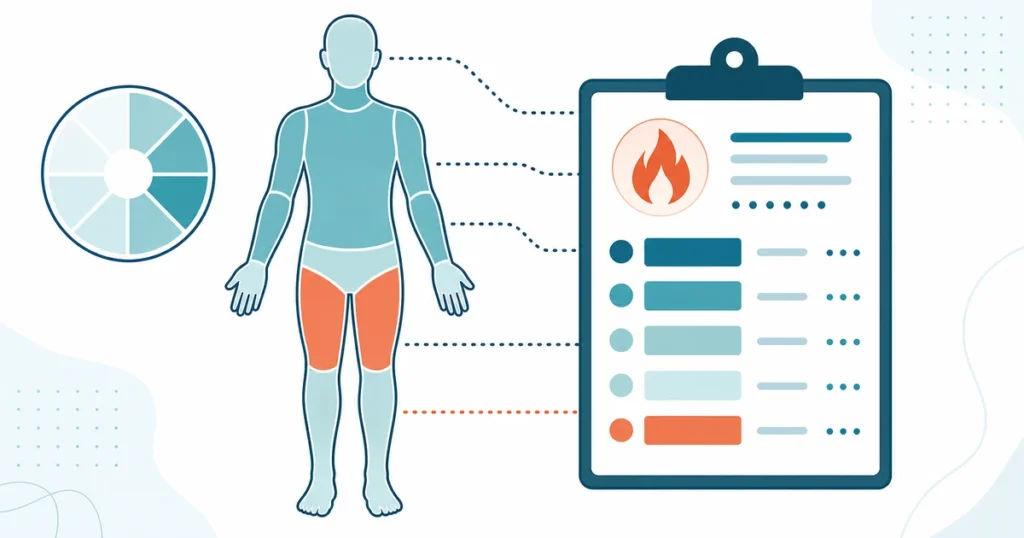
The Rule of Nines divides the adult body into regions of nine percent — or multiples of nine — so total body surface area (TBSA) burned can be estimated quickly.
| Body Region | Adult TBSA % |
|---|---|
| Head and neck | 9% |
| Each upper limb | 9% |
| Anterior trunk (chest and abdomen) | 18% |
| Posterior trunk (back) | 18% |
| Each lower limb | 18% |
| Genitalia | 1% |
The percentages sum to 100 across the whole body. Infants and small children carry proportionally larger heads and smaller legs, so pediatric assessments adjust the percentages, and providers may document TBSA directly from a Lund-Browder chart — in which case you use the documented percentage rather than recalculating. On the exam, the arithmetic is deliberately simple: an adult with burns covering one entire arm and the anterior trunk has 9 + 18 = 27 percent TBSA. Do the addition on scratch paper before looking at any answer choice, because the distractors are built from the most common addition mistakes.
T31 and T32: The Two-Axis Extent Codes
Category T31 (burns) and T32 (corrosions) classify burns by extent, and each code carries two axes. The fourth character reports the total TBSA burned, in ten-percent deciles: T31.0 for less than 10 percent, T31.1 for 10–19 percent, up to T31.9 for 90 percent or more. The fifth character reports how much of that total is third-degree, in the same deciles: 0 for less than 10 percent third-degree (or none), 1 for 10–19 percent, and so on. The fifth character can never represent a larger percentage than the fourth, since the third-degree portion is a subset of the total.
Read T31.42 with that grammar: total burns covering 40–49 percent of the body, of which 20–29 percent is third-degree. The exam tests this decoding in both directions — building the code from stated percentages and translating a code back into percentages. The guidelines assign T31 a supporting role: use it as an additional code alongside the site-specific burn codes when reporting data on burn mortality or when the extent is needed (many payers and registries require it for third-degree burns), and use it alone only when the burn sites are not documented.
Sequencing Multiple Burns
When a patient has multiple burns, the ICD-10-CM guideline is direct: sequence first the code reflecting the burn of the highest degree. A patient with a third-degree burn of the hand and a second-degree burn of the chest lists the T23 third-degree code first, then the T21 second-degree code, then the T31 extent code as an additional code. When the encounter is for something other than the burns — treatment of related inhalation injury, for example — the usual reason-for-encounter logic from Principal vs First-Listed Diagnosis still governs, but among the burn codes themselves, highest degree always leads.
Burns vs Corrosions
Every burn category has a corrosion twin: corrosions are injuries from chemicals — acids, alkalis, caustics — while burns are thermal, from heat, flame, electricity, or radiation. The corrosion codes occupy the same site categories with parallel structure, and T32 mirrors T31 for extent. The coding mechanics are identical, with one addition: for corrosions, a code from categories T51–T65 identifying the chemical substance and intent is sequenced first, followed by the corrosion site codes. The exam signal is pure vocabulary — “splashed with drain cleaner” is a corrosion, “scalded by boiling water” is a burn — and choosing the wrong family is the intended trap.
7th Characters and Episode of Care
Burn codes in T20–T28 require the standard injury 7th characters: A for the initial encounter (active treatment), D for subsequent encounters during routine healing, and S for sequela. Two applications are burn-specific and testable. First, a burn that fails to heal — a non-healing burn or infected burn site — is still coded as an acute burn with the active-treatment logic, because the condition remains under active management. Second, sequelae of burns are common and long-lived: scars and contractures appearing after healing are coded with the scar or contracture code plus the burn code with 7th character S to identify the cause. The placeholder-X mechanics and encounter definitions follow the rules detailed in Injury Coding and 7th Characters, and external cause codes for the source, intent, and place of the burn round out the picture per ICD-10-CM Coding Guidelines.
Burn Treatment CPT Codes
The procedural side of burn care has its own compact code family. Initial treatment of a first-degree burn, when no more than local treatment is required, is 16000. Dressings and/or debridement of partial-thickness burns are coded by the size of the treated surface: 16020 for small (less than 5 percent TBSA), 16025 for medium (5 to 10 percent), and 16030 for large (greater than 10 percent). Escharotomy — incision through constricting burned tissue to restore circulation — is 16035 for the initial incision and add-on 16036 for each additional incision. Extensive debridement and excision of burn wounds beyond dressings connect to the wound-management codes covered in Wound Repair Coding, and definitive coverage of full-thickness losses moves into grafting, covered in the Skin Graft Coding CPT Guide. Note that the TBSA percentages driving CPT code selection are the same percentages you calculated for T31 — one Rule of Nines computation serves both code sets.
Worked Example: A Complete Burn Encounter
An adult presents for initial treatment after a kitchen fire: third-degree burns across the anterior trunk and second-degree burns of the entire right arm. Start with TBSA: anterior trunk 18 percent plus one arm 9 percent equals 27 percent total, of which 18 percent is third-degree. Build the diagnosis list: the T21 third-degree anterior trunk burn code with 7th character A leads (highest degree first), the T22 second-degree arm code with A follows, then T31.21 — total TBSA in the 20–29 band (fourth character 2), third-degree portion in the 10–19 band (fifth character 1) — plus external cause codes for the flame exposure and place of occurrence. If the physician performed dressings and debridement of the partial-thickness component over roughly 9 percent TBSA, the CPT service is 16025, medium. Every burn question on the exam is a subset of this walkthrough.
How the CPC Exam Tests Burn Coding
Pattern 1 — Build the T31 Code from Percentages
The vignette states or implies TBSA percentages and asks for the extent code. Add the Rule of Nines regions, assign the fourth character from total TBSA and the fifth from the third-degree portion, and reject any answer whose fifth character exceeds its fourth.
Pattern 2 — Sequencing Multiple Burn Sites
Two or more burns of different degrees at different sites. The highest-degree burn is sequenced first, each site gets its own code, and same-site burns of multiple degrees collapse to the highest degree only.
Pattern 3 — Burn or Corrosion?
The scenario names the agent. Heat, flame, electricity, and radiation are burns; acids, alkalis, and chemicals are corrosions with a T51–T65 chemical code sequenced ahead of them.
Pattern 4 — Matching the CPT Burn Treatment Code
A dressing-and-debridement scenario supplies a TBSA percentage. Map it to 16020, 16025, or 16030 by the small/medium/large thresholds, reserving 16000 for first-degree-only treatment and 16035–16036 for escharotomy.
Common Mistakes
Letting the fifth character of T31 exceed the fourth. The third-degree percentage is a subset of total TBSA; a code like T31.24 is impossible and will appear among distractors.
Coding every degree present at a single site. When one site has second- and third-degree burns, only the highest degree for that site is coded.
Sequencing burns by narrative order instead of degree. The highest-degree burn leads regardless of the order the vignette mentions the injuries.
Coding sunburn with T-section burn codes. Sunburn classifies to L55 in the skin chapter, not to the burn categories.
Treating chemical injuries as thermal burns. Chemical agents produce corrosions with parallel codes and a required T51–T65 code identifying the chemical.
Forgetting T31 when the payer or registry needs extent. The site codes alone do not capture TBSA; T31/T32 is the vehicle for extent and is required reporting for many third-degree burns.
Dropping the 7th character or misusing S. Active treatment takes A, routine healing follow-up takes D, and scars or contractures after healing take the residual-condition code plus the burn code with S.
Final Exam Strategy for This Section
Burn questions reward a fixed sequence: calculate TBSA with the Rule of Nines, identify each site and its highest degree, order the site codes by degree, build the T31 code from your two percentages, and only then look at the answer choices. The entire topic fits on one review card — the six site categories, the nine-percent regions, the T31 two-axis grammar, and the 16000-series treatment thresholds — so add that card to your CPC Exam Cheat Sheet materials and drill a handful of percentage scenarios using the method in the CPC Exam Study Guide. Arithmetic under time pressure is only intimidating until it becomes routine.
5 quick questions drawn from this guide. Click an answer to check it — explanations appear as you go.
1. Burns cover 45% TBSA with 20% third degree. The extent code is:
2. One site has both second- and third-degree burns. Code:
3. A patient splashes an alkali drain cleaner on the forearm. Code:
4. Dressing and debridement of partial-thickness burns covering 6% TBSA is:
5. Multiple burns of different degrees at different sites are sequenced:
Frequently Asked Questions
How does the Rule of Nines work?
The Rule of Nines divides the adult body into regions representing nine percent of body surface area or multiples of it: head and neck 9%, each arm 9%, anterior trunk 18%, posterior trunk 18%, each leg 18%, and genitalia 1%. Adding the affected regions gives the total body surface area burned.
How do you code burns of multiple sites?
Assign a separate code for each burn site, sequencing the highest-degree burn first. When a single site has burns of more than one degree, code only the highest degree for that site, and add a T31 code to report total extent when needed.
What does T31.42 mean?
T31.42 reports burns involving 40–49 percent of total body surface area, with 20–29 percent of the body having third-degree burns. The fourth character gives total TBSA in ten-percent bands and the fifth character gives the third-degree portion.
Are sunburns coded as burns?
No. Sunburn is classified to category L55 in the skin chapter of ICD-10-CM. The T20–T32 burn categories cover thermal burns from heat, flame, electricity, and radiation, and corrosions from chemicals.
Which burn is sequenced first?
When multiple burns are present, the code for the burn of the highest degree is sequenced first. A third-degree burn always precedes second- and first-degree burns in the code list, regardless of body site or the order described in the documentation.